Largest transiting extrasolar planet found around a distant star
August 6th, 2007 Largest transiting extrasolar planet found around a distant star

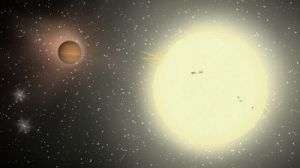
A computer-generated simulation of TrES-4, with its host star on the right. The planet's home star is bigger and hotter than the Sun, and is about ten times larger than the planet. Astronomers speculate that the large size and low density of TrES-4 may cause a small fraction of its outer atmosphere to escape from the planet’s gravitational pull and form an envelope, or a comet-like tail around the planet. Credit: Jeffrey Hall, Lowell Observatory.

An international team of astronomers with the Trans-atlantic Exoplanet Survey announce today the discovery of TrES-4, a new extrasolar planet in the constellation of Hercules. The new planet was identified by astronomers looking for transiting planets – that is, planets that pass in front of their home star – using a network of small automated telescopes in Arizona, California, and the Canary Islands. TrES-4 was discovered less than half a degree (about the size of the full Moon) from the team’s third planet, TrES-3.

"TrES-4 is the largest known exoplanet," said Georgi Mandushev, Lowell Observatory astronomer and the lead author of the paper announcing the discovery. "It is about 70 percent bigger than Jupiter, the Solar System’s largest planet, but less massive, making it a planet of extremely low density. Its mean density is only about 0.2 grams per cubic centimeter, or about the density of balsa wood! And because of the planet’s relatively weak pull on its upper atmosphere, some of the atmosphere probably escapes in a comet-like tail."

The new planet TrES-4 was first noticed by Lowell Observatory's Planet Search Survey Telescope (PSST), set up and operated by Edward Dunham and Georgi Mandushev. The Sleuth telescope, maintained by David Charbonneau (CfA) and Francis O'Donovan (Caltech), at Caltech's Palomar Observatory also observed transits of TrES-4, confirming the initial detections. TrES-4 is about 1400 light years away and orbits its host star in three and a half days. Being only about 4.5 million miles from its home star, the planet is also very hot, about 1,600 Kelvin or 2,300 degrees Fahrenheit.

"TrES-4 appears to be something of a theoretical problem,” said Edward Dunham, Lowell Observatory Instrument Scientist. "It is larger relative to its mass than current models of superheated giant planets can presently explain. Problems are good, though, since we learn new things by solving them."

“We continue to be surprised by how relatively large these giant planets can be,” adds Francis O’Donovan, a graduate student in astronomy at the California Institute of Technology who operates one of the TrES telescopes. “But if we can explain the sizes of these bloated planets in their harsh environments, it may help us understand better our own Solar System planets and their formation.”

By definition, a transiting planet passes directly between the Earth and the star, blocking some of the star’s light and causing a slight drop in its brightness. To look for transits, the small telescopes are automated to take wide-field timed exposures of the clear skies on as many nights as possible. When observations are completed for a particular field – usually over an approximate two-month period – astronomers measure very precisely the light from every star in the field in order to detect the possible signature of a transiting planet. "TrES-4 blocks off about one percent of the light of the star as it passes in front of it," said Mandushev. "With our telescopes and observing techniques, we can measure this tiny drop in the star's brightness and deduce the presence of a planet there."

Not only is the planet TrES-4 mysterious and intriguing, but so is its host star cataloged as GSC 02620-00648. Georgi Mandushev explains: “The host star of TrES-4 appears to be about the same age as our Sun, but because it is more massive, it has evolved much faster. It has become what astronomers call a ‘subgiant’, or a star that has exhausted all of its hydrogen fuel in the core and is on its way of becoming a ‘red giant’, a huge, cool red star like Arcturus or Aldebaran.”

In order to help confirm they had found a planet, Gáspár Bakos of the Hungarian Automated Telescope Network (HATNet) and Harvard's Guillermo Torres switched from the 10-centimeter TrES telescopes to one of the 10-meter telescopes at the W. M. Keck Observatory on the summit of Mauna Kea, Hawaii. Using this giant telescope, they confirmed that the TrES team had indeed found a new planet. In order to measure accurately the size and other properties of TrES-4, astronomers also made follow up observations with bigger telescopes at Lowell Observatory and Fred L. Whipple Observatory in Arizona.

Source: Lowell Observatory


print this article email this article download pdf blog this article bookmark this article     Digg this Stumble it share on Facebook share on Reddit add to delicious save to Yahoo! bookmarks
4.7/5 after 20 votes


August 6th, 2007 all stories
Space & Earth / Astronomy

Comments: 0
Rank: 4.7/5 after 20 votes

  • Stumble this up

  • Digg this

  • Share it:
  • share on Facebook
  • share on MySpace
  • share on Slashdot
  • rss-newsfeed
  • share on Google
  • share on Reddit
  • add to delicious
  • save to Yahoo! bookmarks
  • share on Windows Live
  • Add to Mixx!
Rating: 4.7/5 after 20 votes

  • Related Stories

  • Astronomers discover pair of solar systems in the making
    created Jul 01, 2009 | popularity not rated yet | comments 0
  • Odd discovery may help refine theories about how planets form
    created Jun 17, 2009 | popularity not rated yet | comments 0
  • Water supply shifts as global climate changes
    created Jun 15, 2009 | popularity not rated yet | comments 0
  • Unique sky survey brings new objects into focus
    created Jun 15, 2009 | popularity not rated yet | comments 0
  • Radio telescope images reveal planet-forming disk orbiting twin suns
    created Jun 10, 2009 | popularity not rated yet | comments 0

Tags


  • Physicists Demonstrate Quantum Memory with Matter Qubits
    Physicists Demonstrate Quantum Memory with Matter Qubits
    Physics / General Physics
    created Jul 03, 2009 | popularity 4.4 / 5 (17) | comments 1
  • 'Holey' Nanosheets for Wastewater Dye Removal
    Nanotechnology / Nanomaterials
    created Jul 01, 2009 | popularity 5 / 5 (5) | comments 1
  • Jellyfish Robot Swims Like its Biological Counterpart
    Jellyfish Robot Swims Like its Biological Counterpart
    Electronics / Robotics
    created Jun 26, 2009 | popularity 4.4 / 5 (8) | comments 1
  • Could Maxwell's Demon Exist in Nanoscale Systems?
    Could Maxwell's Demon Exist in Nanoscale Systems?
    Physics / General Physics
    created Jun 24, 2009 | popularity 4.4 / 5 (18) | comments 29
  • Living Safely with Robots, Beyond Asimov's Laws
    Living Safely with Robots, Beyond Asimov's Laws
    Electronics / Robotics
    created Jun 22, 2009 | popularity 4.6 / 5 (52) | comments 40
  • Other News

    Forty years ago man first walked on the moon

    Space & Earth / Space Exploration

    created 19 hours ago | popularity 4.3 / 5 (4) | comments 2

    Forty years ago on July 20, 1969, American astronaut Neil Armstrong realized the oldest dream of human civilizations when he became the first man to walk on the moon.


    The least sea ice in 800 years

    The least sea ice in 800 years

    Space & Earth / Earth Sciences

    created Jul 01, 2009 | popularity 4.2 / 5 (62) | comments 59

    New research, which reconstructs the extent of ice in the sea between Greenland and Svalbard from the 13th century to the present indicates that there has never been so little sea ice as there is now. The ...


    Gas around young galaxy

    Intense heat killed the Universe's would-be galaxies, researchers say

    Space & Earth / Astronomy

    created Jul 01, 2009 | popularity 3.4 / 5 (21) | comments 27

    (PhysOrg.com) -- Our Milky Way galaxy only survived because it was already immersed in a large clump of dark matter which trapped gases inside it, scientists led by Durham University's Institute for Computational ...


    Scientists' Drill Hits Magma: Only Third Time on Record

    Scientists' Drill Hits Magma: Only Third Time on Record

    Space & Earth / Earth Sciences

    created Jun 29, 2009 | popularity 4.7 / 5 (22) | comments 19

    (PhysOrg.com) -- Scientists drilling a borehole deep into Iceland’s rocky crust to explore new methods of using geothermal energy hit a major roadblock on Thursday: Their drill ran into molten rock at a depth ...


    NASA manager pitches a cheaper return-to-moon plan

    Space & Earth / Space Exploration

    created Jun 30, 2009 | popularity 4.1 / 5 (8) | comments 18

    (AP) -- Like a car salesman pushing a luxury vehicle that the customer no longer can afford, NASA has pulled out of its back pocket a deal for a cheaper ride to the moon.