Computer graphics spills from milk to medicine
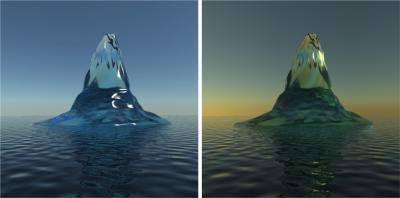
A new UC San Diego computer graphics model capable of generating realistic milk images based on the fat and protein content will likely push the field of computer graphics into the realms of diagnostic medicine, food safety and atmospheric science, according to a new study.
“Computer graphics is no longer just about pretty pictures and realism for the sake of aesthetics. We have harnessed the math and physics necessary to generate realistic images of a wide range of natural materials based on what they are made of. With our approach, computer graphics can contribute to a handful of pressing problems,” said Henrik Wann Jensen, a UC San Diego computer science professor and Academy Award winning computer graphics researcher. Jensen created the model with two colleagues from the Technical University of Denmark – Niels Jørgen Christensen, an associate professor, and Jeppe Revall Frisvad, a Ph.D. student.
On August 8, 2007, the new graphics research will be presented at the Association for Computing Machinery’s SIGGRAPH conference, the premier annual conference for the graphics and interactive techniques community.
If you tell the new computer graphics model how much fat and protein you want in your milk, the model will spit out the information you need to create a life-like milk image by determining how light will interact with your specified ratio of milk fats and proteins. Similarly, if you specify the concentration of algae and different minerals in a sample of ocean water, the same theoretical model will render the color of the water.
The new work extends well beyond milk and ocean water to a wide range of materials called “participating media.” The word “participating” refers to the fact that some of the light that hits the material is absorbed and not reflected.
In addition to creating images based on what the material is made of, the authors used the milk example to show that the new model can work backwards and determine how much fat and protein a sample of milk contains, based on just a digital picture of the milk.
“Putting the model in reverse, grocery stores could identify spoiled meats, contaminants or other food safety issues – if a particular food problem consistently and detectably changed the light scattering properties of the food,” said Jensen.
The model has already provided insights into the mystery of “bottle-green” icebergs. In the SIGGRAPH paper, the authors show that their model agrees with the claim that bottle-green icebergs are, in fact, clean (non-green) icebergs that appear blue during the day but turn green as the sun sets.
The new research eliminates a long-standing roadblock and describes a way to use theoretical math and physics to generate realistic computer graphics of materials that absorb some light and are not made of perfect spheres. In other words, the paper marks a vast extension of the Lorenz-Mie theory, which is a complete solution to Maxwell’s equation for scattering of electromagnetic waves by a homogenous, spherical particle embedded in a non-absorbing medium. The Lorenz-Mie theory has been around for more than a century and was introduced to graphics in 1995. In computer graphics, it has been used to compute the optical properties of certain paints, plastics, clouds, atmospheric phenomena and other media that can be described as spherical particles embedded in a non-absorbing medium. The theory, however, has not been used to render the vast class of participating media, until now. In the past, determining the optical properties of participating media necessary for rendering realistic images has required extensive measurements and/or trial-and-error manual adjustments.
The new model eliminates the restrictions of the Lorenz-Mie theory for participating media such as milk, in which the embedded particles (primarily proteins, fat and vitamin B2) are not perfect spheres and the host medium (water) absorbs light.
“If you are trying to generate realistic computer graphics, it is intuitive to specify what the material is made of, like the amount of fat and protein in the milk. In the past, we had to do a lot of observing and measuring to determine how the milk would scatter and absorb light,” said Jensen. “With our theoretical approach, a much wider range to people will be able to play a role in creating realistic images of natural materials.”
“We can visualize what specific particles – like milk fats or proteins – look like on their own. We can also visualize what a medium would look like if one particle type were missing. Having knowledge about the visual effect caused by each type of particle is incredibly valuable in many different contexts,” explained Jeppe Revall Frisvad, a Ph.D. student from the Technical University of Denmark.
The new work may also help Jensen and colleagues extend their theoretical model for human skin, work that earned Jensen an Academy Award in 2004.
In 2006, at SIGRAPH, Jensen and UCSD computer science graduate student Craig Donner published a paper describing a model that generates realistic looking skin based on specified amounts of hemoglobin and melanin.
Jensen is now looking to extend the skin shading model so that it can predict the appearance of skin based on a detailed description of dermal structures other than hemoglobin and melanin. Understanding how structures within the skin scatter and absorb light could be important to the doctors who are using light to treat skin cancer and other skin diseases, Jensen explained.
Some of the inspiration for their model being presented at SIGGRAPH 2007 came from equations that physicists studying coated soot particles derived to deal with shortcomings in the Lorenz-Mie theory. Jensen and the students from Denmark also called upon their mother tongue, Danish, to pick apart a little-known paper published in 1890 in Denmark by the physicist Ludvig Lorenz, one of the two namesakes of the Lorenz-Mie theory. The report clearly outlined the math and many of the assumptions that are central to Lorenz-Mie theory.
“Going through his assumptions carefully, we hit a series of ‘ah-hah!’ moments in which we saw ways to address some of the assumptions that had made it difficult to generalize the Lorenz-Mie theory beyond perfect spheres,” said Jensen.
Once their new theoretical model predicted the relevant physics for light hitting participating media, the researchers took the next step and made the results useful for computer graphics by determining how the light would actually scatter and be absorbed. It is this information that is used to render realistic images.
“We have the first complete, bottom-up theoretical model that addresses the shortcoming of the Lorenz-Mie theory for participating media. It allows us to render computer graphics for absorbing materials and with non-spherical particles based on the contents of the material. I can’t wait to see how others implement our model,” said Jensen, who is making the model available to other researchers.
Source: University of California - San Diego


