Hold your nose and head for the hills: Titania is opening
August 7, 2007 Hold your nose and head for the hills: Titania is opening

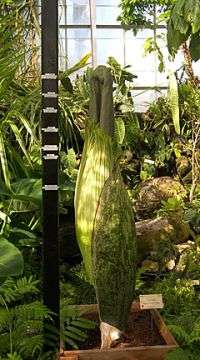
Standing more than 5' tall on July 30, the corpse flower Titania is expected to unfurl its putrid blooms on Monday August 6 or shortly thereafter at the UC Botanical Garden's Tropical House. (UC Botanical Garden photos)

Get a whiff of this: Titania, UC Botanical Garden's corpse flower, is being pollinated today. The plant's skirt of petals now measures 44" in diameter. Visitors to the garden's Tropical House will be treated to a stunning display and the plant's knockout, repulsive stench.

When UC Botanical Garden's rare titan arum, Amorphophallus titanium (corpse flower), blooms this week, the flower will both attract and repel visitors. When the plant opens to a diameter of three to four feet, titan arum looks visually arresting, but it's best known for a characteristic that can only be experienced firsthand after it blooms: its distinctive odor.

"It really does smell like there's a dead body in the room," says Garden Director Paul Licht, recalling his experience with Trudy, another corpse flower that blossomed in the garden's Tropical House in July 2005. The odor helps the plant attract insects that carry its pollen to other titan arums, since corpse flowers can't pollinate themselves.

Titan arum specimens are rare enough to be named like pets. Garden staff call their soon-to-bloom plant Titania after the Queen of the Fairies in Shakespeare's "A Midsummer's Night Dream."

Titania was raised from seed in the garden starting in 1995. Not until July 19 did Licht and his staff know their plant would be one of the rare titan arums that actually flowers. On that day, Titania measured 36 ¾". By Monday morning, July 30, her spadex — the protuberance at the flower's center — had hit the 61" mark. The plant can grow up to 6" a day, notes Licht.

Before blooming, titan arum looks like a rounded column with a green pleated skirt of leaves wrapped around it. When the plant's "skirt" takes on a purple tinge, it will likely bloom two days later. (On Monday of this week, Licht thought it likely that Titania would bloom within two or three days.) And that's when the corpse odor kicks in, lasting for about 12 hours.

Visitors can enter UC Botanical Garden daily until 5 p.m., and viewing is permitted until 6 p.m. During the week, visitors are encouraged to take the campus shuttle, which leaves every half hour from Hearst Mining Circle, since parking is very limited.

The garden is publishing an online photo diary that includes the latest images of Titania.

Source: UC Berkeley, by Wendy Edelstein


print this article email this article download pdf blog this article bookmark this article     Stumble it Digg this share on Facebook retweet share on Reddit add to delicious
Rate this story - 4.7 /5 (9 votes)


August 7, 2007 all stories

Comments: 0

4.7 /5 (9 votes)
  • Stumble this up

  • Digg this

  • share this

  • hide
  • Related Stories

  • Surface-enhanced Raman scattering of Semiconducting Hybrid Nanoparticles
    created Apr 24, 2009 | popularity not rated yet | comments 0
  • Discovery of an Unexpected Boost for Solar Water-Splitting Cells
    created Apr 22, 2009 | popularity not rated yet | comments 0
  • Sunlight turns carbon dioxide to methane
    created Mar 05, 2009 | popularity not rated yet | comments 0
  • Easing Atmospheric CO2 Levels Using Nanotubes and Sunlight
    created Feb 16, 2009 | popularity not rated yet | comments 0
  • Researchers make breakthrough in renewable energy materials
    created May 29, 2008 | popularity not rated yet | comments 0


Other News

Nano bubble gum for enhancing drug delivery in gut

Biology / Biotechnology

created 36 minutes ago | popularity not rated yet | comments 0

Of the many characteristic traits a drug can have, one of the most desirable is the ability for a drug to be swallowed and absorbed into the bloodstream through the gut. Some drugs, like over-the-counter aspirin, lend themselves ...


Study shows that some malignant tumors can be shut down after all

Biology / Cell & Microbiology

created 2 hours ago | popularity 5 / 5 (1) | comments 0

Oncologists have had their hands tied because more than half of all human cancers have mutations that disable a protein called p53. As a critical anti-cancer watchdog, p53 masterminds several cancer-fighting operations within ...


What is the meaning of 'one'? Evolutionary biologists argue for new meaning of 'organismality'

Biology / Evolution

created 3 hours ago | popularity 5 / 5 (1) | comments 1

Rice University evolutionary biologists David Queller and Joan Strassmann argue in a new paper that high cooperation and low conflict between components, from the genetic level on up, give a living thing its "organismality," ...


Researchers show how to divide and conquer 'social network' of cells

Researchers show how to divide and conquer 'social network' of cells

Biology / Biotechnology

created 4 hours ago | popularity not rated yet | comments 0

On Noah's Ark animals came in twos: male and female. In human bodies trillions of cells are coupled, too, and so are the molecules from which they are composed. Yet these don't come in twos, they are regrouped ...


Drought resistance explained

Drought resistance explained

Biology / Cell & Microbiology

created 2 hours ago | popularity 5 / 5 (1) | comments 0

Much as adrenaline coursing through our veins drives our body's reactions to stress, the plant hormone abscisic acid (ABA) is behind plants' responses to stressful situations such as drought, but how it does ...