Lost forest yields several new species
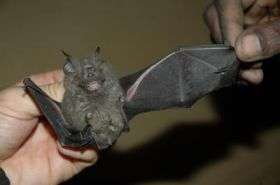
An expedition led by the Wildlife Conservation Society (WCS) to a remote corner of the eastern Democratic Republic of Congo has uncovered unique forests which, so far, have been found to contain six animal species new to science: a bat, a rodent, two shrews, and two frogs.
The forested region—including the Misotshi-Kabogo Forest (formerly Mt. Kabobo)—and nearby Marunga Massif is located just west of Lake Tanganyika and has been off limits to scientists since 1960 as a result of continued instability in the area.
“If we can find six new species in such a short period it makes you wonder what else is out there,” said WCS researcher Dr. Andrew Plumptre, director of the society’s Albertine Rift Program.
The forest survey was conducted between January and March of 2007, and included participants from WCS, the Field Museum in Chicago, the National Centre of Research and Science in Lwiro, and the World Wildlife Fund: the global conservation organization (WWF).
In spite of the conflict and related degradation in the area, the survey team found that some 1,000 square kilometers have remained intact, from the shores of Lake Tanganyika up to elevations of 2,725 meters above sea level. In addition to the new animal species, the survey found that the region of gallery forests and woodlands is extremely rich in biodiversity, containing a number of large mammals such as chimpanzees, bongos, buffalo, elephants, leopards, several types of monkey including a subspecies of colobus only found here, and others, although most of these large-bodied species were found at low densities, probably due to poaching. The survey also found a high diversity of birds, reptile, and amphibian species.
The expedition may also yield a number of new plant species; survey botanists were unable to identify some 10 percent of the collected samples, which will be sent to specialists in the near future. “Given the findings with the vertebrates, it is likely that some of the plants will represent new species as well,” said Ben Kirunda of WCS’s botanical team.
“The forest has been isolated from much of the Congo Forest block for at least 10,000 years and as a result contains some new interesting species,” said WCS researcher Deo Kujirakwinja, one of survey’s participants. “There is a real need to protect this forest and carry out more research in the area.”
The Democratic Republic of Congo has experienced unrest—especially in the biodiversity-rich eastern part of the country—since the 1960s, when Laurent Kabila, father of the current president, set up a base of operations in the Misotshi-Kabogo forests in his attempt to overthrow the regime of Joseph Mobutu, former president of the country (then called Zaire). Kabila succeeded in becoming president himself in 1996, the same year which plunged the region into a state of civil war. As a result, the region has been off limits to conservationists until recently.
Human impacts to the region are currently low, with gold mining on a minor level being the most substantial threat. Further, survey members who met with the leaders of local villages have found that most are supportive of turning the region into a protected area.
“The survey has found that the Misotshi-Kabogo region is biologically important enough to conserve in the form of a protected area,” said Dr. James Deutsch, director of WCS’ Africa Program. “Since few people live there, it would be relatively easy to create a park while supporting the livelihoods of people who live in the landscape.”
Source: Wildlife Conservation Society


