Scientists show differing patterns of rainforest biodiversity
Rainforests are the world’s treasure houses of biodiversity, but all rainforests are not the same. Biodiversity may be more evenly distributed in some forests than in others and, therefore, may require different management and preservation strategies. That is one of the conclusions of a large-scale Smithsonian study of a lowland rainforest in New Guinea, published in the Aug. 9 issue of the journal Nature.
Most previous research has focused on diversity “hot spots,” such as upland rainforests in the foothills of the Andes, where steep gradients in elevation, temperature, rainfall and other environmental factors boost diversity by creating diverse habitats within a short distance. Such change in a region’s species makeup between sites is called beta diversity: some rainforests have steep environmental gradients and high beta diversity.
A large proportion of the world’s remaining rainforests are lowland forests in New Guinea, Borneo and the Congo and Amazon Basins. Many researchers have speculated that such lowland rainforests also would have high beta diversity, but this has not been rigorously tested. Little data exists for species distributions in these vast forests, particularly for insects, which make up a large share of the world’s biodiversity.
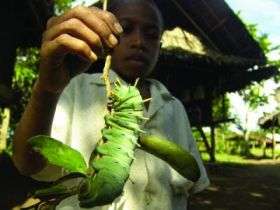
An international group of entomologists and botanists, including Smithsonian researchers, has assembled data representing 500 species of caterpillars, ambrosia beetles and fruit flies in the undisturbed lowland rainforest of the Sepik and Ramu river basins in Papua New Guinea. The team collected insects and plants from eight study sites across 75,000 square kilometers of contiguous forest—an area the size of South Carolina—and noted the variation in species makeup among the different sites.
The data showed low beta diversity across the study area for all three groups of insects as well as for plants, indicating that species tend to be widespread and the biological communities change very little even across large distances. The widespread distribution of insect species was a surprise, given the sedentary lifestyles of many species.
“Some spend their entire lives on a single plant, but they’ve got wings. They may not want to fly, but they can if they need to,” said Smithsonian scientist Scott Miller, an author of the Nature paper. The insects also showed limited specialization in the plant species they feed upon, in contrast to the common assumption that tropical species tend to be highly specialized.
For the types of insects studied, study sites separated by as much as 500 kilometers shared more than half of their species. For fruit flies, the species makeup remained virtually constant for distances up to 950 kilometers. In contrast, upland rainforests sites at different elevations may share less than a fifth of their species, even if the plant species on which they live are constant.
The group of international researchers working in New Guinea includes Scott Miller and Karolyn Darrow from the Smithsonian’s National Museum of Natural History and Yves Basset from the Smithsonian Tropical Research Institute in Panama, with National Museum of Natural History research associates Vojtech Novotny (Czech Academy of Sciences) and George Weiblen (University of Minnesota).
The low beta diversity seen in this study has implications for biological conservation. The homogeneity of the lowland forests suggests that the total diversity of species in tropical rainforests globally may be lower than previously thought.
The study’s results also may help shape strategies for preserving rainforest species. “There are some philosophical questions that our data should be useful to address,” Miller said. “If you can preserve 10,000 hectares of forest, is it better to preserve it as 10 small 1,000 hectare plots or one large 10,000 hectare plot"”
Strategies for preserving high and low beta diversity forests might not be the same. “Our data from the New Guinea lowland forest suggests that bigger is better,” he said. “In this kind of relatively uniform habitat, you’re not losing a lot of beta diversity that would have to be represented by several smaller sites. But the opposite might apply on elevation or climate gradient.”
There is still much to learn because collecting high intensity data is a very time-consuming process. “We haven’t solved the conservation management question by any means,” Miller said. He noted this kind of study needs to be replicated across a large spatial scale in the Amazon Basin and the Congo Basin to see if the low beta diversity pattern holds.
Researchers collected data for more than three years and built on data from a decade of fieldwork in New Guinea. A key to the project’s success has been local researchers. “We have a group of Papua New Guinean scientists and parataxonomists working with us who are basically on the ground all the time and are really good biologists,” Miller said. Parataxonomists are locally-recruited field researchers specifically trained to collect and identify species of their particular region.
Source: Smithsonian


