Two Telescopes Combine to Probe Young 'Family' of Stars
August 8, 2007
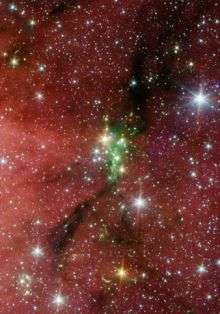
This Spitzer Space Telescope photograph shows the Serpens South star cluster – a relatively dense group of 50 young stars, 35 of which are protostars just beginning to form. Tints of green in the image represent hot hydrogen gas excited when high-speed jets of gas ejected by infant stars collide with the cool gas in the surrounding cloud. Wisps of red in the background are organic molecules called polycyclic aromatic hydrocarbons (PAHs). Credit: NASA/JPL-Caltech/L. Allen (Harvard-Smithsonian CfA) & Gould's Belt Legacy Team
A spectacular new image from NASA's Spitzer Space Telescope uncovers a small group of young stellar "siblings" in the southern portion of the Serpens cloud – located approximately 848 light-years away from Earth. Scientists suspect that this discovery will lead them to more clues about how these cosmic families, which contain hundreds of gravitationally bound stars, form and interact.
"It's amazing how these stars really stand out in the Spitzer images. At visible wavelengths the stars can't be seen at all; they are completely obscured by the dust in the cloud," says Robert Gutermuth, of the Harvard-Smithsonian Center for Astrophysics. "This is the first time that anyone has ever seen these stars."
Astronomers dubbed the newfound cluster “Serpens South” for its location on the sky.
Spitzer uncovered the young star cluster, but couldn’t determine whether they are forming a new "family unit," or are members of an established stellar "clan." In the case of Serpens South, Dr. Tyler Bourke, also of the Harvard-Smithsonian Center for Astrophysics, used the Smithsonian’s Submillimeter Array (SMA) to solve this mystery of stellar ancestry.
From the ground, he measured motions of the gas surrounding the newly formed cluster, and determined that the newly discovered stars belonged to the Serpens star-forming cloud, which also hosts the famous and massive Serpens star cluster.
“With the SMA, we were able to show that Serpens South is moving at the same speed as the Serpens Cluster,” said Bourke. “It looks like the smaller families are sticking together.”
Spitzer’s Family Portrait
In the Spitzer photograph, the newly discovered Serpens South stars are shown as green, yellow, and orange specks, sitting atop a black line that runs through the middle of the image. The "line" is a long, dense patch of cosmic dust and gas, which is currently condensing to form stars. Like raindrops, stars form when thick cosmic clouds collapse.
Tints of green represent hot hydrogen gas. Spitzer can see this hydrogen gas "fingerprint" when the high-speed jets shooting out of the young stars violently collide with cool gas in the surrounding cloud.
Wisps of red in the background are organic molecules called polycyclic aromatic hydrocarbons (PAHs) that are being excited by stellar radiation from a neighboring star-forming region called W40. On Earth, PAHs are found on charred barbeque grills and in sooty automobile exhaust.
"This image provides just a taste of the exciting science that will come from the Gould's Belt Legacy project," says Lori Allen of the Harvard-Smithsonian Center for Astrophysics, principal investigator of the Gould’s Belt Legacy program, which discovered the Serpens South Cluster.
The Gould’s Belt Survey will study all prominent star-forming regions within about 1,600 light-years of Earth. Taken together, these regions comprise a ring of molecular clouds and associated young stars known as the Gould’s Belt. Data from Spitzer will be combined with observations from the James Clerk Maxwell telescope and the Herschel Space Observatory to better characterize Gould’s Belt, which was first described by astronomer Benjamin Gould in 1879.
Cluster Beginnings
For years, astronomers have debated how members of large stellar families, which can contain hundreds of stars, are related. Some astronomers suspect that the stars may be "fraternal siblings" – born at the same time from the same "parent" cloud of gas and dust. Meanwhile, other scientists suspect that these stellar family members are "adopted" – meaning the stars are born in small batches of a few at a time, and eventually many of these small stellar groups will "bond" to form a massive star cluster, or family.
According to Allen, one of the greatest challenges in determining how a cluster's stars are related is finding the smaller, younger star clusters in the first place.
"Spitzer is currently the only telescope with the capabilities to find young star clusters like Serpens South, which are deeply embedded inside giant cosmic clouds of gas and dust," says Allen.
The Gould’s Belt Legacy project will examine the evidence for “fraternal” versus “adopted” star families in detail for a well-defined region of space. The answers thereby generated will lead to a greater understanding of how stars, including our Sun, form. The project’s CfA team members include Allen, Tracy Huard, Dawn Peterson and Phil Myers.
Source: Harvard-Smithsonian Center for Astrophysics
-
Eagle Nebula: A new view of an icon
Jan 17, 2012 |
4.7 / 5 (7) |
0
-
An Eagle of Cosmic Proportions
Jul 16, 2009 |
4.8 / 5 (9) |
1
-
Turbulence May Promote the Birth of Massive Stars
Feb 23, 2009 |
3.8 / 5 (8) |
1
-
Astronomers pioneer new method for probing exotic matter
Aug 27, 2007 |
4.7 / 5 (36) |
0
-
Hubble Eyes Star Birth in the Extreme
Jun 13, 2006 |
3.4 / 5 (5) |
0
-
Engineers build first sub-10-nm carbon nanotube transistor
Feb 01, 2012 |
4.9 / 5 (31) |
30
-
Something old, something new: Evolution and the structural divergence of duplicate genes
Jan 31, 2012 |
4.6 / 5 (7) |
1
-
The hidden nanoworld of ice crystals: Revealing the dynamic behavior of quasi-liquid layers
Jan 30, 2012 |
5 / 5 (3) |
1
-
Stock market network reveals investor clustering
Jan 27, 2012 |
3.9 / 5 (23) |
8
-
Of microchemistry and molecules: Electronic microfluidic device synthesizes biocompatible probes
Jan 26, 2012 |
5 / 5 (1) |
0
-
Never ending outer space.....
14 hours ago
-
Neutron Star fragments?
16 hours ago
-
stationary or not?
20 hours ago
-
Scale of the Universe
Feb 10, 2012
-
Titan's lack of impact craters
Feb 09, 2012
-
Real pictures of black hole eating a star?
Feb 08, 2012
- More from Physics Forums - General Astronomy
More news stories
Latin America mining boom clashes with conservation
Latin America is experiencing a mining boom as prices rise fuelled by a hike in global demand, but the region is also being hit by a wave of violent protests, strikes and rallies by environmentalists.
7 hours ago |
not rated yet |
0
Political leaders play key role in how worried Americans are by climate change: study
More than extreme weather events and the work of scientists, it is national political leaders who influence how much Americans worry about the threat of climate change, new research finds.
Feb 06, 2012 |
5 / 5 (6) |
73
NASA budget will axe Mars deal with Europe: scientists
US President Barack Obama's budget proposal to be submitted next week for 2013 will cut NASA's budget by 20 percent and eliminate a major partnership with Europe on Mars exploration, scientists said Thursday.
Space & Earth / Space Exploration
Feb 10, 2012 |
5 / 5 (3) |
55
Humans may have helped the decline of African rainforests 3000 years ago
(PhysOrg.com) -- Large areas of rainforests in Central Africa mysteriously disappeared over three thousand years ago, to be replaced by savannas. The prevailing theory has been that the cause was a change ...
Study shows global glaciers, ice caps, shedding billions of tons of mass annually
Earth's glaciers and ice caps outside of the regions of Greenland and Antarctica are shedding roughly 150 billion tons of ice annually, according to a new study led by the University of Colorado Boulder.
Space & Earth / Earth Sciences
Feb 08, 2012 |
4.4 / 5 (9) |
14
|
Injured boomers beware: Know when to see doctor
(AP) -- It happened to nurse Jane Byron years after an in-line skating fall, business owner Haralee Weintraub while doing "men's" push-ups, and avid cyclist Gene Wilberg while lifting a heavy box.
Google might launch Drive for cloud storage soon
(PhysOrg.com) -- Google's next big move, according to the Wall Street Journal, is a cloud storage service called Drive. Hardly first to the plate, Google is simply catching up to introducing its cloud reposi ...
Love a click away in Indonesia's Twitter Republic
He was a geeky kid from Yogyakarta, she a glamorous city girl in Jakarta. In a country with one of the world's most vibrant social networking scenes they fell in love on Twitter.
Europeans protest controversial Internet pact
Tens of thousands of people marched in protests in more than a dozen European cities Saturday against a controversial anti-online piracy pact that critics say could curtail Internet freedom.
Walney offshore wind farm is world's biggest (for now)
(PhysOrg.com) -- The Walney wind farm on the Irish Sea--characterized by high tides, waves and windy weather--officially opened this week. The farm is treated in the press as a very big deal as the Walney ...
Navy to begin tests on electromagnetic railgun prototype launcher
The Office of Naval Research (ONR)'s Electromagnetic (EM) Railgun program will take an important step forward in the coming weeks when the first industry railgun prototype launcher is tested at a facility ...