IBM Scientists Demonstrate Chipset to Boost Wireless Communications
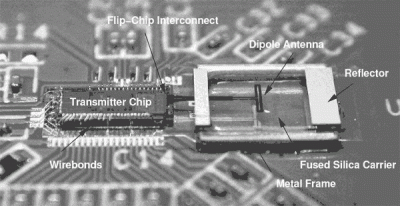
IBM scientists today announced that they have created a small, low-cost chipset that could allow wireless electronic devices to transmit and receive ten times faster than today's advanced WiFi networks.
Using the IBM-pioneered chip-making technology called silicon germanium, the chipset is able to send and receive information in a portion of the radio spectrum that is both unlicensed and can carry a much higher volume of data, a key advantage as data-intensive digital media formats, such as HDTV, become more pervasive.
Several electronics companies are exploring the potential of including these chipsets in their products.
"In the past, wireless has always lagged in speed compared to wired communications, making it frustrating for users who want to enjoy the same access and applications regardless of where they are," said Dr. T.C. Chen, vice president, Science & Technology, IBM Research. "This new technology has the capability to reduce or eliminate this 'download divide,' realizing the full potential of wireless communications and changing the way we live."
Scientists refer to the portion of the radio spectrum from roughly 30 to 300 GHz as "millimeter wave frequency bands," since the actual length of the electromagnetic wave in a signal in these bands is measured in millimeters. Electronics makers have been looking for ways to exploit this portion of the radio spectrum, recognizing its potential for carrying vast amounts of information. However, previous chip designs attempting to exploit this spectrum have been too large, expensive and difficult to integrate with the rest of their products. Their use often required the purchase of multiple separate components and access to specialized skills. This represented a time consuming, expensive process with very low yield.
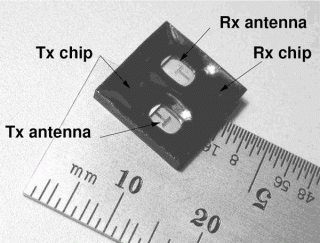
IBM's novel design and use of silicon germanium technology permits a high level of integration in the chips themselves. The embedding of the antennas directly within the unique chipset package helps further reduce system cost since fewer components are needed. As an example, a prototype chipset module, including the receiver, the transmitter, and two antennas, would occupy the area of a dime. By integrating the chipset and antennas in commercial IC packages, companies can use existing skills and infrastructure to build this technology into their commercial products.
Some applications that might now be possible using this 60 GHz technology include wireless personal-area networks (PANs) for intra-office communications in the 10m and below range. PANs are designed to support wireless Gb Ethernet, wireless display, wireless docking station, synchronization of PDAs with desktops/laptops, and wireless downloading of pictures from a camera. Similarly, the technology could enable wireless broadband video distribution, in which a 60-GHz link could be used to stream an uncompressed high-definition video signal from, for example, the DVD player to the plasma display mounted on the wall.
The report on this work, "A 60-GHz Receiver and Transmitter Chipset for Broadband Communications in Silicon," by Brian Floyd, Scott Reynolds, Ullrich Pfeiffer, Troy Beukema, Janusz Grzyb, and Chuck Haymes of IBM's Thomas J. Watson Research Center in Yorktown Heights, NY will be presented on February 7 at the 2006 International Solid State Circuits Conference in San Francisco.
Source: IBM


