Transistor laser functions as non-linear electronic switch, processor
February 6, 2006 Transistor laser functions as non-liner electronic switch, processor

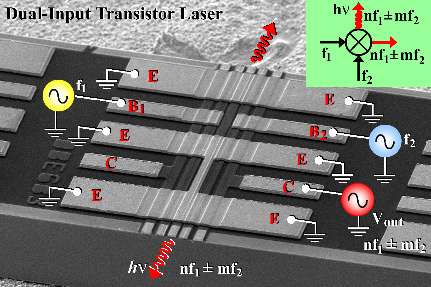
Scanning electron microscope image of a dual-input heterojunction bipolar transistor laser (HBTL) on a Cu heat sink acting as frequency mixer for up and down conversion. The image shows a cleaved, front to back, segment of the laser crystal with emitter (E), base (B), and collector (C) metallization as shown. The laser output is shown schematically as hV and the electrical output as Vout. Both output signals produce integer multiples (mixing) of the input signals at frequencies mf1 +nf2. Credit: Milton Feng and Nick Holonyak

The transistor laser invented by scientists at the University of Illinois at Urbana-Champaign has now been found to possess fundamental non-linear characteristics that are new to a transistor and permit its use as a dual-input, dual-output, high-frequency signal processor.

“We have hit upon something surprisingly fundamental and rich in possibilities,” said Nick Holonyak Jr., a John Bardeen Chair Professor of Electrical and Computer Engineering and Physics at Illinois. “We have at once a new form of transistor and a new form of laser.”

By modifying the base region with quantum wells and resonator configurations, Holonyak, electrical and computer engineering professor Milton Feng, and their colleagues have shifted the transistor operation from spontaneous emission to stimulated emission. The altered recombination process of the transistor changes the device characteristics, giving near laser threshold a fundamental and potentially useful non-linearity. The scientists describe their work in the Feb. 6 issue of the journal Applied Physics Letters.

“Transistors have never done this before,” said Holonyak, who also is a professor in the university’s Center for Advanced Study, one of the highest forms of campus recognition. “Operating as a new form of transistor, the transistor laser offers new signal mixing and switching capabilities.”

The transistor laser combines the functionality of both a transistor and a laser by converting electrical input signals into two output signals, one electrical and one optical.

“Using separate base inputs, we can apply two independent signals to the active region of the transistor laser,” said Feng, the Holonyak Chair Professor of Electrical and Computer Engineering at Illinois.

“We can mix them, manipulate them, so that we get out an electrical signal which is some multiple of the first input plus some multiple of the second input,” Feng said. “We also get out an optical signal, which is modulated by some multiple of the first input plus some multiple of the second input.”

As proof of concept, the researchers demonstrated the operation of a transistor laser as a non-linear microwave mixing device and signal processor using a single emitter and a twin-contact base. Two signals, one at 2.0 gigahertz and one at 2.1 gigahertz, were mixed. Both electrical and optical output signals were obtained at mixing frequencies from 0.1 gigahertz to 8.4 gigahertz.

The data make it clear that stimulated recombination in a transistor, besides its implications for another form of laser with modulation speed potentially as high as that of a transistor, is the basis for a useful non-linear element, a different form of electronic switch and processor, the researchers said.

The transistor laser also raises the possibility of replacing wiring between components at the chip- or board-level with optical interconnects, thus offering more flexibility and capability in electronic-photonic integrated circuits.

“It’s too early to tell where all of this will go,” Holonyak said. “We’re still studying the physics and device properties of the transistor laser. We’re a long way from the end.”

Source: University of Illinois at Urbana-Champaign


print this article email this article download pdf blog this article bookmark this article     Stumble it Digg this share on Facebook retweet share on Reddit add to delicious
Rate this story - 4.4 /5 (27 votes)


February 6, 2006 all stories

Comments: 0

4.4 /5 (27 votes)
  • Stumble this up

  • Digg this

  • share this

  • hide
  • Related Stories

  • 'Masters of light' win Nobel Physics Prize
    created Oct 06, 2009 | popularity not rated yet | comments 0
  • Radiation-Hardened Microelectronics Could Reduce Spacecraft Weight
    created Sep 28, 2009 | popularity not rated yet | comments 0
  • Modelling nano-worlds
    created Aug 10, 2009 | popularity not rated yet | comments 0
  • Lasers can lengthen quantum bit memory by 1,000 times
    created Jun 24, 2009 | popularity not rated yet | comments 0
  • Bilayer graphene gets a bandgap
    created Jun 10, 2009 | popularity not rated yet | comments 0


Other News

Stars Fueled by Dark Matter Could Hold Secrets to the Universe

Stars Fueled by Dark Matter Could Hold Secrets to the Universe

Physics / General Physics

created Nov 03, 2009 | popularity 4.5 / 5 (51) | comments 41

(PhysOrg.com) -- The first stars in the universe may have been very different from the stars we see today, yet they may hold clues to understanding some of the mysterious features of the universe. These "dark ...


Second Law of Thermodynamics May Explain Economic Evolution

Second Law of Thermodynamics May Explain Economic Evolution

Physics / General Physics

created Nov 02, 2009 | popularity 4.3 / 5 (30) | comments 28

(PhysOrg.com) -- Terms such as the "invisible hand," laissez-faire policy, and free-market principles suggest that economic growth and decline in capitalist societies seem to be somehow self-regulated. Now, ...


High-performance plasmas may make reliable, efficient fusion power a reality

High-performance plasmas may make reliable, efficient fusion power a reality

Physics / Plasma Physics

created Nov 02, 2009 | popularity 4.7 / 5 (39) | comments 32

In the quest to produce nuclear fusion energy, researchers from the DIII-D National Fusion Facility have recently confirmed long-standing theoretical predictions that performance, efficiency and reliability ...


'Teapot effect' solved

Solving Teapot Effect

Physics / General Physics

created Nov 02, 2009 | popularity 4.9 / 5 (11) | comments 10

(PhysOrg.com) -- A team of scientists from France have worked out why teapots dribble at low flow rates, and how to stop them. The effect is called the "teapot effect", and solving it could finally put an ...


Laser accelerated protons to the highest energies so far

Researchers use trident laser to accelerate protons to record energies

Physics / General Physics

created Nov 02, 2009 | popularity 4.7 / 5 (6) | comments 10

An international team of physicists at Los Alamos National Laboratory has succeeded in using intense laser light to accelerate protons to energies never before achieved. Using this technique, scientists can ...