Physicists Take a Trip to Nuclear 'Island of Inversion'
Far from the everyday world occupied by such common elements such as gold and lead lies a little-understood realm inhabited by radioactive, or unstable, elements. Recently, a nuclear physicist from Florida State University collaborated with other scientists from the United States, Japan and England in an experiment that illustrated how the “normal” rules of physics don’t apply for some of these radioactive elements.
Kirby W. Kemper, the Robert O. Lawton Distinguished Professor of Physics and vice president for Research at FSU, took part in an experiment at the National Superconducting Cyclotron Laboratory, a national user facility located at Michigan State University in East Lansing, Mich. In the experiment, Kemper and his colleagues found that the structure of atomic nuclei of one radioactive isotope in particular -- magnesium-36, or Mg-36 -- is odd and unexpected.
“Ten years ago, complicated experiments like this one were a dream,” Kemper said. “Five years ago, we thought that in the next 10 years we would be able to carry it out. Now we have done one and so are much further along in experimental capability than even our wildest hopes.”
Protons and neutrons that comprise a nucleus array themselves in shells, each shell with a different energy level, Kemper explained. The phenomenon is described by the nuclear shell model. According to the model, specific numbers of protons and neutrons lead to shell structures that are especially stable -- except, that is, for nuclei of elements in the so-called “island of inversion.” There, ground-state nuclei that otherwise would have fairly typical shell structures adopt weird and strongly deformed structures. Mapping out which nuclei are within or outside the island of inversion helps researchers extend the usefulness of the nuclear shell model, which earned its creators the Nobel Prize for Physics in 1963 and continues to be a powerful tool for understanding the structure of nuclei.
Kemper collaborated with researchers from Michigan State University, the University of Tokyo and RIKEN in Japan, and the University of Surrey in England to study Mg-36. Contemporary theoretical models suggested that its nucleus, with 12 protons and 24 neutrons, should exist just within the island of inversion. But until the team’s result, which will appear in Physical Review Letters, experimentalists hadn’t made the necessary measurements of the rare magnesium isotope to know for sure.
The experiment was conducted at the National Superconducting Cyclotron Laboratory’s Coupled Cyclotron Facility, where a beam of calcium-48 nuclei was generated and directed at a beryllium target. This generated a variety of reaction products, including silicon-38, or Si-38. A large scientific instrument known as a fragment separator then was tuned to allow Si-38 to pass through and continue down the beam line.
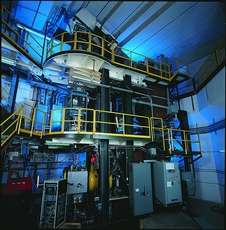
Downstream, these Si-38 isotopes struck a second beryllium target, resulting in the creation of a smattering of new nuclei, including Mg-36. The beam was turned up into the focal plane of a three-story-tall spectrograph -- a giant analytical tool -- that was set to accept only Mg-36. When analyzed, the spectroscopic data indicated that Mg-36 is in fact within the island of inversion.
“Gamma-ray spectroscopy for Mg-36 has never been done because this nucleus is incredibly hard to reach,” said Alexandra Gade, an assistant professor at the National Superconducting Cyclotron Laboratory and lead author of the Physical Review Letters paper. “It’s not just another nucleus.”
For every 400,000 Si-38 nuclei impacting the second target, just one Mg-36 nucleus was produced.
“To the average person, this might seem like a lot of work for not a whole lot of benefit,” Kemper said. “But experiments like this are really all about broadening our understanding of matter -- how it is formed, how it behaves under extreme conditions, and what universal rules apply to it. This is fundamental to increasing our understanding of all matter in the universe. After all, even common elements such as gold and lead had to come from somewhere.”
Source: FSU


