Penguins march into new park
August 9, 2007
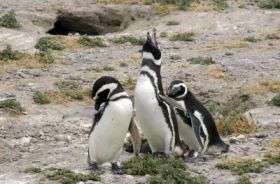
Three Magellanic penguins in the new marine park declared by Argentina on Aug. 8. Over half a million of these marine birds will call home to this new protected area. Credit: Graham Harris/Wildlife Conservation Society
The Bronx Zoo-based Wildlife Conservation Society announced today that the government of Argentina will create a new marine park along its isolated and windswept Patagonia coast to safeguard more than half a million penguins and other rare seabirds. Located in Golfo San Jorge, the new protected area covers around 250 square miles (647 square kilometers) of coastal waters and nearby islands strung along almost 100 miles (160 kilometers) of shoreline.
The announcement was made by President Nestor Kirchner of Argentina, the Governor of the Province of Chubut—Mario Das Neves—and by Argentina’s National Park Service. The park’s creation represents a joint effort by the Government of Chubut, the National Parks Service of Argentina, the Wildlife Conservation Society and the Fundación Patagonia Natural.
“This decision represents a significant commitment by the government to protect one of the most productive and extraordinary marine ecosystems on the planet,” said Dr. Guillermo Harris, director of the Wildlife Conservation Society’s Argentina Program. “The creation of this park comes in the nick of time for many species that are threatened by the region’s fisheries and energy industry.”
The new park serves as a nesting and feeding ground for some quarter million pairs of Magellanic penguin, estimated to represent 20 percent of the entire species. The park includes more than 40 small islands, which support the only two nesting colonies of southern giant petrels on the entire Patagonian coast, as well as the only colonies of Southern American fur seals. Other denizens of this coastal oasis include the endangered Olrog’s gull, the white-headed steamer duck, and almost a quarter of all imperial and rock cormorants of Argentina.
While the coastline is largely undeveloped, its wildlife is under pressure from a number of threats, including Argentina’s commercial shrimp industry. Many birds become entangled in fishing nets, and oil pollution from tankers transporting petroleum from southern Patagonia to Buenos Aires and from expanding offshore oil drilling operations is a looming possibility.
Legislation to formally create the protected area will be drafted in the next few months and approved by the Argentine Congress and local legislators.
Source: Wildlife Conservation Society
-
Deforestation threatens Brazil's wetland sanctuary
Feb 03, 2012 |
5 / 5 (3) |
0
-
Yellow fever strikes monkey populations in South America
Mar 11, 2010 |
not rated yet |
0
-
A happy new year for penguins
Dec 31, 2008 |
5 / 5 (2) |
0
-
'Deadly dozen' reports diseases worsened by climate change
Oct 07, 2008 |
4.6 / 5 (5) |
0
-
Central America Agrees to Jaguar Corridor
May 24, 2006 |
4 / 5 (2) |
0
-
Engineers build first sub-10-nm carbon nanotube transistor
Feb 01, 2012 |
4.9 / 5 (33) |
30
-
Something old, something new: Evolution and the structural divergence of duplicate genes
Jan 31, 2012 |
4.6 / 5 (7) |
1
-
The hidden nanoworld of ice crystals: Revealing the dynamic behavior of quasi-liquid layers
Jan 30, 2012 |
5 / 5 (4) |
1
-
Stock market network reveals investor clustering
Jan 27, 2012 |
3.9 / 5 (23) |
8
-
Of microchemistry and molecules: Electronic microfluidic device synthesizes biocompatible probes
Jan 26, 2012 |
5 / 5 (2) |
0
More news stories
A mitosis mystery solved: How chromosomes align perfectly in a dividing cell
Although the process of mitotic cell division has been studied intensely for more than 50 years, Whitehead Institute researchers have only now solved the mystery of how cells correctly align their chromosomes during symmetric ...
10 hours ago |
4.3 / 5 (16) |
0
|
Researchers find extensive RNA editing in human transcriptome
In a new study published online in Nature Biotechnology, researchers from BGI, the world's largest genomics organization, reported the evidence of extensive RNA editing in a human cell line by analysis of RNA-seq data, demons ...
9 hours ago |
5 / 5 (4) |
0
|
The proteins ensuring genome protection
Researchers from the University of Geneva (UNIGE), Switzerland, have discovered the crucial role of two proteins in developing a cell 'anti-enzyme shield'. This protection system, which operates at the level of molecular ...
10 hours ago |
5 / 5 (3) |
0
|
Entire genome of extinct human decoded from fossil
(PhysOrg.com) -- In 2010, Svante Pääbo and his colleagues presented a draft version of the genome from a small fragment of a human finger bone discovered in Denisova Cave in southern Siberia. The ...
Feb 07, 2012 |
4.7 / 5 (60) |
51
|
Why are there so few fish in the Earth's oceans?
(PhysOrg.com) -- A Stony Brook University researcher has found that, contrary to popular belief, there are not plenty of fish in the sea.
Feb 08, 2012 |
4.2 / 5 (18) |
27
|
Scientists discover molecular secrets of 2,000-year-old Chinese herbal remedy
For roughly two thousand years, Chinese herbalists have treated Malaria using a root extract, commonly known as Chang Shan, from a type of hydrangea that grows in Tibet and Nepal. More recent studies suggest that halofuginone, ...
New method to examine batteries -- MRI from the inside
There is an ever-increasing need for advanced batteries for portable electronics, such as phones, cameras, and music players, but also to power electric vehicles and to facilitate the distribution and storage of energy derived ...
Google might launch Drive for cloud storage soon
(PhysOrg.com) -- Google's next big move, according to the Wall Street Journal, is a cloud storage service called Drive. Hardly first to the plate, Google is simply catching up to introducing its cloud reposi ...
Lab study raises questions over nano-particle impact
Tests involving chickens have raised questions about the impact on health from engineered nano-particles, the ultra-fine grains commonly used in drugs and processed foods, scientists said on Sunday.
Starve a virus, feed a cure? Findings show how some cells protect themselves against HIV
A protein that protects some of our immune cells from the most common and virulent form of HIV works by starving the virus of the molecular building blocks that it needs to replicate, according to research published online ...
Overeating may double risk of memory loss
New research suggests that consuming between 2,100 and 6,000 calories per day may double the risk of memory loss, or mild cognitive impairment (MCI), among people age 70 and older. The study was released today and will be ...