Tropical insects 'go the distance' to inform rainforest conservation
August 9, 2007
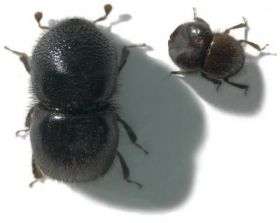
Ambrosia beetles were studied by the research team. The large one is a female, the smaller one a male. As an aside, these beetles mate within individual families only, brothers with sisters. The males are small, flightless and die soon after mating. Credit: Jiri Hulcr, Michigan State University
The long-held belief that plant-eating insects in tropical forests are picky eaters that stay “close to home” – dining only on locale-specific vegetation – is being challenged by new research findings that suggest these insects feast on a broader menu of foliage and can be consistently found across hundreds of miles of tropical forestland.
These findings have significant implications related to the sustainability and conservation of these globally-important areas.
Michigan State University scientist Anthony Cognato and graduate student Jiri Hulcr were part of an international team that conducted this groundbreaking research, the results of which are described in the Aug.ust 9 online issue of the journal Nature. The group included scientists from Australia, the Czech Republic, the United Kingdom, New Guinea and the United States.
“Tropical rain forests are home to a rich diversity of plants, birds, insects and other animals,” said Hulcr, an entomology PhD doctoral student working with Cognato and co-author of the report. “They also play an important role in our global climate and provide aesthetic, recreational and medicinal benefits. For these reasons and others, it is critical that we understand how these forests generate and sustain their diversity and what we can do to help conserve them.”
The study included approximately 500 species of caterpillars, beetles and fruitfliesfruit flies from common plant-eating families and 175 species from four diverse plant groups across 28,950 square miles of contiguous lowland rain forest in Paupua, New Guinea.
Cognato and Hulcr were key collaborators on the project because of their expertise related to the biology and ecology of the bark and ambrosia beetle family, a model group of insects compoprised of 6,000 species worldwide, and one common to tropical rain forests.
“What we found was that the composition of the community of beetles does not change with distance as long as the environment is stable,” Cognato said. “Even communities hundreds of miles apart are the same. And if there are differences, they seem to be random and not caused by any environmental change.”
Study findings were similar for the butterfly and fruit fly species examined in the study.
“Such knowledge is critical to understanding the roles of ecological processes in maintaining tropical diversity, predicting species extinction and designing the systems of protected natural areas,” Hulcr said. “Because diversity doesn’t necessarily increase with distance, but animals in small reserves
tend to go extinct, you should plan for one large area instead of having a lot of small and distant areas to manage and conserve.”
Cognato and Hulcr expect similar patterns in other tropical lowland rain forests, as they are typically situated in the extensive low basins of major rivers comparable to the study area in New Guinea. They are currently conducting research in other areas of the tropics – including Borneo, Ecuador, Guyana, Ghana and Thailand – to confirm the New Guinea findings.
“If we want the stability of these forests, especially given how much they are threatened now, we need to understand how to best set up conservation areas,” said Cognato said. “And it’s not just about the flashy species; it’s about the whole thing.”
Hulcr agrees.
“This and additional research will allow conservation managers and policy makers to base decisions on data rather than on theory so that we can preserve as much diversity as possible,” Hulcr said. “We are excited to be part of the ongoing, international effort to add to the extensive data necessary for the understanding, analysis and conservation of complex tropical forest ecosystems.”
Source: Michigan State University
-
A new species of bamboo-feeding plant lice found in Costa Rica
Feb 06, 2012 |
not rated yet |
0
-
Competition is at the root of diversity in rainforests: study
Jan 26, 2012 |
4 / 5 (1) |
8
-
A hint of frog in the air: Macrolides are volatile pheromones from Madagascar frogs
Jan 24, 2012 |
not rated yet |
0
-
Unprecedented, man-made trends in ocean's acidity
Jan 22, 2012 |
4 / 5 (20) |
29
-
Trees influence epiphyte and invertebrate communities
Jan 05, 2012 |
5 / 5 (1) |
0
-
Engineers build first sub-10-nm carbon nanotube transistor
Feb 01, 2012 |
4.9 / 5 (33) |
30
-
Something old, something new: Evolution and the structural divergence of duplicate genes
Jan 31, 2012 |
4.6 / 5 (7) |
1
-
The hidden nanoworld of ice crystals: Revealing the dynamic behavior of quasi-liquid layers
Jan 30, 2012 |
5 / 5 (5) |
1
-
Stock market network reveals investor clustering
Jan 27, 2012 |
3.9 / 5 (23) |
8
-
Of microchemistry and molecules: Electronic microfluidic device synthesizes biocompatible probes
Jan 26, 2012 |
5 / 5 (2) |
0
More news stories
Germination of Bacillus species which can lead to food poisoning
Some bacteria can form spores (survival capsules) that are particularly resistant to heat. Since sporogenous bacteria can also cause food poisoning and a reduction in food quality, they constitute a significant ...
15 minutes ago |
not rated yet |
0
New molecule has potential to help treat genetic diseases and HIV
(PhysOrg.com) -- Chemists at The University of Texas at Austin have created a molecule that's so good at tangling itself inside the double helix of a DNA sequence that it can stay there for up to 16 days before ...
1 hour ago |
5 / 5 (2) |
0
|
Integrated pest management recommendations for the southern pine beetle
The southern pine beetle, Dendroctonus frontalis Zimmermann, is a chronic insect pest within pine forests in the southeastern United States. Under favorable environmental and host conditions, it is an agg ...
4 hours ago |
not rated yet |
0
A mitosis mystery solved: How chromosomes align perfectly in a dividing cell
Although the process of mitotic cell division has been studied intensely for more than 50 years, Whitehead Institute researchers have only now solved the mystery of how cells correctly align their chromosomes during symmetric ...
18 hours ago |
4.5 / 5 (22) |
0
|
Researchers find extensive RNA editing in human transcriptome
In a new study published online in Nature Biotechnology, researchers from BGI, the world's largest genomics organization, reported the evidence of extensive RNA editing in a human cell line by analysis of RNA-seq data, demons ...
18 hours ago |
5 / 5 (4) |
0
|
With climate change, today's '100-year floods' may happen every three to 20 years: research
Last August, Hurricane Irene spun through the Caribbean and parts of the eastern United States, leaving widespread wreckage in its wake. The Category 3 storm whipped up water levels, generating storm surges ...
Researchers make better heat sensor based on butterfly wings
(PhysOrg.com) -- Scientists have long known that butterfly wings produce their iridescent colors by bouncing light around and between tiny ridges in structures made of chitin. More recently they’ve discovered ...
Manipulating genes with hidden TALENs
(PhysOrg.com) -- A better understanding of gene function in model plant and animal systems could be used to develop useful traits in livestock and crop plants, and might someday lead to developments in stem ...
Alien matter in the solar system: A galactic mismatch
This just in: The Solar System is different from the space just outside it.
The joy of cheques
An electronic cheque which eliminates the need for costly processing by banks but preserves the simplicity and ease of a traditional cheque book has been designed by a team of academics in the UK.
Research shows promise in converting camelina oil into jet fuel
(PhysOrg.com) -- Researchers at Montana State University-Northern have developed a process to convert camelina oil to jet fuel and other high-value chemicals. MSU has applied for a U.S. patent and research is ongoing.