One of Deep Ocean's Most Turbulent Areas Has Big Impact on Climate
More than a mile beneath the Atlantic’s surface, roughly halfway between New York and Portugal, seawater rushing through the narrow gullies of an underwater mountain range much as winds gust between a city’s tall buildings is generating one of the most turbulent areas ever observed in the deep ocean.
In fact, the turbulence packs an energy wallop equal to about five million watts -- comparable to output from a small nuclear reactor, according to a landmark study led by Florida State University researcher Louis St. Laurent and described in the August 9 edition of the journal Nature.
The study -- an international collaboration of scientists from the United States and France -- documents for the first time the turbulent conditions in an undersea mountain range known as the Mid-Atlantic Ridge. It provides never-before-seen evidence that deep water turbulence swirling in the small passageways of such mountains is generating much of the mixing of warm and cold waters in the Atlantic Ocean.
Better understanding of the mechanisms of mixing is crucial, says St. Laurent, an assistant professor of physical oceanography at FSU and the study’s co-principal investigator, because mixing produces the overall balance of water temperatures that helps control the strength of the Gulf Stream -- the strong, warm ocean current that starts in the Gulf of Mexico, flows along the U.S. east coast to Canada and on to Europe, and plays a crucial climate role.
“Oceanographers are working hard to understand how processes in the ocean help to keep the Earth’s climate stable,” St. Laurent said. “We are aware that the climate is warming, but we don’t yet fully understand how the changes will affect society. Our work will result in better models for predicting how the ocean will affect the climate in the future and a better understanding of sea-level rise, weather patterns such as El Nino, and the impact of these events on fisheries.”
St. Laurent compared the flow of seawater through underwater gullies in the Mid-Atlantic Ridge to the wind, so familiar to hikers, that blows through mountain passages on land.
“That wind creates a condition known as turbulence, which can blow the hat from your head,” St. Laurent said. “In the ocean, turbulence is produced when water flows quickly though oceanic passages. The turbulence stirs the almost freezing-water near the bottom with warmer water that is closer to the surface much as you would mix cream into coffee by stirring it with a spoon.
“We know that the mixing of warm surface water with very cold deep water is one of several factors that influence the Earth's climate,” he said. “The mixing we observed and measured for our study allows the warmth at the surface of the ocean to ‘diffuse’ deep into the sea. The overall balance between warm and cold water in the Atlantic helps control the strength of the Gulf Stream, which moves heat away from the Earth’s equator toward regions that receive much less heating from the sun’s rays.”
St. Laurent’s co-principal investigator and co-author was Andreas M. Thurnherr, a former postdoctoral researcher in the FSU oceanography department and now a scientist at Columbia University. The field study took place in August 2006 during a three-week expedition aboard a French research vessel to a location close to the Azores, volcanic islands 2,000 miles east of the U.S. and west of Europe that comprise an above-sea portion of the mostly submerged Mid-Atlantic Ridge.
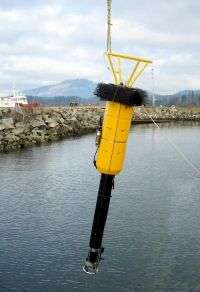
To measure the energy generated by the extraordinarily intense turbulence more than a mile below the ocean’s surface, St. Laurent and crew used a custom-made instrument called the "turbulence profiler," outfitted with special sensors.
“The turbulence profiler measured the output using ‘watts,’ the same unit of measurement as printed on light bulbs,” St. Laurent said. “In the undersea mountain passage where we intentionally looked, we found turbulence levels as large as one-10th watt per cubic meter of seawater. This is a huge amount of energy when you add all the seawater in the passage, equal to around five million watts, which is comparable to output from a nuclear reactor.”
Source: FSU


