Computers expose the physics of NASCAR
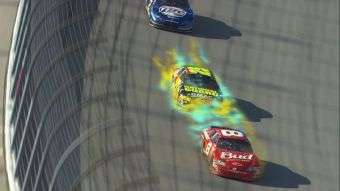
It's an odd combination of Navier-Stokes equations and NASCAR driving. Computer scientists at the University of Washington have developed software that is incorporated in new technology allowing television audiences to instantaneously see how air flows around speeding cars.
The algorithm, first presented at a computer graphics conference last August, was since used by sports network ESPN and sporting-technology company Sportvision Inc. to create a new effect for racing coverage. The fast-paced innovation hit prime time in late July when ESPN used the Draft Track technology to visualize the air flow behind cars in the Allstate 400 at the Brickyard, a NASCAR race at the Indianapolis Motor Speedway.
Zoran Popović, an associate professor in the UW's department of computer science and engineering, and two students wrote the code that dramatically speeds up real-time fluid dynamics simulations. Working with ESPN, a Chicago-based company named Sportvision developed the application for NASCAR competition.
The Draft Track application calculates air flow over the cars and then displays it as colors trailing behind the car. Green, blue, yellow and red correspond to different speeds and directions for air flow when two or more cars approach one another while driving at speeds upward of 200 miles per hour.
"What ESPN wanted to do is tell the story for the viewer of how drafting works because it's such a big part of the event," said Rick Cavallaro, chief scientist at Sportvision. "How the drivers use drafting to save gas, pick up speed, et cetera."
The UW researchers' breakthrough was figuring out how to simulate and display complex systems very quickly. Studios such as Pixar already use physical laws, such as the Navier-Stokes fluids equations, in their animations. This allows the studios to create realistic pictures of how smoke curls, how a fire's flames lick, and even how hair or fabric blows in the wind. But these calculations take hours to run on many high-performance computers. And increasing the speed of the image is only one challenge of moving to a real-time setting.
"The studios shoot a two-second special effect and if it doesn't work they just change the parameters and try again," Popović said. "But in a real-time context the simulation has to run indefinitely, and for an unforeseen set of inputs."
To make the simulation work in real time and be interactive, "you kind of need to rethink the math problem," he said. "The method that ended up being used is drastically different from what people have done before."
The new algorithm first simulates all the ways that smoke, fire -- or in this case, modified stock cars -- can behave. Then it runs the simulation for a reduced number of physically possible parameters. This allows the model to run a million times faster than before. The researchers presented the work at the SIGGRAPH computer graphics conference in August 2006.
Popović imagined that the first applications would be introducing interactive simulations in video games that would allow players to drive through a smoky fire, interact with the weather in a flight simulator, or drive racecars in a virtual wind tunnel. Other research results from his lab were licensed to the game industry and then adopted in video games.
But in March, Sportvision approached the researchers to see whether it could license the software for use in NASCAR visualizations. The two parties agreed to a nonexclusive, open-source agreement where the company would be allowed to use the technique.
"What's interesting is how the flow from the car in front is affecting the cars behind," Popović said. "When there are two cars behind, then the interaction becomes very complex."
Sportvision creates technology to enhance sports coverage. It introduced the glowing puck for National Hockey League telecasts in the mid 1990s and later came up with the yellow lines that drag a virtual highlighter over the first-down line in football. The company has already developed add-ons for ESPN's NASCAR coverage, placing Global Positioning System receivers, inertial measurement systems and telemetry on each car that can determine each car's speed and position several times a second. Now company engineers will use data from those sensors to model and display the air flowing over the cars.
"This is certainly not an application that had occurred to me," admitted Adrien Treuille, a doctoral student who co-authored the software. He, like Popović, said he had not previously been a NASCAR fan.
The group hoped the work might be used for realistic training simulations such as firefighters entering a smoke-filled building. "But once [Sportvision] called us and started describing what they wanted to do," Treuille recalled, "We said, 'Yes, that would totally work.'"
Source: University of Washington


