August 10, 2007 feature
Coil design confines plasma in stellarator fusion reactor
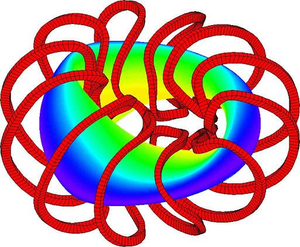
Researchers from New York University have designed a configuration of coils for a stellarator, a type of device that controls fusion reactions. The shape, number and position of the coils are optimized to generate an external magnetic field for the stellarator that will prevent the hot plasma from deteriorating.
NYU scientists Romeo Alexander and Paul Garabedian have published their coil design in a recent issue of the Proceedings of the National Academy of Sciences. The group hopes that the improved design will overcome a significant challenge faced by fusion reactors: disruptions in the plasma that cause particles to escape the machine, resulting in a machine crash.
“A pressing issue of our time is to develop clean and efficient energy sources,” the researchers explained in their paper. “One proposed solution of the problem implements the concept of nuclear fusion of hydrogen to form helium, which does not leave radioactive wastes that are as permanent as those involved in fission.”
Fusion reactors can produce energy by the nuclear fusion of deuterium and tritium—isotopes of hydrogen that contain one and two neutrons, respectively (hydrogen contains no neutrons). When confined by a strong magnetic field in the vacuum of a fusion reactor, the isotopes can overcome their repulsion and combine, producing helium ions (containing two protons) and releasing energetic neutrons. If the velocity of these neutrons can be slowed, their energy can be safely harnessed and transferred to, for example, a steam generator to cleanly and efficiently produce electricity.
The ability of stellarators to precisely confine plasma is one of the key benefits of this type of fusion reactor. Although its biggest rival, the tokamak, is widely considered the leading candidate for fusion energy production, the tokamak’s symmetrical torus shape requires a current to be driven through the plasma to keep the particles from drifting. On the other hand, the stellarator’s asymmetrical torus shape can use twisted coils to generate a confining magnetic field, avoiding the need for a current.
“After the magnetic field inside the boundary of a physically desirable plasma has been optimized, we determine the number, shape, and position of coils that are required to generate the external field,” the scientists wrote.
Alexander and Garabedian’s design consists of 12 circular coils wrapped around the torus in a moderately twisted fashion, generating a magnetic field that is compatible with the field inside the plasma. Although this requirement may sound simple to compute, the researchers explained that mathematical solutions can result in a design that is too complicated to realistically construct.
While using as few coils as possible, the design maintains the shape of the plasma and optimizes the physical properties inside. The coils generate both vertical and toroidal magnetic fields in order to stabilize the confinement force on the plasma. The design also requires the coils to have smooth surfaces to enable effective construction and to eliminate extraneous harmonics that may cause the magnetic surfaces in the plasma to deteriorate.
“Monte Carlo calculations of thermal transport that take into account quasineutrality suggest that confinement in QAS [quasi-axial symmetry] stellarators may be comparable to that in existing tokamaks, but a test is needed to show that these configurations can achieve the high ion temperatures required for ignition in a fusion plasma,” the researchers concluded. “The physics issues seem to be secondary to a more technical question of finding smooth coils that can be built to generate the external magnetic field in a stellarator with robust flux surfaces. … [T]he methods we have used seem adequate to justify going forward promptly with a stellarator ignition experiment.”
Citation: Alexander, Romeo and Garabedian, Paul R. “Choice of coils for a fusion reactor.” Proceedings of the National Academy of Sciences, July 24, 2007, vol. 104, no. 30, 12250-12252.
Copyright 2007 PhysOrg.com.
All rights reserved. This material may not be published, broadcast, rewritten or redistributed in whole or part without the express written permission of PhysOrg.com.


