What makes Mars magnetic?
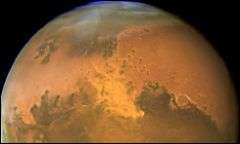
So how have these rocks hung onto their magnetic directions and what do they tell us about Mars? Strangely, the answer to these questions might be sitting here on Earth.
Most continental rocks on Earth align their magnetic moments with the current magnetic field – they are said to have ‘induced’ magnetism. “I consider induced rocks to have ‘Alzheimers’. These are the rocks that forgot where they were born and how to get home,” explains Suzanne McEnroe from the Geological Survey of Norway at a European Science Foundation (ESF), EuroMinScI conference near Nice, France this year.
However, not all of Earth’s continental rocks have an induced magnetization. Some rocks stubbornly refuse to swing with the latest magnetic field, and instead keep hold of the direction they were born with. These rocks are said to have a remanent magnetization.
McEnroe and her colleagues have been studying some of Earth’s strongest and oldest remanent magnetic rocks, to find out why they have such good memories. Understanding these rocks may give us clues as to what kind of rocks lie on Mars.
One of their research projects (in cooperation with Phil Schmidt and David Clark at CSIRO, Australia and just published in the Journal of Geophysical Research) is on the Peculiar Knob Formation in South Australia. These rocks are around 1 billion years old and have a strong magnetic remanence, more than 30 times larger than typically found in basaltic rocks.
“This particular research evolved from looking for an economic mineral deposit,” says McEnroe. The mining company had assumed that the rocks in this strongly magnetic area were holding an induced magnetic field and that there would be magnetite buried down below. However, they were puzzled when a different mineral – hematite, came out of the drill core. Had they missed their target, or were their assumptions wrong"
By studying the samples under a powerful microscope and modelling their magnetic properties, McEnroe was able to show that the hematite was responsible for the strong magnetic field and that it was holding a remanent field from around 1 billion years ago. “We could see that the hematite contained small intergrowths that carried the magnetism,” says McEnroe, who presented her findings at the 1st EuroMinScI Conference near Nice, France in March this year.
And it turns out that the microstructure of the rock is the key to whether it can hold a remanent magnetization or not. Together with Richard Harrison, a mineral physicist at Cambridge University, UK, and Peter Robinson at NGU, McEnroe has been studying strong remanent magnetic rocks from a variety of places including Scandinavia and the U.S. A study on nearly billion-year-old rocks in Norway showed a remanent magnetic anomaly comparable in scale to those observed on Mars. The remanent magnetic anomaly dominates the local magnetic field to such a degree that more than half the Earth's field is cancelled. It is nearly impossible to use a compass in the area, which cannot point correctly north because of the strong remanent magnetization in the rocks.
What they have found is that rocks containing nanometre scale intergrowths of ilmenite and hematite are better able to cling onto their original magnetization than those without such fine-scale features. “Placing a nanoparticle of ilmenite into the hematite host creates a strong and stable magnetic signal that can survive large changes in temperature and magnetic field over billions of years,” explains Harrison.
So can this tell us anything about the rocks on Mars" “These rocks are good analogues for the magnetic rocks we see on Mars because of their strong magnetism and the length of time they have retained this memory,” says McEnroe. Certainly this nano-scale microstructure is a plausible candidate for the magnetic rocks on Mars.
However, the rocks on Earth can’t answer all our questions. “There is not going to be one mineral or one tectonic setting on Mars. There are going to be different reasons that enhance the signature in different places,” says McEnroe. The only way to definitively answer the question is to go and pick up some rocks from Mars.
Source: European Science Foundation


