Hypershort flash of visible light produces 'white' attosecond X-ray light
No flash of light can be shorter than the time it takes the wave carrying the flash to perform a full oscillation. A team headed by Prof. Ferenc Krausz has now succeeded in generating – for the first time – flashes of intense laser light that deliver more than half of their energy within a single well-controlled wave cycle.
Atoms exposed to this extreme light pulse emit an attosecond X-ray pulse (1 attosecond = one billionth of a billionth of a second) whose wave components, if oscillating more slowly, would represent nearly all colours of visible light, all the way from blue through green and yellow to red. The resultant “white” pulse has an expected duration of about 100 attoseconds and is composed of more than a million X-ray photons.
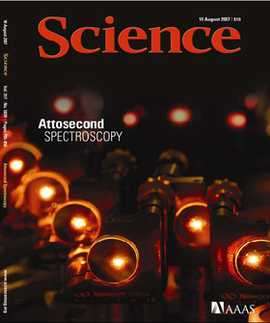
Therefore, it is brief enough, and powerful enough to capture the motion of electrons moving on molecular orbitals. Real-time observation of the electrons that bind atoms together will provide invaluable insight into the microscopic origin of the formation and deformation of molecules. The results were reported in the July issue of New Journal of Physics [1,2] and featured on the cover of Science (August 10, 2007).
Light is a wave in which the oscillating electromagnetic field changes its direction and strength with awesome rapidity. In the case of visible light, these changes occur several 100 trillion times per second. Consequently, it takes a visible light wave only several thousand attoseconds to perform an oscillation. A team of researchers at the Ludwig Maximilians University Munich and the Max Planck Institute of Quantum Optics led by Prof. Ferenc Krausz has now produced intense flashes of visible laser light ontaining more than 50% of their energy within a single oscillation cycle. This single, large amplitude, field oscillation is used to exert a well-controlled ultrastrong force on charged particles, such as electrons, allowing unprecedented precise control of their motion in and around atoms.
On the crest of this ultra-intense wave cycle, the force is strong enough to pull an electron away from an atom with almost 100% probability. The freed electron is first pulled away from the atom with a speed of several thousand km/s. Even at this high velocity, the electron can travel only several nanometers before it is turned around and directed back toward its parent atom by the next half wave cycle, which exerts its force in the opposite direction. As a result, only some two thousand attoseconds after being freed, the electron is recombined with its parent atom, emitting an X-ray pulse during the recombination.
In a conventional laser pulse, consisting of many wave cycles, this process of recombination and X-ray emission occurs many times, once during each half wave cycle. In striking contrast, the intense, hypershort laser pulse generated by the LMU-MPQ team [1] allows only one energetic recombination to occur, resulting in the emission of a single isolated burst of soft-X-ray light spanning a spectral range equivalent to the entire visible spectrum. The hypershort laser light pulse is used to illuminate a large number of atoms (in a gas jet), inducing this energetic electronatom recombination in a large number of atoms in unison. These individual atoms all emit an ultrashort X-ray burst in the same way at the same time, collectively giving rise to a powerful X-ray pulse delivered in a collimated, laser-like beam.
The ultra-strong, single wave cycle of the hypershort laser pulse, results in the emission of vastly different frequencies (colours) within the X-ray pulse. By slicing out only the central portion of this wide band of frequencies, 170 attosecond X-ray pulses were generated [2]. This result suggests that by using the entire band of available X-ray frequencies, which is more than twice as broad as the spectrum used to produce the 170-as pulse, X-ray pulses substantially shorter than 100 attoseconds can be generated. A mirror capable of reflecting and focusing all these X-ray waves is currently under development [3]. Once available, it is likely to lead to the production of the world’s first light source producing powerful laser-like X-ray flashes of duration shorter than 100 attoseconds – the first source producing sub-100-as light. In the near future these X-ray pulses will allow researchers to take “freeze-frame” snapshots of electrons moving in molecules, allowing reconstruction of the motions that control information transfer on molecular scales as well as structural changes of both small and large (bio-) molecules [4]. These snapshots may reveal the ultimate speed and size limits in electronics, the mechanisms of biological information transfer, and the microscopic origins of the function and malfunction of biological macromolecules.
References:
[1] A. L. Cavalieri et al., New J. Phys. 9, 242 (2007).
[2] M. Schultze et al., New J. Phys. 9, 243 (2007).
[3] Ulf Kleineberg, unpublished.
[4] E. Goulielmakis et al., Science 317, 769 (2007).
Source: Max Planck Institute


