Seismologists confirm Utah mine collapse caused temblor
August 10, 2007
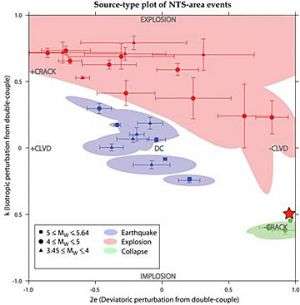
UC Berkeley researchers have categorized earthquakes (blue), underground explosions (pink) and crack collapses (green) according to volume change and other parameters. The Utah temblor of Aug. 6 (red star) falls within the area of an underground cavity collapse, showing that it was not an earthquake. (Graphic by Doug Dreger and Sean Ford/UC Berkeley)
A 3.9 magnitude temblor recorded at the time of a mine collapse in southern Utah on Monday, Aug. 6, was not from an earthquake, but more likely the result of the collapse itself, according to an analysis by University of California, Berkeley, seismologists.
The study by UC Berkeley graduate student Sean Ford and seismologist Douglas Dreger, associate professor of earth and planetary science, complements and confirms the conclusions of University of Utah seismologists, despite claims by the mine owner that a tectonic earthquake triggered the collapse.
There is no evidence of both an earthquake and a collapse - just the collapse, Dreger said, and the shaking that was detected bears the signature of a collapse, not a tectonic earthquake.
Rescuers are now drilling toward six coal miners trapped by the collapse, in hopes that they are still alive.
Ford, Dreger and their colleagues, all affiliated with the Berkeley Seismological Laboratory, published their report on the Web on Aug. 8.
Dreger and Ford are involved in a Department of Energy project to detect and characterize different types of seismic events, and have established criteria that distinguish underground explosions and crack collapses from tectonic earthquakes.
After the mine collapse, University of Utah seismologists performed a standard analysis of the seismic data, basically finding that all seismic monitors surrounding the mine recorded initial downward movement, whereas a tectonic earthquake would typically produce both up and down motion, depending on the distance of the seismometer from the event. They concluded that the mine collapse probably caused the shaking.
On Tuesday, Ford and Dreger ran their own analysis of data from seismometers surrounding the mine. They also saw the initial P waves moving downward, but in addition looked at slower S waves and surface waves generated by the event. Performing a more complex analysis of these seismic waves, and allowing for a change in volume underground, they determined that the data fit exactly what would be expected from an underground cavity collapse.
"Using a completely different model and different data, we confirmed what the Utah scientists found," Dreger said. "Together, I'd say these are pretty convincing."
Though Dreger could not pinpoint the exact depth of the event, evidence shows it was shallow, on the order of one kilometer deep, whereas earthquakes typically are centered between 5 and 15 kilometers below the surface. The event also produced mostly low-frequency waves, whereas earthquakes produce low and high-frequency waves.
While the Utah scientists estimated a Richter magnitude of 3.9, Dreger and Ford estimate a moment magnitude of 4.2. These results are generally consistent with one another, Dreger said.
The researchers used data from the National Science Foundation's EarthScope network, which covers about 20 percent of the United States. Coauthors on their paper are UC Berkeley seismologists Robert Uhrhammer and Peggy Hellweg.
Source: UC Berkeley
-
New system for earthquake early warning
Nov 10, 2005 |
3.2 / 5 (19) |
0
-
Japan, U.S. team deploys underwater robots to coast
Apr 21, 2011 |
not rated yet |
0
-
Hormone treatment to prevent ambiguous genitalia in baby girls spurs debate
Aug 15, 2010 |
4.4 / 5 (5) |
0
-
Stem cell transplantation of therapy-resistant chronic leukemia successful
Jul 12, 2010 |
5 / 5 (2) |
0
-
Patients with treatment-resistant CLL respond positively to stem cell transplants
Jul 02, 2010 |
not rated yet |
0
-
Engineers build first sub-10-nm carbon nanotube transistor
Feb 01, 2012 |
4.9 / 5 (32) |
30
-
Something old, something new: Evolution and the structural divergence of duplicate genes
Jan 31, 2012 |
4.6 / 5 (7) |
1
-
The hidden nanoworld of ice crystals: Revealing the dynamic behavior of quasi-liquid layers
Jan 30, 2012 |
5 / 5 (4) |
1
-
Stock market network reveals investor clustering
Jan 27, 2012 |
3.9 / 5 (23) |
8
-
Of microchemistry and molecules: Electronic microfluidic device synthesizes biocompatible probes
Jan 26, 2012 |
5 / 5 (2) |
0
-
Do some geologists actually act a lot like Randy Marsh?
Feb 11, 2012
-
Discrepancy between oxygen and carbon-dioxide levels
Feb 09, 2012
-
where gems are found in the world
Feb 09, 2012
-
Wind Waves in Reservoir ~ Wind run-up and Wind set-up
Feb 08, 2012
-
Balance of oxygen in the atmosphere
Feb 01, 2012
-
The case for a methanol-based economy
Jan 30, 2012
- More from Physics Forums - Earth
More news stories
Salvage workers begin pumping fuel from Italian shipwreck
Salvage workers Sunday began pumping fuel from the shipwrecked Italian cruise liner Costa Concordia, a day ahead of schedule, officials said.
1 hour ago |
not rated yet |
0
Latin America mining boom clashes with conservation
Latin America is experiencing a mining boom as prices rise fuelled by a hike in global demand, but the region is also being hit by a wave of violent protests, strikes and rallies by environmentalists.
9 hours ago |
5 / 5 (1) |
1
Political leaders play key role in how worried Americans are by climate change: study
More than extreme weather events and the work of scientists, it is national political leaders who influence how much Americans worry about the threat of climate change, new research finds.
Feb 06, 2012 |
5 / 5 (6) |
73
NASA budget will axe Mars deal with Europe: scientists
US President Barack Obama's budget proposal to be submitted next week for 2013 will cut NASA's budget by 20 percent and eliminate a major partnership with Europe on Mars exploration, scientists said Thursday.
Space & Earth / Space Exploration
Feb 10, 2012 |
5 / 5 (3) |
57
Humans may have helped the decline of African rainforests 3000 years ago
(PhysOrg.com) -- Large areas of rainforests in Central Africa mysteriously disappeared over three thousand years ago, to be replaced by savannas. The prevailing theory has been that the cause was a change ...
Scientists discover molecular secrets of 2,000-year-old Chinese herbal remedy
For roughly two thousand years, Chinese herbalists have treated Malaria using a root extract, commonly known as Chang Shan, from a type of hydrangea that grows in Tibet and Nepal. More recent studies suggest that halofuginone, ...
New method to examine batteries -- MRI from the inside
There is an ever-increasing need for advanced batteries for portable electronics, such as phones, cameras, and music players, but also to power electric vehicles and to facilitate the distribution and storage of energy derived ...
Lab study raises questions over nano-particle impact
Tests involving chickens have raised questions about the impact on health from engineered nano-particles, the ultra-fine grains commonly used in drugs and processed foods, scientists said on Sunday.
Google might launch Drive for cloud storage soon
(PhysOrg.com) -- Google's next big move, according to the Wall Street Journal, is a cloud storage service called Drive. Hardly first to the plate, Google is simply catching up to introducing its cloud reposi ...
A mitosis mystery solved: How chromosomes align perfectly in a dividing cell
Although the process of mitotic cell division has been studied intensely for more than 50 years, Whitehead Institute researchers have only now solved the mystery of how cells correctly align their chromosomes during symmetric ...
Starve a virus, feed a cure? Findings show how some cells protect themselves against HIV
A protein that protects some of our immune cells from the most common and virulent form of HIV works by starving the virus of the molecular building blocks that it needs to replicate, according to research published online ...