NCAR adds resources to TeraGrid
August 10, 2007
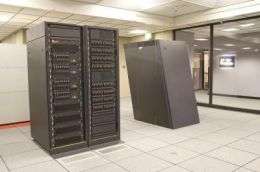
NCAR's BlueGene/L system, code-named "frost," requires a fraction of the power and space of most production systems. The integration of frost brings the capacity of the TeraGrid to more than 250 teraflops of computing capability and more than 30 petabytes of online and archival data storage. Credit: Photo by Carlye Calvin, ©UCAR
Researchers who use the TeraGrid, the nation’s most comprehensive and advanced infrastructure for open scientific research, can now leverage the computing resources of a powerful, 2048-processor BlueGene/L system at the National Center for Atmospheric Research (NCAR).
NCAR plans to provide up to 4.5 million processor-hours of BlueGene/L computing annually to researchers who have received computing grants from the National Science Foundation (NSF).
The operational integration of TeraGrid with the BlueGene/L system, nicknamed “frost,” involved extensive preparation by NCAR’s Computational and Information Systems Laboratory (CISL). Engineers deployed the necessary networking infrastructure, then established connectivity to NCAR’s data storage systems, and merged the local resource accounting system with the TeraGrid.
“We are excited to be at a point where all our hard work and preparation pays off, and to provide the TeraGrid community with access to this valuable collaborative resource,” says Richard Loft, NCAR TeraGrid principal investigator.
NCAR is also testing experimental systems and services on the TeraGrid. These include the wide-area versions of general parallel file systems from IBM and cluster file systems, as well as a remote data visualization capability based on the VAPOR tool, an open source application developed by NCAR, the University of California, Davis, and Ohio State University under the sponsorship of NSF (see On the Web, below).
NCAR’s frost system, which is operated in partnership with the University of Colorado, will be the second BlueGene/L system on the TeraGrid, joining the San Diego Supercomputer Center’s 6,144 processor system. With the addition of frost, the TeraGrid has more than 250 teraflops of computing capability and more than 30 petabytes of online and archival data storage, with rapid access and retrieval over high-performance networks.
Source: National Center for Atmospheric Research
-
Engineers build first sub-10-nm carbon nanotube transistor
Feb 01, 2012 |
4.9 / 5 (33) |
30
-
Something old, something new: Evolution and the structural divergence of duplicate genes
Jan 31, 2012 |
4.6 / 5 (7) |
1
-
The hidden nanoworld of ice crystals: Revealing the dynamic behavior of quasi-liquid layers
Jan 30, 2012 |
5 / 5 (4) |
1
-
Stock market network reveals investor clustering
Jan 27, 2012 |
3.9 / 5 (23) |
8
-
Of microchemistry and molecules: Electronic microfluidic device synthesizes biocompatible probes
Jan 26, 2012 |
5 / 5 (2) |
0
-
Synergistic relations between computer science and technology.
Feb 06, 2012
-
how do iphone gloves work?
Feb 05, 2012
-
iPhone battery over time
Jan 30, 2012
-
Best alternate Tablet to an iPad for writing math or physics equations?
Jan 26, 2012
-
Sending SMS to a website
Jan 20, 2012
-
Need help with my technical fest!
Jan 19, 2012
- More from Physics Forums - Computing & Technology
More news stories
Google might launch Drive for cloud storage soon
(PhysOrg.com) -- Google's next big move, according to the Wall Street Journal, is a cloud storage service called Drive. Hardly first to the plate, Google is simply catching up to introducing its cloud reposi ...
Iran blocks email, restricts net access: reports
Iran has further restricted access to the Internet and blocked popular email services for the past few days, in a move a top lawmaker said could "cost the regime dearly," media reports said on Sunday.
10 hours ago |
5 / 5 (2) |
5
Walney offshore wind farm is world's biggest (for now)
(PhysOrg.com) -- The Walney wind farm on the Irish Sea--characterized by high tides, waves and windy weather--officially opened this week. The farm is treated in the press as a very big deal as the Walney ...
Love a click away in Indonesia's Twitter Republic
He was a geeky kid from Yogyakarta, she a glamorous city girl in Jakarta. In a country with one of the world's most vibrant social networking scenes they fell in love on Twitter.
18 hours ago |
4 / 5 (1) |
0
Navy to begin tests on electromagnetic railgun prototype launcher
The Office of Naval Research (ONR)'s Electromagnetic (EM) Railgun program will take an important step forward in the coming weeks when the first industry railgun prototype launcher is tested at a facility ...
Feb 06, 2012 |
4.6 / 5 (20) |
95
|
Scientists discover molecular secrets of 2,000-year-old Chinese herbal remedy
For roughly two thousand years, Chinese herbalists have treated Malaria using a root extract, commonly known as Chang Shan, from a type of hydrangea that grows in Tibet and Nepal. More recent studies suggest that halofuginone, ...
New method to examine batteries -- MRI from the inside
There is an ever-increasing need for advanced batteries for portable electronics, such as phones, cameras, and music players, but also to power electric vehicles and to facilitate the distribution and storage of energy derived ...
A mitosis mystery solved: How chromosomes align perfectly in a dividing cell
Although the process of mitotic cell division has been studied intensely for more than 50 years, Whitehead Institute researchers have only now solved the mystery of how cells correctly align their chromosomes during symmetric ...
Lab study raises questions over nano-particle impact
Tests involving chickens have raised questions about the impact on health from engineered nano-particles, the ultra-fine grains commonly used in drugs and processed foods, scientists said on Sunday.
Starve a virus, feed a cure? Findings show how some cells protect themselves against HIV
A protein that protects some of our immune cells from the most common and virulent form of HIV works by starving the virus of the molecular building blocks that it needs to replicate, according to research published online ...
Researchers find extensive RNA editing in human transcriptome
In a new study published online in Nature Biotechnology, researchers from BGI, the world's largest genomics organization, reported the evidence of extensive RNA editing in a human cell line by analysis of RNA-seq data, demons ...