SMART-1 To Crash Into Lunar Surface In August
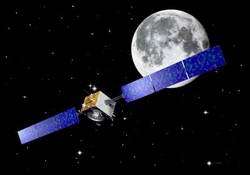
February 7, 2006 SMART-1

The European Moon probe SMART-1, which was developed by SSC for ESA, has been orbiting the Moon since November 2004. Its main mission, to qualify an electric propulsion system, is completed, and the probe is now making observations of the lunar surface using its onboard scientific instruments.

The first scientific results from SMART-1 will be published in connection with an ESA event in February.

The natural effects of gravity from the Sun and the Earth will cause SMART-1 to crash into the lunar surface in August this year. The touch-down will occur at a flat angle near latitude 37 degrees south. The crash, which will be observable by telescope from Earth, may stir up dust or create other effects, providing valuable information about the lunar surface.

Astronomers are invited to take part in observations of the crash

For the crash to be observable, the touch-down must take place on the part of the Moon that is facing Earth. To enable this, ESA is considering using the small remaining quantity of fuel onboard to modify the spacecraft's orbit. At present, SSC's engineers are preparing the necessary rocket impulses. ESA has also distributed a circular letter to scientists to gauge their interest in these observations.

China and India training with SMART-1

Apart from making observations of the lunar surface from a gradually lower orbit, SMART-1 will be used by Indian and Chinese ground stations for radio control training for their future moon orbiters.

Copyright 2006 by Space Daily, Distributed United Press International


print this article email this article download pdf blog this article bookmark this article     Stumble it Digg this share on Facebook retweet share on Reddit add to delicious
Rate this story - 4.2 /5 (6 votes)


February 7, 2006 all stories

Comments: 0

4.2 /5 (6 votes)
  • Stumble this up

  • Digg this

  • share this

  • hide
  • Related Stories

  • NASA and X Prize Announce Winners of Lunar Lander Challenge
    created Nov 03, 2009 | popularity not rated yet | comments 0
  • Icebreaker: Scientist brings out big gun to explore behavior of ice in planetary collisions
    created Oct 29, 2009 | popularity not rated yet | comments 0
  • Detecting Life-Friendly Moons
    created Oct 26, 2009 | popularity not rated yet | comments 0
  • LADEE Mission to Study the Moon's Fragile Atmosphere
    created Oct 26, 2009 | popularity not rated yet | comments 0
  • Panel says NASA should skip moon, fly elsewhere (Update)
    created Oct 23, 2009 | popularity not rated yet | comments 0


Other News

2 Earth-sized bodies with oxygen rich atmospheres found -- but they're stars not planets

Two Earth-sized bodies with oxygen rich atmospheres found -- but they're stars not planets

Space & Earth / Astronomy

created 1hour ago | popularity 5 / 5 (5) | comments 1

Astrophysicists at the University of Warwick and Kiel University have discovered two earth sized bodies with oxygen rich atmospheres - however there is a bit of a disappointing snag for anyone looking for ...


Greenland ice cap melting faster than ever

Greenland ice cap melting faster than ever

Space & Earth / Earth Sciences

created 1hour ago | popularity 4.2 / 5 (5) | comments 0

Satellite observations and a state-of-the art regional atmospheric model have independently confirmed that the Greenland ice sheet is loosing mass at an accelerating rate, reports a new study in Science.


A faraway planet intrigues: Exoplanet with extremely tilted orbit raises new interest in stellar astronomy

A faraway planet intrigues: Exoplanet with extremely tilted orbit raises new interest in stellar astronomy

Space & Earth / Astronomy

created 8 hours ago | popularity 4.9 / 5 (7) | comments 5

(PhysOrg.com) -- Two teams of astronomers have found a planet outside the solar system that might be orbiting backwards compared to its star's rotation, a discovery that could shed light on how unique the ...


A glimpse at the Earth's crust deep below the Atlantic

A glimpse at the Earth's crust deep below the Atlantic

Space & Earth / Earth Sciences

created 5 hours ago | popularity 5 / 5 (2) | comments 0

Long-term variations in volcanism help explain the birth, evolution and death of striking geological features called oceanic core complexes on the ocean floor, says geologist Dr Bram Murton of the National ...


Record high temperatures far outpace record lows across US

Record high temperatures far outpace record lows across US (w/ Video)

Space & Earth / Earth Sciences

created 2 hours ago | popularity 2.3 / 5 (6) | comments 1

Spurred by a warming climate, daily record high temperatures occurred twice as often as record lows over the last decade across the continental United States, new research shows. The ratio of record highs ...