How to Steal a Million Stars?
February 7, 2006
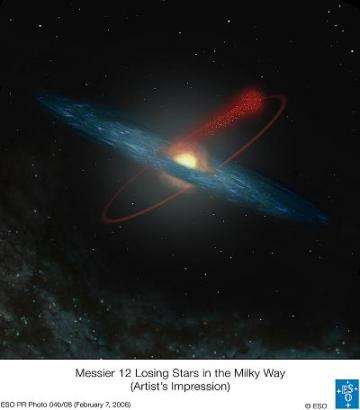
An artist's impression of the orbit of the globular cluster Messier 12 in the Milky Way. Due to gravitational disruption, this cluster continuously loses stars, in particular light ones. This process is enhanced when it passes through the central plane in which most of the Galaxy's stars and nebulae are located. The cluster emerges in a less dense state after such a passage. The stars that are lost move on in orbits similar to that of the cluster and populate the halo of the Milky Way. (ESO)
Based on observations with ESO's Very Large Telescope, a team of Italian astronomers reports that the stellar cluster Messier 12 must have lost to our Milky Way galaxy close to one million low-mass stars.
"In the solar neighbourhood and in most stellar clusters, the least massive stars are the most common, and by far", said Guido De Marchi (ESA), lead author of the study. "Our observations with ESO's VLT show this is not the case for Messier 12."
The team, which also includes Luigi Pulone and Francesco Paresce (INAF, Italy), measured the brightness and colours of more than 16,000 stars within the globular cluster Messier 12 with the FORS1 multi-mode instrument attached to one of the Unit Telescopes of ESO's VLT at Cerro Paranal (Chile). The astronomers could study stars that are 40 million times fainter than what the unaided eye can see (magnitude 25).
Messier 12 is one of about 200 globular clusters known in our Galaxy. These are large groupings of 10,000 to more than a million stars that were formed together in the youth of the Milky Way, about 12 to 13 billion years ago. Globular clusters are a key tool for astronomers, because all the stars in a globular cluster share a common history. They were all born together, at the same time and place, and only differ from one another in their mass. By accurately measuring the brightness of the stars, astronomers can determine their relative sizes and stage of evolution precisely. Globular clusters are thus very helpful for testing theories of how stars evolve.
Located at a distance of 23,000 light years in the constellation Ophiuchus (The Serpent-holder), Messier 12 got its name by being the 12th entry in the catalogue of nebulous objects compiled in 1774 by French astronomer and comet chaser Charles Messier. It is also known to astronomers as NGC 6218 and contains about 200,000 stars, most of them having a mass between 20 and 80 percent of the mass of the Sun.
"It is however clear that Messier 12 is surprisingly devoid of low-mass stars", said De Marchi. "For each solar-like star, we would expect roughly four times as many stars with half that mass. Our VLT observations only show an equal number of stars of different masses."
Globular clusters move in extended elliptical orbits that periodically take them through the densely populated regions of our Galaxy, the plane, then high above and below, in the 'halo'. When venturing too close to the innermost and denser regions of the Milky Way, the 'bulge', a globular cluster can be perturbed, the smallest stars being ripped away.
"We estimate that Messier 12 lost four times as many stars as it still has", said Francesco Paresce. "That is, roughly one million stars must have been ejected into the halo of our Milky Way."
The total remaining lifetime of Messier 12 is predicted to be about 4.5 billion years, i.e. about a third of its present age. This is very short compared to the typical expected globular cluster's lifetime, which is about 20 billion years.
The same team of astronomers had found in 1999, another example of a globular cluster that lost a large fraction of its original content.
The scientists hope to discover and study many more clusters like these, since catching clusters while being disrupted should clarify the dynamics of the process that shaped the halo of our home galaxy, the Milky Way.
Source: European Southern Observatory (ESO)
-
First images from the VLT Survey Telescope 268-megapixel camera
Jun 08, 2011 |
4.9 / 5 (14) |
3
-
A swarm of ancient stars
Dec 08, 2010 |
5 / 5 (3) |
0
-
Vampires and collisions rejuvenate stars
Dec 23, 2009 |
4.3 / 5 (9) |
2
-
Globular clusters tell tale of star formation in nearby galaxy metropolis
Aug 05, 2008 |
4.3 / 5 (13) |
5
-
Hubble photographs grand spiral galaxy Messier 81
May 29, 2007 |
4.1 / 5 (21) |
0
-
Engineers build first sub-10-nm carbon nanotube transistor
Feb 01, 2012 |
4.9 / 5 (31) |
30
-
Something old, something new: Evolution and the structural divergence of duplicate genes
Jan 31, 2012 |
4.6 / 5 (7) |
1
-
The hidden nanoworld of ice crystals: Revealing the dynamic behavior of quasi-liquid layers
Jan 30, 2012 |
5 / 5 (3) |
1
-
Stock market network reveals investor clustering
Jan 27, 2012 |
3.9 / 5 (23) |
8
-
Of microchemistry and molecules: Electronic microfluidic device synthesizes biocompatible probes
Jan 26, 2012 |
5 / 5 (1) |
0
More news stories
Europe stakes billion-dollar bet on new rocket
A pencil-slim rocket is scheduled to lift into space from South America on Monday, carrying a billion-dollar bet that Europe can grab a juicy slice of the market to place satellites in low orbit.
Space & Earth / Space Exploration
5 hours ago |
3.5 / 5 (2) |
0
NASA sees wide-eyed cyclone Jasmine
Cyclone Jasmine's eye has opened wider on NASA satellite imagery, as it moves through the Southern Pacific Ocean.
Space & Earth / Earth Sciences
21 hours ago |
3.5 / 5 (2) |
2
NASA sees Giovanna reach cyclone strength, threaten Madagascar
Tropical Storm 12S built up steam and became a cyclone on February 10, 2012 as NASA's Terra satellite passed overhead. Residents of east-central Madagascar should prepare for this cyclone to make landfall ...
Space & Earth / Earth Sciences
21 hours ago |
not rated yet |
0
Political leaders play key role in how worried Americans are by climate change: study
More than extreme weather events and the work of scientists, it is national political leaders who influence how much Americans worry about the threat of climate change, new research finds.
Feb 06, 2012 |
5 / 5 (6) |
68
Humans may have helped the decline of African rainforests 3000 years ago
(PhysOrg.com) -- Large areas of rainforests in Central Africa mysteriously disappeared over three thousand years ago, to be replaced by savannas. The prevailing theory has been that the cause was a change ...
Walney offshore wind farm is world's biggest (for now)
(PhysOrg.com) -- The Walney wind farm on the Irish Sea--characterized by high tides, waves and windy weather--officially opened this week. The farm is treated in the press as a very big deal as the Walney ...
GPS court ruling leaves US phone tracking unclear
A US Supreme Court decision requiring a warrant to place a GPS device on the car of a criminal suspect leaves unresolved the bigger issue of police tracking using mobile phones, legal experts say.
Europeans protest controversial Internet pact
Tens of thousands of people marched in protests in more than a dozen European cities Saturday against a controversial anti-online piracy pact that critics say could curtail Internet freedom.
Anonymous briefly knocks CIA website offline (Update 2)
The website of the Central Intelligence Agency was briefly inaccessible on Friday after the hacker group Anonymous claimed to have knocked it offline.
Study finds that anti-diabetic medication can prevent the long-term effects of maternal obesity
In a study to be presented today at the Society for Maternal-Fetal Medicine's annual meeting, The Pregnancy Meeting, in Dallas, Texas, researchers will report findings that show that short therapy with the anti-diabetic medication ...
Netflix settlement trims 14 pct off 4Q earnings
(AP) -- Netflix pressed the rewind button on its fourth-quarter earnings after settling allegations that the video subscription service violated a consumer-privacy law.