Indians predated Newton 'discovery' by 250 years
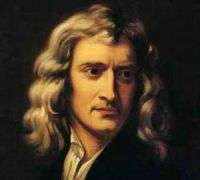
August 13, 2007 Newton

A little known school of scholars in southwest India discovered one of the founding principles of modern mathematics hundreds of years before Newton according to new research.

Dr George Gheverghese Joseph from The University of Manchester says the 'Kerala School' identified the 'infinite series'- one of the basic components of calculus - in about 1350.

The discovery is currently - and wrongly - attributed in books to Sir Isaac Newton and Gottfried Leibnitz at the end of the seventeenth centuries.

The team from the Universities of Manchester and Exeter reveal the Kerala School also discovered what amounted to the Pi series and used it to calculate Pi correct to 9, 10 and later 17 decimal places.

And there is strong circumstantial evidence that the Indians passed on their discoveries to mathematically knowledgeable Jesuit missionaries who visited India during the fifteenth century.

That knowledge, they argue, may have eventually been passed on to Newton himself.

Dr Joseph made the revelations while trawling through obscure Indian papers for a yet to be published third edition of his best selling book 'The Crest of the Peacock: the Non-European Roots of Mathematics' by Princeton University Press.

He said: "The beginnings of modern maths is usually seen as a European achievement but the discoveries in medieval India between the fourteenth and sixteenth centuries have been ignored or forgotten.

"The brilliance of Newton's work at the end of the seventeenth century stands undiminished - especially when it came to the algorithms of calculus.

"But other names from the Kerala School, notably Madhava and Nilakantha, should stand shoulder to shoulder with him as they discovered the other great component of calculus- infinite series.

"There were many reasons why the contribution of the Kerala school has not been acknowledged - a prime reason is neglect of scientific ideas emanating from the Non-European world - a legacy of European colonialism and beyond.

"But there is also little knowledge of the medieval form of the local language of Kerala, Malayalam, in which some of most seminal texts, such as the Yuktibhasa, from much of the documentation of this remarkable mathematics is written."

He added: "For some unfathomable reasons, the standard of evidence required to claim transmission of knowledge from East to West is greater than the standard of evidence required to knowledge from West to East.

"Certainly it's hard to imagine that the West would abandon a 500-year-old tradition of importing knowledge and books from India and the Islamic world.

"But we've found evidence which goes far beyond that: for example, there was plenty of opportunity to collect the information as European Jesuits were present in the area at that time.

"They were learned with a strong background in maths and were well versed in the local languages.

"And there was strong motivation: Pope Gregory XIII set up a committee to look into modernising the Julian calendar.

"On the committee was the German Jesuit astronomer/mathematician Clavius who repeatedly requested information on how people constructed calendars in other parts of the world. The Kerala School was undoubtedly a leading light in this area.

"Similarly there was a rising need for better navigational methods including keeping accurate time on voyages of exploration and large prizes were offered to mathematicians who specialised in astronomy.

"Again, there were many such requests for information across the world from leading Jesuit researchers in Europe. Kerala mathematicians were hugely skilled in this area."

Source: University of Manchester


print this article email this article download pdf blog this article bookmark this article     Stumble it Digg this share on Facebook retweet share on Reddit add to delicious
Rate this story - 4.4 /5 (232 votes)

Rank Filter

Move the slider to adjust rank threshold, so that you can hide some of the comments.


Display comments: newest first

  • g_3nair - Oct 18, 2007
    • Rank: 3 / 5 (1)
    In the Hindi Book " Pracheen Bharateeya Ganit",
    you can read such information. Paramewara of Vadassery, Kerala, stated the priciples of Gregory series, differencial calculus, etc.
    My article in the Malayalam journal Pragati(Kozhickode, September 1983) throws light on this and several other Indian firsts in Science and Mathematics. Also useful is the monograph
    Science in Sanskrit authored by Dr.V.K.Umadevi.

August 13, 2007 all stories

Comments: 1

4.4 /5 (232 votes)
  • Stumble this up

  • Digg this

  • share this

  • hide
  • Related Stories

  • India State to Dump Windows for Linux
    created Aug 31, 2006 | popularity not rated yet | comments 0
  • Mobile phone towers a threat to honey bees: study
    created Aug 31, 2009 | popularity not rated yet | comments 0
  • Wireless sensors learn from life
    created Aug 25, 2008 | popularity not rated yet | comments 0
  • More than 2,700 dengue cases in India
    created Oct 04, 2006 | popularity not rated yet | comments 0
  • More problems for Coke and Pepsi in India
    created Aug 09, 2006 | popularity not rated yet | comments 0


  • hide
  • Relevant PhysicsForums posts

  • Adding all the numbers between one and 100
    created 3 hours ago
  • Two points - four circles?
    created 9 hours ago
  • Wanting to Learn Lie Algebras
    created 22 hours ago
  • one wayness of boolean functions
    created Nov 06, 2009
  • More from Physics Forums - General Math

Other News

70 million-year-old dinosaur footprints have been found in various locations in New Zealand

Dinosaur prints found on NZealand's South Island

Other Sciences / Archaeology & Fossils

created 13 hours ago | popularity 5 / 5 (1) | comments 0

Scientists have discovered the first evidence that dinosaurs roamed the South Island of New Zealand with 70-million-year-old footprints found in six locations.


Growth in secular attitudes leaves Americans room for belief in God

Other Sciences / Social Sciences

created Oct 31, 2009 | popularity 4 / 5 (5) | comments 115

(PhysOrg.com) -- The nature of the American religious experience is changing as a rising number of people report having no formal religious affiliation, even though the number of Americans who say they pray is increasing, ...


Forest clearances sealed ancient civilisation's downfall

Forest clearances sealed ancient civilisation's downfall

Other Sciences / Archaeology & Fossils

created Nov 02, 2009 | popularity 4.9 / 5 (8) | comments 5

(PhysOrg.com) -- An ancient South American civilisation which disappeared around 1,500 years ago helped to cause its own demise by damaging the fragile ecosystem that held it in place, a study has found. ...


Oscar Pistorius

New study further disputes notion that amputee runners gain advantage from protheses

Other Sciences / Other

created Nov 04, 2009 | popularity 5 / 5 (4) | comments 5

A study by six researchers, including a University of Colorado at Boulder associate professor and his former doctoral student, shows that amputees who use running-specific prosthetic legs have no performance ...


Racial segregation key factor in subprime lending

Other Sciences / Economics

created Nov 06, 2009 | popularity 3 / 5 (2) | comments 2

(PhysOrg.com) -- New study examines impact of segregation on the prevalence of high-cost loans in U.S. metro areas. Subprime loans disproportionately located in segregated areas.