Star light, star bright: FSU facility duplicating conditions of supernovas
August 14th, 2007 Resolut Team

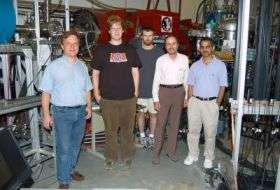
Standing in front of the RESOLUT facility are, from left, Ingo Wiedenhoever, an associate professor of physics and leader of the RESOLUT team at Florida State University; graduate research assistants Eric Diffenderfer and Patrick Peplowski; Professor Samuel L. Tabor, who directs the John D. Fox Superconducting Accelerator Laboratory at FSU; and assistant scholar/scientist Lagy Baby. Credit: Ken Ford/Florida State University department of physics

How is matter created? What happens when stars die? Is the universe shrinking, or is it expanding? For decades, scientists have been looking for answers to such "big picture" questions.

For the past few months, members of the department of physics at Florida State University have begun using a groundbreaking new research facility to conduct experiments that may help provide answers to just such questions.

RESOLUT -- short for "REsonator SOLenoid with Upscale Transmission" -- is the name of the facility, which is located within the John D. Fox Superconducting Accelerator Laboratory on the FSU campus. Over the past few months, FSU researchers have begun using RESOLUT to create very rare, extremely short-lived radioactive particles similar to those that form inside exploding stars -- and then using the analytical data produced in the experiments as the basis for hypotheses about the behavior of matter and the physical properties governing the universe.

"We're doing experiments that replicate, in a very controlled manner, the explosions that take place in stars," said Ingo Wiedenhover, an associate professor of physics at FSU who heads up the RESOLUT team. "This helps us understand the nuclear processes that occur in stars, the origin of elements, and how stars explode."

Getting to this point has been an arduous process that began in 2002.

"After five years of proposals, fundraising, designing, building and carefully testing RESOLUT, we are very excited that it has now come online for experiments," said Samuel L. Tabor, a professor of physics at FSU who directs the John D. Fox Superconducting Accelerator Laboratory. "To my knowledge, only one other university in the entire United States has a facility similar to RESOLUT, so our students have a pretty unique opportunity to receive hands-on experience that they can get almost nowhere else."

Weighing some 16 tons and taking up more than 450 square feet of space along a wall inside the accelerator lab, RESOLUT enables researchers to fire a beam of atomic particles through a steel tube at speeds approaching 60 million miles per hour -- roughly one-tenth the speed of light -- and then to observe the nuclear reactions that occur.

"When the beam strikes a target, the collision produces very exotic nuclei that contain properties similar to those occurring in stars and star explosions," Wiedenhover said. "But perhaps RESOLUT's greatest value as a scientific instrument is its function as a mass spectrometer -- a device that allows us to identify and study the short-lived particles created during these miniature explosions."

Wiedenhover currently is overseeing several experiments using RESOLUT that create, for a fraction of a second, a specific type of radioactive nuclei that are found only in a type of exploding star known as a Type Ia supernova.

"Type Ia supernovas result when a certain type of star known as a white dwarf reaches a critical mass and burns through its nuclear fuel so quickly that it suddenly explodes," Wiedenhover said. "What makes these explosions so useful for astrophysicists is that they always release the same amount of energy, so their peak brightness is virtually the same in all instances. This uniform level of brightness makes Type Ia supernovas useful as a 'standard candle' -- a gauge for measuring distances across the universe."

Such standard candles also have helped scientists to determine in recent years that the universe is expanding, not shrinking -- and that the expansion is taking place at an ever-increasing rate.

"Observations of Type Ia supernovas have greatly increased science's understanding of the workings of the universe," Tabor said. "Now, with RESOLUT, we hope to learn even more about these gigantic nuclear explosions -- all from the safety of a lab in a basement on the FSU campus."

Source: Florida State University


print this article email this article download pdf blog this article bookmark this article     Digg this Stumble it share on Facebook share on Reddit add to delicious save to Yahoo! bookmarks
4.2/5 after 9 votes


August 14th, 2007 all stories
Physics / General Physics

Comments: 0
Rank: 4.2/5 after 9 votes

  • Stumble this up

  • Digg this

  • Share it:
  • share on Facebook
  • share on MySpace
  • share on Slashdot
  • rss-newsfeed
  • share on Google
  • share on Reddit
  • add to delicious
  • save to Yahoo! bookmarks
  • share on Windows Live
  • Add to Mixx!
Rating: 4.2/5 after 9 votes

Tags


  • Physicists Demonstrate Quantum Memory with Matter Qubits
    Physicists Demonstrate Quantum Memory with Matter Qubits
    Physics / General Physics
    created Jul 03, 2009 | popularity 4.4 / 5 (17) | comments 1
  • 'Holey' Nanosheets for Wastewater Dye Removal
    Nanotechnology / Nanomaterials
    created Jul 01, 2009 | popularity 5 / 5 (5) | comments 1
  • Jellyfish Robot Swims Like its Biological Counterpart
    Jellyfish Robot Swims Like its Biological Counterpart
    Electronics / Robotics
    created Jun 26, 2009 | popularity 4.4 / 5 (8) | comments 1
  • Could Maxwell's Demon Exist in Nanoscale Systems?
    Could Maxwell's Demon Exist in Nanoscale Systems?
    Physics / General Physics
    created Jun 24, 2009 | popularity 4.4 / 5 (18) | comments 29
  • Living Safely with Robots, Beyond Asimov's Laws
    Living Safely with Robots, Beyond Asimov's Laws
    Electronics / Robotics
    created Jun 22, 2009 | popularity 4.6 / 5 (52) | comments 40
  • Other News

    Scientists create first electronic quantum processor

    Scientists create first electronic quantum processor

    Physics / General Physics

    created Jun 28, 2009 | popularity 4.8 / 5 (53) | comments 39

    A team led by Yale University researchers has created the first rudimentary solid-state quantum processor, taking another step toward the ultimate dream of building a quantum computer.


    Science journals

    How to Spot an Influential Paper Based on its Citations

    Physics / General Physics

    created Jul 04, 2009 | popularity 4 / 5 (9) | comments 5

    (PhysOrg.com) -- At first it may seem that the number of citations received by a published scientific paper is directly related to that paper's quality of content. The higher the quality, the more people read ...


    Fermilab's CDF observes Omega-sub-b baryon

    Fermilab's CDF observes Omega-sub-b baryon

    Physics / General Physics

    created Jun 29, 2009 | popularity 4.7 / 5 (16) | comments 7

    (PhysOrg.com) -- At a recent physics seminar at the Department of Energy’s Fermi National Accelerator Laboratory, Fermilab physicist Pat Lukens of the CDF experiment announced the observation of a new particle, ...


    New insights, and a new angle, on high-temperature superconductivity

    New insights, and a new angle, on high-temperature superconductivity

    Physics / Superconductivity

    created Jun 29, 2009 | popularity 4.8 / 5 (13) | comments 6

    (PhysOrg.com) -- A Princeton-led research team has revealed surprising information about how electron behavior influences the conduction of electricity in a class of high-temperature superconductors. An increased ...


    The art of invisibility and the perfect cat's eye

    The art of invisibility and the perfect cat's eye

    Physics / Optics & Photonics

    created Jun 30, 2009 | popularity 4 / 5 (8) | comments 6

    (PhysOrg.com) -- In recent years scientists have explored the impossible by developing invisibility or 'cloaking' devices, but can the same technology also help make things more visible?