Frigid Enceladus: An unlikely harbor for life
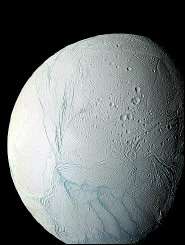
A new model of Saturn’s icy moon Enceladus may quell hopes of finding life there. Developed by researchers at the University of Illinois, the model explains the most salient observations on Enceladus without requiring the presence of liquid water.
Orbiting Saturn since June 30, 2004, the Cassini spacecraft has revealed a south polar region of Enceladus with an elaborate arrangement of fractures and ridges, intense heat radiation and geyser-like plumes consisting of ice crystals and gases such as methane, nitrogen and carbon dioxide. The plumes erupt from vents located in large fractures called “tiger stripes” that cut across the south pole.
The plumes monitored by Cassini had a rate of discharge similar to Old Faithful geyser in Yellowstone National Park. Dubbed “Cold Faithful,” the first model that was proposed to explain the plumes suggested the plumes tap into shallow pockets of liquid water in a water-ice shell.
Last year, U. of I. geology professor and planetary scientist Susan Kieffer and colleagues proposed an alternate model, which they called “Frigid Faithful.” In this model, the plumes originate in the dissociation of certain stiff compounds of ice, called clathrates, which may cover Enceladus to a depth of tens of kilometers. The researchers published their model in the Dec. 15, 2006, issue of the journal Science.
“Frigid Faithful gives a straightforward account of the measured composition, including the gases left unaccounted by Cold Faithful,” said Kieffer, who holds a Charles R. Walgreen Jr. Chair at Illinois and is also a professor in the University’s Center for Advanced Study, one of the highest forms of campus recognition.
“Perhaps more important, the plumes of Frigid Faithful could remain active far below the freezing point of water, under the frigid conditions that might be surmised inside a tiny, icy moon,” Kieffer said.
Now, Kieffer, mechanical science and engineering professor Gustavo Gioia, geology research associate Pinaki Chakraborty and geology professor and department head Stephen Marshak have expanded the model to account for both the tectonic features and the heat transport in the southern hemisphere. They describe the model in a paper accepted for publication in the Proceedings of the National Academy of Sciences and posted on the journal’s Web site.
By examining the deformation of a clathrate-rich shell containing a mildly warm heat source buried under the south pole, the researchers show it is possible for a frigid, stiff Enceladus without a shifting interior (such as plate tectonics on Earth) to develop fractures and ridges, and convey heat at the observed rate.
“As the heat source warmed at depth, it expanded and stretched the clathrate-rich shell above, giving rise to tensile stresses in the south polar cap,” said Gioia, lead author of the paper. “As a result, the shell cracked, forming the four 130 kilometer-long fractures known as tiger stripes.”
The researchers estimate the heat source could have been only 40 degrees warmer than the surrounding shell. “In this model, the tiger stripes are analogous to the cracks that form in the glazing of a porcelain vessel when the vessel is filled with hot tea,” Gioia said.
The researchers also show that, northwards of the south polar cap (in which the stresses were tensile), the stresses turned first from tensile to compressive – forming the ring of ridges that circles the tiger stripes – and then back to tensile – forming the set of “starfish” fractures that radiates northward from the ring of ridges. Thus the model explains the formation of the entire arrangement of fractures and ridges observed by Cassini on the southern hemisphere of Enceladus.
The Illinois researchers estimate the tiger stripes cut through the shell of Enceladus to a depth of about 35 kilometers. After the tiger stripes formed, the clathrates exposed on the cracked surfaces of the tiger stripes were decompressed. Upon decompression, the exposed clathrates absorbed heat from the source at depth and dissociated explosively, exposing more clathrates to decompression, in a process that continues today.
The gaseous products of clathrate dissociation rush up the tiger stripes, transporting heat to the surface where they may occasionally leak in the form of plumes. The transport of heat by fast-moving gases is called “heat advection.” The cracked shell of Frigid Faithful acts as a gigantic “advection machine,” which efficiently conveys heat from the source to the surface.
In contrast to “heat conduction”, where the transport of heat (in a bar of steel, for example) can only occur from points at higher temperature towards points at lower temperature, heat advection takes place at a nearly uniform temperature.
The implication is that Frigid Faithful’s shell remains close to the surface temperature to a depth of about 35 kilometers, Gioia said. According to the Cassini measurements, the surface temperature might be as many as 150 degrees below the freezing point of water.
“This is indeed a frigid Enceladus,” Gioia said. “It appears that high heat fluxes, geyser-like activity and complex tectonic features can occur even if moons do not have hot, liquid or shifting interiors.”
While the Enceladus envisioned by the Illinois researchers is unlikely to possess liquid water and therefore unlikely to harbor life, it is compatible with the available evidence and is the only model that has been shown to explain the origin of the arrangement of fractures and ridges documented by Cassini.
Source: University of Illinois at Urbana-Champaign


