Researchers seeking to understand consequences of unintended releases of H2
The Department of Energy’s domestic FreedomCAR and Fuels presidential initiative has now gone global, and researchers at Sandia National Laboratories are playing a key role in that worldwide effort.
Late last year Sandia joined a European consortium called “HYPER,” for HYdrogen PERmitting. The endeavor, part of the international goal of making hydrogen one of the dominant carriers of energy, is driven by wide optimism that the so-called “hydrogen economy” will eventually become a reality, and by a feeling that developing alternative sources of energy is no longer a choice but a necessity.
“We’re all working toward a similar goal — making hydrogen a dominant energy carrier sooner rather than later,” says Jay Keller, hydrogen program manager at Sandia. “We’re better off all playing together than alone, so this international research effort is essential.” Sandia’s primary contribution to HYPER, says Keller, is in the area of safety codes and standards, work it has been carrying out on DOE’s behalf.
HYPER has 15 partners from France, Germany, Greece, Italy, the Netherlands, the Russian Federation, the United Kingdom, and the United States. HYPER’s research focus is on small (10 kilowatts), stationary hydrogen fuel cells that could be used to provide auxiliary power in homes. Even though this differs from the FreedomCAR focus on transportation, there is enough overlap for a fruitful collaboration, says Keller.
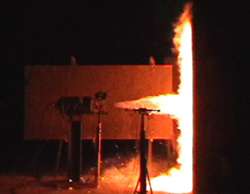
Sandia is addressing the science and technology that goes into understanding unintended releases of hydrogen. This work will ultimately aid in developing codes and standards that will suggest how to design and operate a hydrogen fueling station in the safest possible manner. This year DOE has asked Sandia to focus specifically on barriers and how they might impact safety. Several HYPER partners are collaborating with Sandia on this barrier work.
“Everyone needs to consider barriers as a mitigation strategy,” says Bill Houf, a principal investigator for Sandia’s work with HYPER. “The question we are trying to answer is ‘does a barrier mitigate the effects of an unintended release, or does it create conditions that exacerbate the release?’”
An unintended release of hydrogen at 2,500 psi (pounds per square inch) could result in a 12-foot-long jet flame. A barrier would block that flame but could cause unintended detrimental effects, such as a significant and possibly damaging overpressure.
The overpressure, explained Houf, could induce a more dangerous situation than a jet flame. If the overpressure gets high enough it could break glass, damage walls, or eardrums. Modeling is key to hydrogen research, so a lot of the experimental results will go toward validating models. Modeling is also used to refine tests to maximize use of money and resources.
“We can’t test everything. Most of our tests are done for supply pressures of 2,500 to 6,500 psi, but vehicles may be fueled at 10,000 psi,” says Houf.
Sandia is involved in two projects for HYPER, one on modeling and the other on barrier interaction experiments. At a HYPER meeting in Pisa, Italy, in May, Sandia’s work plan was touted as an example to be emulated by other members of the consortium.
Along with Sandia, the University of Ulster, University of Pisa, the UK’s Health and Safety Executive (HSE), Germany’s Forschungszentrum Karlsruhe (FZK), and Russia’s Kurchatov Institute are collaborating on the two projects. Each partner brings its own strengths to the project. For example, Keller points out that FZK’s modeling capability will be used to complement Sandia’s efforts in understanding the overpressure issue. HSE has larger test facilities that will allow consequence and behavior work on a massive scale — what Keller called the “big bang.” Kurchatov Institute has enclosed facilities capable of testing explosive mixtures, something that Sandia does not have access to in the U.S.
Some of the international partners have an advantage in terms of government support and funding. For example, Germany has enjoyed strong funding for fuel cell research for much longer than the U.S.
“Europe has been pretty aggressive at pushing hydrogen into their infrastructure,” says Keller. “This partnership helps us leverage international activities in science. The energy problem is too important to work in isolation.”
Source: SNL


