Double Trouble for the Big Island of Hawaii: Flossie and Quakes
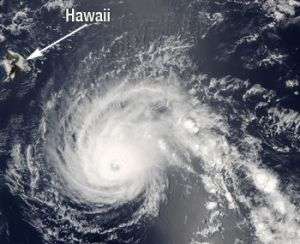
August 14, 2007 Double Trouble for the Big Island of Hawaii: Flossie and Quakes

Image credit: NASA/Jesse Allen/MODIS Rapid Response team

On Tuesday, August 14, 2007, the Big Island of Hawaii will feel Hurricane Flossie's effects after experiencing an earthquake the night before.

At 11:00 a.m. EDT, August 14, Hurricane Flossie was downgraded to a category two storm. It is on course to brush the Big Island of Hawaii today. Flossie has maximum sustained winds of 110 mph. At 5:00 a.m. EDT, Flossie was 260 miles south-southeast of Hilo, Hawaii moving west-northwest at 15 mph.

The Moderate Resolution Imaging Spectroradiometer (MODIS) on NASA's Aqua satellite captured this image of Hurricane Flossie on August 13 at 23:10 UTC (1:10 p.m. HST), as it swirled in the Pacific Ocean, approaching Hawaii.

According to local television station meteorologists at KHNL-TV, Channel 8, Hurricane Flossie's eye was starting to cloud over, indicating a sign of weakening. However, when a storm fills over, they stretch out over a larger area. Forecasters at KHNL-TV are calling for rainfall from 5 to 10 inches and very large surf up to 20 feet.

The earthquake which registered 5.3 on the Richter scale and hit at 7:38 p.m. HST on Monday the 13th, was centered 25 miles south of Hilo, Hawaii. That area is mainly rural with about 150,000 people, many of which live on the west or northeast side of the big island.

Source: NASA


print this article email this article download pdf blog this article bookmark this article     Stumble it Digg this share on Facebook retweet share on Reddit add to delicious
Rate this story - 3.4 /5 (11 votes)


August 14, 2007 all stories

Comments: 0

3.4 /5 (11 votes)
  • Stumble this up

  • Digg this

  • share this


  • hide
  • Relevant PhysicsForums posts

  • The IPCC and the term "most"
    created Nov 23, 2009
  • Is global warming a fact?
    created Nov 23, 2009
  • Random variability of wind patterns
    created Nov 23, 2009
  • Record precipitation in the UK
    created Nov 22, 2009
  • More from Physics Forums - Earth

Other News

Cassini Captures Ghostly Dance of Saturn's Northern Lights

Cassini Captures Ghostly Dance of Saturn's Northern Lights (w/ Video)

Space & Earth / Space Exploration

created 11 hours ago | popularity 5 / 5 (3) | comments 0

(PhysOrg.com) -- In the first video showing the auroras above the northern latitudes of Saturn, Cassini has spotted the tallest known "northern lights" in the solar system, flickering in shape and brightness ...


First black holes may have incubated in giant, starlike cocoons, says CU-Boulder study

First black holes may have incubated in giant, starlike cocoons

Space & Earth / Astronomy

created 13 hours ago | popularity 4.4 / 5 (10) | comments 9

(PhysOrg.com) -- The first large black holes in the universe likely formed and grew deep inside gigantic, starlike cocoons that smothered their powerful x-ray radiation and prevented surrounding gases from ...


ET: Check your voicemail

ET: Check your voicemail

Space & Earth / Space Exploration

created 10 hours ago | popularity 3.4 / 5 (5) | comments 5

(PhysOrg.com) -- Alien beings on faraway planets may not have noticed, but it’s been 35 years since human beings made the first deliberate effort to send them a message.


Infrared Image of Circumstellar Disk Illuminates Massive Star Formation Process

Infrared Image of Circumstellar Disk Illuminates Massive Star Formation Process

Space & Earth / Astronomy

created 9 hours ago | popularity 4.5 / 5 (2) | comments 0

(PhysOrg.com) -- A team of astronomers from Ibaraki University, Japan Aerospace Exploration Agency, Kanagawa University, University of Tokyo, Academica Sinica, and National Astronomical Observatory of Japan ...


Humanity would need five Earths to create the resources needed if everyone lived as like Americans, a report has stated

Mankind using Earth's resources at alarming rate

Space & Earth / Environment

created 19 hours ago | popularity 3.2 / 5 (13) | comments 19

Humanity would need five Earths to produce the resources needed if everyone lived as profligately as Americans, according to a report issued Tuesday.