Hubble Snaps Images of a Pinwheel-Shaped Galaxy
February 7, 2006 Hubble Snaps Images of a Pinwheel-Shaped Galaxy

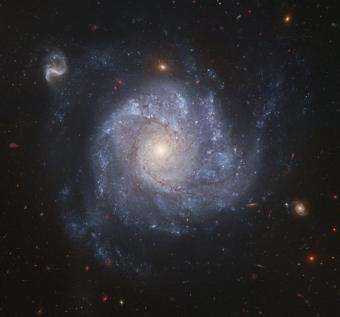
Stunning details of the face-on spiral galaxy, catalogued as NGC 1309, are captured in this NASA Hubble Space Telescope color image. NGC 1309 was home to supernova SN 2002fk, whose light reached Earth in September 2002. NGC 1309 resides 100 million light-years (30 Megaparsecs) from Earth. It is one of about 200 galaxies that make up the Eridanus group of galaxies. The Hubble Advanced Camera for Surveys images were taken in August and September 2005. (NASA, ESA, The Hubble Heritage Team (STScI/AURA) and A. Riess (STScI))

Looking like a child's pinwheel ready to be set a spinning by a gentle breeze, this dramatic spiral galaxy is one of the latest viewed by NASA's Hubble Space Telescope. Stunning details of the face-on spiral galaxy, cataloged as NGC 1309, are captured in this color image.

Recent observations of the galaxy taken in visible and infrared light come together in a colorful depiction of many of the galaxy's features. Bright blue areas of star formation pepper the spiral arms, while ruddy dust lanes follow the spiral structure into a yellowish central nucleus of older-population stars. The image is complemented by myriad far-off background galaxies.

However, this galaxy image is more than just a pretty picture. It is helping astronomers to more accurately measure the expansion rate of the universe. NGC 1309 was home to supernova SN 2002fk, whose light reached Earth in September 2002. This supernova event, known as a Type Ia, resulted from a white dwarf star accreting matter from its companion in a binary star system. When the white dwarf collected enough mass and was no longer able to support itself, the star detonated, becoming the brightest object in the galaxy for several weeks.

Nearby type Ia supernovae like SN 2002fk in NGC 1309 are used by astronomers to calibrate distance measures in the universe. By comparing nearby type Ia supernovae to more distant ones, they can determine not only that the universe
is expanding, but that this expansion is accelerating. However, this method only works if the distance to the host galaxies is known extremely well.

That's where the Hubble Telescope comes into play. Since NGC 1309 is relatively close to us, the high resolution of Hubble's Advanced Camera for Surveys can help accurately determine the distance to the galaxy by looking at the light output of a particular type of variable star called a Cepheid variable. Cepheids are well studied in our own galaxy, and vary regularly in brightness at a rate that is directly related to their total intrinsic brightness. By comparing their variation rate with how bright they appear, astronomers can deduce their distance. In this way, the Cepheids in NGC 1309 allow astronomers to accurately measure the distance to NGC 1309, and thus to SN 2002fk. The expansion of the universe was discovered by Edwin Hubble, the Hubble Space Telescope's namesake, nearly a century ago, but the accelerating expansion is a recent discovery which has interesting consequences for cosmological models.

These Hubble images were taken in August and September 2005. NGC 1309 resides 100 million light-years (30 Megaparsecs) from Earth. It is one of about 200 galaxies that make up the Eridanus group of galaxies.

Source: Space Telescope Science Institute


print this article email this article download pdf blog this article bookmark this article     Stumble it Digg this share on Facebook retweet share on Reddit add to delicious
Rate this story - 4.8 /5 (31 votes)


February 7, 2006 all stories

Comments: 0

4.8 /5 (31 votes)
  • Stumble this up

  • Digg this

  • share this

  • hide
  • Related Stories


Other News

The drying shores of the Dead Sea

Dead Sea needs world help to stay alive

Space & Earth / Environment

created 15 minutes ago | popularity not rated yet | comments 0

The Dead Sea may soon shrink to a lifeless pond as Middle East political strife blocks vital measures needed to halt the decay of the world's lowest and saltiest body of water, experts say.


Shuttle, station crews seal hatches for departure (AP)

Shuttle, station crews seal hatches for departure

Space & Earth / Space Exploration

created 3 minutes ago | popularity not rated yet | comments 0

(AP) -- After nearly a week together, the crews of shuttle Atlantis and the International Space Station said goodbye Tuesday and closed the hatches between them.


LSU gets to the bottom of things -- in Antarctica

Space & Earth / Earth Sciences

created 23 minutes ago | popularity not rated yet | comments 0

Antarctica has long held secrets of the earth's history locked in its icy depths, and until recently, there has been very little information on the environments that have been sealed beneath miles of ice for millions of years. ...


First black holes may have incubated in giant, starlike cocoons, says CU-Boulder study

First black holes may have incubated in giant, starlike cocoons

Space & Earth / Astronomy

created 1hour ago | popularity 5 / 5 (1) | comments 6

(PhysOrg.com) -- The first large black holes in the universe likely formed and grew deep inside gigantic, starlike cocoons that smothered their powerful x-ray radiation and prevented surrounding gases from ...


Researchers Establish Common Seasonal Patterns Among Bacterial Communities in Arctic Rivers

Researchers Establish Common Seasonal Patterns Among Bacterial Communities in Arctic Rivers

Space & Earth / Earth Sciences

created 3 hours ago | popularity not rated yet | comments 0

(PhysOrg.com) -- New research on bacterial communities throughout six large Arctic river ecosystems reveals predictable temporal patterns, suggesting that scientists could use these communities as markers ...