First all-African GM crop is resistant to maize streak virus
August 15, 2007 First all-African GM crop is resistant to maize streak virus

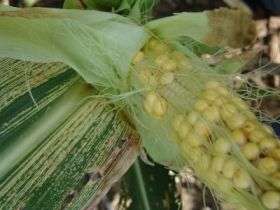
Maize streak virus symptoms in a commercial maize field in Klerksdorp, NorthWest South Africa, showing chlorotic streaking and deformed cob development. This farm grew USA commercial hybrids and experienced almost total yield losses. Credit: Photograph taken in April 2005 by Dr F. Kloppers

The first all-African genetically modified crop plant with resistance to the severe maize streak virus (MSV), which seriously reduces the continent’s maize yield, has been developed by scientists from the University of Cape Town and PANNAR PTY Ltd, a South African seed company.

The research, published in Plant Biotechnology Journal represents a significant advance in African agricultural biotechnology, and will play an important role in alleviating Africa’s food shortages and famine.

Dr Dionne Shepherd, lead researcher explains, “MSV is transmitted to maize by small insects called leafhoppers. The disease is therefore a result of a complex interplay between the plant, the virus and insect. Factors that can influence the severity of the disease include the age at which the plant is infected (the younger the plant, the more severe the infection), the maize variety (some are more susceptible than others), and environmental conditions.

“We have created an MSV-resistant maize variety by genetic engineering, using an approach known as pathogen-derived resistance. This means that a gene from the viral pathogen is used to protect the plant from that pathogen. We mutated a viral gene that under normal circumstances produces a protein that is essential for the virus to replicate itself and inserted it into the maize plant’s genome, creating genetically modified maize. When the virus infects one of these transgenic maize plants, it displays a significant delay in symptom development, a decrease in symptom severity and higher survival rates than non-transgenic plants.”

The next stage of the research involves field trials to ensure that the transformed crop is digestible, that the protein is not an allergen and that it will be ecologically friendly to other organisms within the environment. Following the results of these trials, the crop will be monitored over a number of growing seasons before it is made accessible to local farmers.

Source: Blackwell Publishing


print this article email this article download pdf blog this article bookmark this article     Stumble it Digg this share on Facebook retweet share on Reddit add to delicious
Rate this story - 3.5 /5 (2 votes)


August 15, 2007 all stories

Comments: 0

3.5 /5 (2 votes)
  • Stumble this up

  • Digg this

  • share this

  • hide
  • Related Stories

  • Scientists fight stem rust UG99 before it becomes a threat
    created Nov 18, 2008 | popularity not rated yet | comments 0
  • Tracking a crop disease could save millions of lives
    created Aug 20, 2008 | popularity not rated yet | comments 0
  • Building disease-beating wheat
    created Dec 12, 2007 | popularity not rated yet | comments 0
  • First all-African produced genetically engineered maize is resistant to maize streak virus
    created Jul 08, 2007 | popularity not rated yet | comments 0
  • Flowering Signal Found
    created Jun 09, 2007 | popularity not rated yet | comments 0


Other News

First-ever blueprint of a minimal cell is more complex than expected

First-ever blueprint of a minimal cell is more complex than expected

Biology / Cell & Microbiology

created 1hour ago | popularity 5 / 5 (2) | comments 0

What are the bare essentials of life, the indispensable ingredients required to produce a cell that can survive on its own? Can we describe the molecular anatomy of a cell, and understand how an entire organism ...


Ecological speciation by sexual selection on good genes: Is speciation adaptive?

Biology / Ecology

created 1hour ago | popularity not rated yet | comments 0

Darwin suggested that the action of natural selection can produce new species, but 150 years after the publication of his famous book, 'On the Origin of Species', debate still continues on the mechanisms of speciation. New ...


The six elephants in Sierra Leone were shot and "crudely butchered"

S.Leone elephants 'wiped out' by poachers: official

Biology / Ecology

created 3 hours ago | popularity 5 / 5 (2) | comments 1

Poachers "wiped out" the entire elephant herd in Sierra Leone's only wildlife park, wildlife managers said Thursday after police said they had arrested a gang of 10 poachers.


Knockouts in human cells point to pathogenic targets

Knockouts in human cells point to pathogenic targets

Biology / Cell & Microbiology

created 4 hours ago | popularity not rated yet | comments 0

(PhysOrg.com) -- Whitehead researchers have developed a new approach for genetics in human cells and used this technique to identify specific genes and proteins required for pathogens.


Whiteflies sabotage alarm system of plant in distress

Whiteflies sabotage alarm system of plant in distress

Biology / Plants & Animals

created 5 hours ago | popularity 5 / 5 (1) | comments 0

(PhysOrg.com) -- When spider mites attack a bean plant, the plant responds by producing odours which attract predatory mites. These predatory mites then exterminate the spider mite population, thus acting ...