August 15, 2007 feature
Ultrafast quantum computer uses optically controlled electrons
Scientists have designed a scheme to create one of the fastest quantum computers to date using light pulses to rotate electron spins, which serve as quantum bits. This technique improves the overall clock rate of the quantum computer, which could lead to the fastest potentially scalable quantum computing scheme of which the scientists are aware.
Susan Clark and Kai-Mei Fu, both of Stanford University, and Thaddeus Ladd and Yoshihisa Yamamoto, both with Stanford University as well as the National Institute of Informatics in Tokyo, have published their results on the new scheme in a recent issue of Physical Review Letters.
“We still don't know what a final quantum computer will look like,” Ladd explained to PhysOrg.com. “Large scale quantum computation is a technology that is still very far away from being implemented, and will probably incorporate many new ideas that have not been imagined yet. The important development in this paper is finding a physical implementation of an existing theoretical idea [using phase gates to couple non-local spins] and estimating the speed.”
On a single semiconductor chip, the researchers combine fast single-bit rotations and fast two-qubit gates, both of which are optically controlled. In quantum computing, the orientation and phase of the electron spin serve as the bit state, and the gates are responsible for performing reversible operations on input data to produce output data.
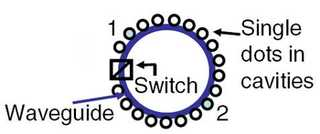
The semiconductor chip is a square millimeter in size, and consists of a loop of cavities—together, this apparatus is called a “loop-qubus.” Each cavity holds a quantum dot, which is a small piece of semiconductor that contains, in this scheme, a single electron. By focusing optical pulses at individual quantum dots, the electron spins rotate, changing the state of the bit.
The architecture is built on the idea of using phase gates to couple non-local spins. The optical pulses can provide a means to couple distant electron spins, or qubits, so that the phase of one qubit can depend on the phase of another qubit. When coupled, the qubits’ spin states form a “qu-bus,” which is the basis of a two-qubit gate.
The operating speed of a quantum computer is measured by its clock signal, which could take many different forms. In the optical control scheme, the pulses, which could be supplied by a laser, provide a clock rate for the system. Ladd explained that there are several limitations on speed for quantum computers.
“In quantum computing, not only is the state of the bit (0 or 1) important, but also the phase of the bit,” he said. “How quickly we can control the phase of the qubit, in our scheme, depends on the magnetic field. Increasing the magnetic field increases how fast the phase for any single qubit changes in time and ultimately sets the limit of how fast we can control our qubits. In the article, we give the limit of about 100 GHz, which is assuming a very high magnetic field, which would require superconducting magnets to achieve.
“The second limitation on speed is the time it takes for the phase of one qubit to change the phase of another,” he continued. “This must be done with pulses that are slower than the rate light moves in and out of each optical cavity, so this brings the speed down to more like 10 GHz. Finally, as the computer gets bigger, the amount of time it takes for light to propagate around the system will also limit speed, perhaps bringing the speed of physical qubits down to GHz compared to classical computers.”
However, Ladd added that the proposed architecture, with its speedy physical operations, non-local couplings, potential for monolithic semiconductor implementation, and non-reliance on single photon sources or detectors, is still much faster than other schemes for quantum computing, such as ion traps.
“As opposed to classical computers, quantum computers critically depend on error correcting schemes,” Clark said, explaining the complexity of calculating a quantum computer’s speed. “Techniques for correcting errors can get complicated; however, in general, they require many physical qubits and qubit operations to represent one fault-tolerant logical operation (and therefore more time). The speed of the physical qubit manipulation makes the computer appear faster than it is. Proper error correction may reduce the speed of the quantum computer to 1-10 MHz.”
Besides speed, the proposed scheme also has benefits in terms of scalability and manufacturing potential. Because the system can create two-qubit gates between distant qubits, the scheme favors scalability compared with systems that rely on adjacent qubit interactions. Also, the system doesn’t require the two qubits to have the same frequency, which matches other proposals in its potential for large-scale fabrication.
“In terms of building this computer, we are working on that one step at a time,” Clark said. “We are starting by putting the quantum dot qubits in cavities, performing rotations on those qubits, and then coupling them via qubus. But a complete, scalable device remains many years away.”
Citation: Clark, Susan M., Fu, Kai-Mei C., Ladd, Thaddeus D., and Yamamoto, Yoshihisa. “Quantum Computers Based on Electron Spins Controlled by Ultrafast Off-Resonant Single Optical Pulses.” Physical Review Letters, 99, 04051 (2007).
Copyright 2007 PhysOrg.com.
All rights reserved. This material may not be published, broadcast, rewritten or redistributed in whole or part without the express written permission of PhysOrg.com.


