Ancient drawing of mammoth found in Cheddar caves
August 15th, 2007 Ancient drawing of mammoth found in Cheddar caves

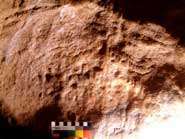
The 13,000-year-old carving found in Cheddar Caves

A possible Palaeolithic engraving has been discovered at Cheddar Caves and Gorge by members of the University of Bristol Spelaeological Society (UBSS).

This new find follows the discovery of presumed Mesolithic engravings at Aveline's Hole in Burrington Combe, Somerset and in Long Hole Cheddar Gorge by UBSS in 2005.

The team, led by Graham Mullan and Linda Wilson, has carried out investigations in a number of the Cheddar Gorge caves. The latest find is of a possibly late Upper Palaeolithic engraving in a small alcove in the main showcave, Gough’s Cave.

The engraving, which is difficult to see owing to some degradation of the rock surface since the last Ice Age, appears to be an outline drawing of a mammoth made by the addition of what is believed to be humanly engraved lines to some natural features of the rock, a technique which is well-known from the famous French and Spanish decorated caves.

Graham Mullan said: "Unlike our previous finds of abstract designs in the caves in this area, this is a clear representation of an animal. We are more confident that at least part of it was humanly made and the subject material places it firmly in the latter part of the last Ice Age. Finds of mammoth ivory of that age have been made in this cave in the past indicating that these animals would have been known to the inhabitants.

"Although the cave has been studied by many archaeologists, this engraving has previously escaped notice because it is quite difficult to make out. For this reason, a careful study has been made and this announcement was delayed until we were reasonably confident of the attribution."

Bob Smart of Cheddar Caves and Gorge said: "We welcome yet another indication of how important the Cheddar Caves were to our ancestors 13,000 years ago, and hope this will broaden the general understanding of early British life. We were intrigued when Graham and Linda first suggested this project, and are delighted that they have brought it to a successful conclusion both in Gough’s Cave and in Long Hole. We congratulate them on the persistence and perceptivity with which they have brought to light evidence which had been overlooked for a century."

The Spelaeological Society’s research into the engravings is being carried out in conjunction with the British Museum's Department of Prehistory and Europe.

Jill Cook, Deputy Keeper in the Department said: "Had I been shown this outline of a mammoth during a visit to one of the well known cave art sites in France or Spain, I would have nodded and been able to accept it in the context of other more obvious pictures. At Gough’s, or anywhere in England, it is not so easy. Cave art is so rare here that we must always question and test to make sure we are getting it right. Opinions on this may differ but we do seem to be looking at an area of ancient rock surface and the lines which appear to form the head and back of the mammoth could have been made by a stone tool. They are certainly different from natural markings on the cave wall.

“This little cartoon might well represent a moment of quiet reflection by someone using the cave 13,000 years ago. It is yet another aspect of the site which suggests that the cave may have been special to the people who used it at the end of the Last Ice Age."

Source: University of Bristol


print this article email this article download pdf blog this article bookmark this article     Digg this Stumble it share on Facebook share on Reddit add to delicious save to Yahoo! bookmarks
4.1/5 after 12 votes


August 15th, 2007 all stories
Other Sciences / Archaeology & Fossils

Comments: 0
Rank: 4.1/5 after 12 votes

  • Stumble this up

  • Digg this

  • Share it:
  • share on Facebook
  • share on MySpace
  • share on Slashdot
  • rss-newsfeed
  • share on Google
  • share on Reddit
  • add to delicious
  • save to Yahoo! bookmarks
  • share on Windows Live
  • Add to Mixx!
Rating: 4.1/5 after 12 votes

  • Related Stories

  • Prehistoric flute in Germany is oldest known
    created Jun 24, 2009 | popularity not rated yet | comments 0
  • Ivory sculpture in Germany could be world's oldest
    created May 13, 2009 | popularity not rated yet | comments 0
  • Scientists reveal family tree of 'super-sized lions'
    created Mar 31, 2009 | popularity not rated yet | comments 0
  • Climate change wiped out cave bears 13 millennia earlier than thought
    created Nov 26, 2008 | popularity not rated yet | comments 0
  • Exploding asteroid theory strengthened by new evidence located in Ohio, Indiana
    created Jul 02, 2008 | popularity not rated yet | comments 0

Tags


  • Physicists Demonstrate Quantum Memory with Matter Qubits
    Physicists Demonstrate Quantum Memory with Matter Qubits
    Physics / General Physics
    created Jul 03, 2009 | popularity 4.4 / 5 (17) | comments 1
  • 'Holey' Nanosheets for Wastewater Dye Removal
    Nanotechnology / Nanomaterials
    created Jul 01, 2009 | popularity 5 / 5 (5) | comments 1
  • Jellyfish Robot Swims Like its Biological Counterpart
    Jellyfish Robot Swims Like its Biological Counterpart
    Electronics / Robotics
    created Jun 26, 2009 | popularity 4.4 / 5 (8) | comments 1
  • Could Maxwell's Demon Exist in Nanoscale Systems?
    Could Maxwell's Demon Exist in Nanoscale Systems?
    Physics / General Physics
    created Jun 24, 2009 | popularity 4.4 / 5 (18) | comments 29
  • Living Safely with Robots, Beyond Asimov's Laws
    Living Safely with Robots, Beyond Asimov's Laws
    Electronics / Robotics
    created Jun 22, 2009 | popularity 4.6 / 5 (52) | comments 40
  • Other News

    Creation Museum president Ken A. Ham

    Paleontologists brought to tears, laughter by Creation Museum

    Other Sciences / Other

    created Jun 30, 2009 | popularity 4.3 / 5 (44) | comments 124

    For a group of paleontologists, a tour of the Creation Museum seemed like a great tongue-in-cheek way to cap off a serious conference.


    Mummified dinosaur skin yields up new secrets

    Mummified dinosaur skin yields up new secrets

    Other Sciences / Archaeology & Fossils

    created Jul 01, 2009 | popularity 4.7 / 5 (15) | comments 10

    (PhysOrg.com) -- Scientists from The University of Manchester have identified preserved organic molecules in the skin of a dinosaur that died around 66-million years ago.


    Liberal? Conservative? Stanford study says mental nudge can make voters flip-flop

    Liberal? Conservative? Stanford study says mental nudge can make voters flip-flop

    Other Sciences / Social Sciences

    created Jul 02, 2009 | popularity 3.8 / 5 (6) | comments 4

    (PhysOrg.com) -- No doubt you’ve worked hard for your success. But chances are you’ve also had some help and lucky breaks along the way.


    Probing Question: How do Ponzi Schemes work?

    Other Sciences / Economics

    created Jul 02, 2009 | popularity 5 / 5 (2) | comments 2

    Imagine the shock, the horror, and the sheer panic that would come with learning that the financial plan you’d sunk your life savings into was a sham, the financial experts you trusted were crooks, and all your money was ...


    Tourists enjoy a "Pineapple Tour" in Costa Rica

    Costa Rica tops happiness, 'green living' poll

    Other Sciences / Social Sciences

    created Jul 04, 2009 | popularity 3.5 / 5 (4) | comments 0

    Costa Rica is the happiest place on earth, and one of the most environmentally friendly, according to a new survey by a British non-governmental group.