Speeding Bullet Star Leaves Enormous Streak Across Sky
August 15, 2007 Johnny Appleseed of the Cosmos

Enlarge

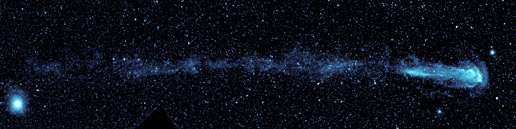
A new ultraviolet mosaic from NASA's Galaxy Evolution Explorer shows a speeding star that is leaving an enormous trail of "seeds" for new solar systems. The star, named Mira (pronounced my-rah) after the latin word for "wonderful," is shedding material that will be recycled into new stars, planets and possibly even life as it hurls through our galaxy. Mira appears as a small white dot in the bulb-shaped structure at right, and is moving from left to right in this view. The shed material can be seen in light blue. The dots in the picture are stars and distant galaxies. The large blue dot at left is a star that is closer to us than Mira. Image credit: NASA/JPL-Caltech

NASA's Galaxy Evolution Explorer has spotted a surprisingly long comet-like tail behind a star streaking through space at supersonic speeds. The star, named Mira after the Latin word for "wonderful," has been a favorite of astronomers for approximately 400 years. It is a fast-moving, older red giant that is shedding massive amounts of surface material.

The space-based Galaxy Evolution Explorer scanned the popular star during its ongoing survey of the entire sky in ultraviolet light. Astronomers then noticed what looked like a comet with a gargantuan tail. Material blowing off Mira is forming a wake 13 light-years long, or about 20,000 times the average distance of Pluto from the sun. Nothing like this has been seen before around a star.

"I was shocked when I first saw this completely unexpected, humongous tail trailing behind a well-known star," said Christopher Martin of the California Institute of Technology in Pasadena, Calif. "It was amazing how Mira's tail echoed on vast, interstellar scales the familiar phenomena of a jet's contrail or a speedboat's turbulent wake." Martin is the principal investigator for the Galaxy Evolution Explorer and lead author of a paper appearing about the discovery in the Aug. 15 edition of Nature.

Astronomers say Mira's tail offers a unique opportunity to study how stars like our sun die and ultimately seed new solar systems. As Mira hurtles along, its tail sheds carbon, oxygen and other important elements needed to form new stars, planets and possibly even life. This tail material, visible for the first time, has been released during the past 30,000 years.

"This is an utterly new phenomenon to us, and we are still in the process of understanding the physics involved," said co-author Mark Seibert of the Observatories of the Carnegie Institution of Washington in Pasadena. "We hope to be able to read Mira's tail like a ticker tape to learn about the star's life."

Billions of years ago, Mira was similar to our sun. Over time, it began to swell into what is called a variable red giant - a pulsating, puffed-up star that periodically grows bright enough to see with the naked eye. Mira eventually will eject all its remaining gas into space, forming a colorful shell called a planetary nebula. The nebula will fade with time, leaving only the burnt-out core of the original star, which will then be called a white dwarf.

Compared to other red giants, Mira is traveling unusually fast, possibly due to gravitational boosts from other passing stars. It now plows along at 291,000 miles per hour. Racing along with Mira is a small, distant companion thought to be a white dwarf. The pair, also known as Mira A (the red giant) and Mira B, orbit slowly around each other as they travel together in the constellation Cetus, 350 light-years from Earth.

In addition to Mira's tail, the Galaxy Evolution Explorer also discovered a bow shock, a type of buildup of hot gas, in front of the star, and two sinuous streams of material emanating from the star's front and back. Astronomers think hot gas in the bow shock is heating the gas blowing off the star, causing it to fluoresce with ultraviolet light. This glowing material then swirls around behind the star, creating a turbulent, tail-like wake. The process is similar to a speeding boat leaving a choppy wake or a steam train producing a trail of smoke.

Mira's tail only glows with ultraviolet light, which might explain why other telescopes have missed it. The Galaxy Evolution Explorer is very sensitive to ultraviolet light and also has an extremely wide field of view, allowing it to scan the sky for unusual ultraviolet activity.

"It is amazing to discover such a startlingly large and important feature of an object that has been known and studied for more than 400 years," said James D. Neill of the California Institute of Technology.

Source: NASA


print this article email this article download pdf blog this article bookmark this article     Stumble it Digg this share on Facebook retweet share on Reddit add to delicious
Rate this story - 4.8 /5 (48 votes)


August 15, 2007 all stories

Comments: 0

4.8 /5 (48 votes)
  • Stumble this up

  • Digg this

  • share this

  • hide
  • Related Stories

  • Galaxy Evolution Explorer Mission Celebrates Sixth Anniversary
    created Apr 28, 2009 | popularity not rated yet | comments 0
  • Sky merger yields sparkling dividends
    created Oct 13, 2009 | popularity not rated yet | comments 0
  • Tweeting Shooting Stars
    created Aug 10, 2009 | popularity not rated yet | comments 0
  • First tri-continuous mesoporous Silica complex structure developed in Singapore
    created Apr 05, 2009 | popularity not rated yet | comments 0
  • A Black Hole in Medusa's Hair
    created Mar 11, 2009 | popularity not rated yet | comments 0


  • hide
  • Relevant PhysicsForums posts

  • The shape of our solar system's orbits.
    created Nov 07, 2009
  • Above or Below the Line of Nodes
    created Nov 07, 2009
  • Supernova vs. Nova?
    created Nov 07, 2009
  • Supernova's Gamma Rays and Comets
    created Nov 06, 2009
  • More from Physics Forums - General Astronomy

Other News

Scientists seek safe carbon dioxide storage for 'greener' power generation (w/ Video)

Space & Earth / Environment

created 8 minutes ago | popularity not rated yet | comments 0

The U.S. Department of Energy (DOE) has announced plans to fund research at the University of Alabama at Birmingham (UAB) School of Engineering on technologies that would help reduce greenhouse gas emissions through the capture ...


Antarctica glacier retreat creates new carbon dioxide store

Antarctica glacier retreat creates new carbon dioxide store

Space & Earth / Earth Sciences

created 3 hours ago | popularity 5 / 5 (1) | comments 1

Large blooms of tiny marine plants called phytoplankton are flourishing in areas of open water left exposed by the recent and rapid melting of ice shelves and glaciers around the Antarctic Peninsula. This ...


Success in 'space elevator' competition (AP)

Success in 'space elevator' competition (Update 3)

Space & Earth / Space Exploration

created Nov 05, 2009 | popularity 4.3 / 5 (33) | comments 53

(AP) -- A robot powered by a ground-based laser beam climbed a long cable dangling from a helicopter on Wednesday to qualify for prize money in a $2 million competition to test the potential reality of the ...


In a Galaxy Far, Far Away...

In a Galaxy Far, Far Away...

Space & Earth / Astronomy

created Nov 06, 2009 | popularity 4.8 / 5 (5) | comments 15

(PhysOrg.com) -- Astronomers have published the discovery of the farthest known object in the cosmos: a star that exploded when the universe was only 630 million years old -- only 4.6% of its current age. ...


'Dropouts' pinpoint earliest galaxies

'Dropouts' pinpoint earliest galaxies

Space & Earth / Astronomy

created Nov 06, 2009 | popularity 4.2 / 5 (10) | comments 13

Astronomers, conducting the broadest survey to date of galaxies from about 800 million years after the Big Bang, have found 22 early galaxies and confirmed the age of one by its characteristic hydrogen signature ...