Brains learn better at night
August 15, 2007 Brains learn better at night

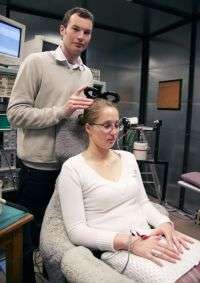
Martin Sale demonstrates the technique to stimulate nerve activity in the brain. Credit: University of Adelaide

If you think that the idea of a morning person or an evening person is nonsense, then postgraduate student Martin Sale and his colleagues from the University of Adelaide have news for you.

They have found that the time of day influences your brain's ability to learn - and the human brain learns more effectively in the evening.

And by identifying at what point in the day the brain is best able to operate, rehabilitation therapy can be targeted to that time, when recovery is maximised.

"Our research has several future applications," Mr Sale says. "If the brains of stroke patients can be artificially stimulated to improve learning, they may be able to recover better and faster."

The researchers used a magnetic coil over the head to stimulate nerve activity in the brain, and linked it to an electrical stimulus of the hand.

Mr Sale, from the School of Molecular and Biomedical Science at the University of Adelaide, discovered that the brain's capacity to control hand movements is influenced by the time of day.

His study found that larger changes are induced when the experiments are performed in the evening, as compared with mornings.

"Such time-of-day variations in function are not unusual. Organisms are adapted to the continual change in light and dark during a 24 hour period to avoid predators and to reproduce faster," he says.

"For example, the petals of many flowers only open during the day, while some organisms only reproduce at night. In humans, these rhythms are governed by a variety of hormones that control many bodily functions."

Martin Sale is one of 16 young scientists presenting their research to the public for the first time thanks to Fresh Science, a national program sponsored by the Federal and Victorian Governments which identifies new and interesting research being done by early-career scientists around the country.

Source: University of Adelaide


print this article email this article download pdf blog this article bookmark this article     Stumble it Digg this share on Facebook retweet share on Reddit add to delicious
Rate this story - 3.9 /5 (23 votes)


August 15, 2007 all stories

Comments: 0

3.9 /5 (23 votes)
  • Stumble this up

  • Digg this

  • share this

  • hide
  • Related Stories

  • Pulling the plug on hybrid myths
    created Nov 19, 2009 | popularity not rated yet | comments 0
  • 'Call of Duty' sells $310M in N Amer, UK in 24 hrs
    created Nov 12, 2009 | popularity not rated yet | comments 0
  • New 'Call of Duty' could set entertainment record
    created Nov 06, 2009 | popularity not rated yet | comments 0
  • Microsoft launches Windows 7 (Update)
    created Oct 22, 2009 | popularity not rated yet | comments 0
  • Big Japanese brands readying 3-D flat-screen TVs (Update)
    created Oct 06, 2009 | popularity not rated yet | comments 0


  • hide
  • Relevant PhysicsForums posts

  • Has the H1N1 vaccine been scientifically proven to work?
    created 1hour ago
  • nesfatin
    created Nov 22, 2009
  • Obsessive Compulsive Disorder
    created Nov 20, 2009
  • West's zone 2 starling resistor respiratory physiology
    created Nov 18, 2009
  • More from Physics Forums - Medical Sciences

Other News

ISU psychologists offer parental advice on promoting kids' healthy video game play

ISU psychologists offer parental advice on promoting kids' healthy video game play

Medicine & Health / Psychology & Psychiatry

created 22 minutes ago | popularity not rated yet | comments 0

(PhysOrg.com) -- Parents often find themselves in a holiday quandary when deciding on which video games to purchase for their kids. They know that their children want video games, but they also want to ensure ...


Factors from common human bacteria may trigger multiple sclerosis

Medicine & Health / Diseases

created 22 minutes ago | popularity not rated yet | comments 0

Current research suggests that a common oral bacterium may exacerbate autoimmune disease. The related report by Nichols et al, "Unique Lipids from a Common Human Bacterium Represent a New Class of TLR2 Ligands Capable of ...


Road rage: Fuel vapor heightens aggression

Medicine & Health / Research

created 30 minutes ago | popularity not rated yet | comments 0

Outrageous prices may not be the only thing causing anger at the petrol pumps. A new study, published in the open access journal BMC Physiology, has shown that rats exposed to fumes from leaded and unleaded gasoline become ...


Evaluating eHealth: How to make evaluation more methodologically robust

Medicine & Health / Health

created 44 minutes ago | popularity not rated yet | comments 0

eHealth -- the organisation and delivery of health services and information using information technology (IT) systems—is playing an increasingly important role in shaping health care systems. This week PLoS Medicine publis ...


Children unaffected by smoking ban consequences

Medicine & Health / Health

created 51 minutes ago | popularity not rated yet | comments 0

The smoking ban in Wales has not displaced secondhand smoke from public places into the home. A study of 3500 children from 75 primary schools in Wales, published in the open access journal BMC Public Health, found that t ...