Comet May Have Exploded Over North America 13,000 Years Ago
New scientific findings suggest that a large comet may have exploded over North America 12,900 years ago, explaining riddles that scientists have wrestled with for decades, including an abrupt cooling of much of the planet and the extinction of large mammals.
The discovery was made by scientists from the University of California at Santa Barbara and their colleagues. James Kennett, a paleoceanographer at the university, said that the discovery may explain some of the highly debated geologic controversies of recent decades.
The period in question is called the Younger Dryas, an interval of abrupt cooling that lasted for about 1,000 years and occurred at the beginning of an inter-glacial warm period. Evidence for the temperature change is recorded in marine sediments and ice cores.
According to the scientists, the comet before fragmentation must have been about four kilometers across, and either exploded in the atmosphere or had fragments hit the Laurentide ice sheet in the northeastern North America.
Wildfires across the continent would have resulted from the fiery impact, killing off vegetation that was the food supply of many of larger mammals like the woolly mammoths, causing them to go extinct.
Since the Clovis people of North America hunted the mammoths as a major source of their food, they too would have been affected by the impact. Their culture eventually died out.
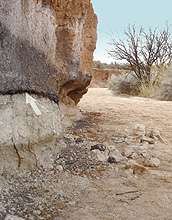
The scientific team visited more than a dozen archaeological sites in North America, where they found high concentrations of iridium, an element that is rare on Earth, and is almost exclusively associated with extraterrestrial objects such as comets and meteorites.
They also found metallic microspherules in the comet fragments; these microspherules contained nano-diamonds. The comet also carried carbon molecules called fullerenes (buckyballs), with gases trapped inside that indicated an extraterrestrial origin.
The team concluded that the impact of the comet likely destabilized a large portion of the Laurentide ice sheet, causing a high volume of freshwater to flow into the north Atlantic and Arctic Oceans.
"This, in turn, would have caused a major disruption of the ocean's circulation, leading to a cooler atmosphere and the glaciation of the Younger Dryas period," said Kennett. "We found evidence of the impact as far west as the Santa Barbara Channel Islands."
Source: NSF


