Exotic crab poised for widespread UK invasion
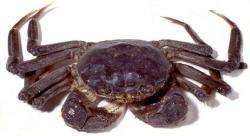
An exotic type of crab is spreading at an alarming rate throughout Britain’s coast and rivers, a new study suggests. The Chinese mitten crab, brought to Britain during the last century in ships’ ballast water, could cause devastating environmental problems if populations are not monitored and controlled, say the study’s authors.
Researchers from the University of Newcastle upon Tyne carried out the first comprehensive modelling of the crab’s migration through Europe and the UK. They compared the two and found the pattern of the crabs’ ongoing invasion of the UK is similar to the population expansion in Europe earlier in the last century when the Continent experienced a major outbreak.
The study authors predict that the mitten crab - so called because its claws are coated with small clumps of dark brown fur, or mittens - has the potential to establish itself in all major UK estuaries in several years time.
Mitten crabs are unwelcome because they prey on protected UK native species such as the white-clawed crayfish and salmon eggs and fry. They also settle in river banks, burrowing into them and riddling them with bore holes up to half a metre long which may eventually cause the bank to collapse.
The Newcastle University study, published in the academic journal Biological Invasions, recommends that a nationwide monitoring and trapping system for the crab should be introduced before it is too late to control the population.
Chinese mitten crabs are already present in some of our waterways, including the Thames, Humber and Tyne rivers and parts of the North Sea and Channel coasts.
The study details how the UK colonisation of mitten crabs has increased on a large scale in recent years. From 1997-1999 the spread along the coast was 448km per year - nearly six times the average spread of 78km per year from 1976-1999. In rivers, the increased spread from 1995-1998 was 49km per year, around three times the average spread of 16km per year from 1973-1998.
The UK spread was most marked along the east coast northwards to the River Tyne and on the south coast westwards to the River Teign.
Dr Matt Bentley, one of the research team*, said: “The pattern of the spread in the UK since the 1970s mirrors the spread in mainland Europe and in the Baltic region which experienced an major outbreak. This is a fairly good indication that the UK is set for a similar situation.”
Mitten crabs can be found in the sea or rivers because they are catadromous - meaning they mainly live in freshwater but must migrate to the sea to breed. Their potential for widespread colonisation is increased by the fact they can cross dry land and can migrate up to 1,000km while growing to adult size.
A decrease in river pollution and a prolonged period of drought in the late 1980s - which together improved habitat conditions for mitten crabs - are potential reasons for the recent population rise.
Dr Bentley, of Newcastle University’s School of Marine Science and Technology added: “This study demonstrates the importance of a monitoring programme for the mitten crab, even if its appearance is just a rare occurrence in an estuary. Records demonstrate the crab’s ability to rapidly expand once the local population reaches a critical density and or conditions become favourable.
“With most invasive species, such as the grey squirrel, the problem is not recognised until it is too late to do anything and you can not eliminate it without taking drastic environmental measures.
“This study shows there is a need for a monitoring system for the mitten crab which could help manage the spread at an early stage. Low cost options could include a public awareness campaign where anglers and other users of rivers and the coastline are encouraged to report sightings of crabs. Measures which are currently used to monitor fish in our rivers, such as the electrical fish counters, could also be adapted to include monitoring of mitten crabs.”
The research was funded by Newcastle University and the Esmee Fairbairn Foundation.
Mitten crab facts:
- The crab is a delicacy in Chinese and Japanese restaurants and is eaten raw, preferably with its reproductive organs swollen!
- If you see a crab in freshwater it is almost certain to be a mitten crab (only one other small non-native crab has been reported from Cardiff Docks)
- Politician Peter Mandelson was once jokingly likened to a mitten crab by Deputy Prime Minister John Prescott during a photocall on the Thames.
- The mature crab is the size of a dinner plate when its legs are extended (the body is around 8cm wide and the legs about 12cm long)
- The scientific name is Eriocheir sinensis (from the Greek meaning wool hand of the Chinese) and the crab originated in the Province of Fukien, China.
- The first UK recorded sighting was at Lots Power Station, Chelsea in 1935. However, it is likely any crabs around then died out and were not reintroduced into this country until the 1970s.
Source: University of Newcastle upon Tyne


