Structure of 450 million year old protein reveals evolution's steps
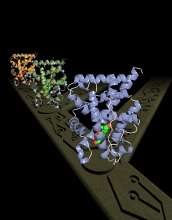
A detailed map that pinpoints the location of every atom in a 450-million-yeard-old resurrected protein reveals the precise evolutionary steps needed to create the molecule’s modern version, according to researchers from the University of North Carolina at Chapel Hill and the University of Oregon.
Until now, scientists trying to unravel the evolution of the proteins and other molecules necessary for life have worked backwards, making educated guesses based on modern human body chemistry. By moving forward from an ancient protein, the team laid out the step-by-step progression required to reach its current form and function.
The study appears in the Aug. 17, 2007, issue of the journal Science.
“We were able to see exactly how mutations in the ancient structure led to the modern receptor,” said lead author Eric Ortlund, who carried out the research as a UNC-Chapel Hill postdoctoral fellow. Ortlund is now an assistant professor of biochemistry in the Emory University School of Medicine.
In the current study, Ortlund and Matt Redinbo, a professor of chemistry, biochemistry and biophysics at UNC-Chapel Hill, generated a three-dimensional picture of the ancient receptor with an imaging technique called X-ray crystallography. The nanoscale image revealed the receptor’s structure, down to the placement of every atom. With the structure in place, Ortlund and his colleagues retraced evolution’s path.
The researchers examined the precursor to a modern protein known as a glucocorticoid receptor. In humans, the receptor plays a crucial role, responding to the hormone cortisol and regulating the body’s stress response. The two – receptor and hormone – fit together as precisely as a lock and key. The precursor preferred a different hormone, so several mutations were necessary before the lock could fit the cortisol key.
The University of Oregon team, which included postdoctoral scientist Jamie Bridgham, resurrected the ancient protein via a large database of modern receptor genes. This earlier work, which compared the genetic similarities and differences among two of these modern genes, found the receptor descended from a single common genetic ancestor 450 million years ago. The researchers then recreated the ancient receptor in the laboratory.
Only seven mutations were needed to bridge the 450-million-year gulf, the researchers found. However, not every mutation changed the protein’s function. These “permissive” mutations appear to pave the way for future, more significant changes. “It’s like they prepared for opportunity to knock in the form of a new hormone,” Ortlund said.
The permissive mutations bolstered the receptor’s structure, like contractors reinforce a historic home’s foundation before making renovations. After these changes took place, a more extreme mutation repositioned an entire group of atoms, bringing them closer to fitting the cortisol hormone. Another created the tight new fit with cortisol.
“These permissive mutations are chance events. If they hadn’t happened first, then the path to the new function could have become an evolutionary road not taken,” said co-author John Thornton, a professor of evolutionary biology at the University of Oregon.
The researchers worked out which mutations came first by synthesizing different versions of the mutated protein in the laboratory. Had the radical mutations come first, the receptor protein would have lost its function entirely, they found.
Source: University of North Carolina at Chapel Hill


