Tropical Depression Erin Soaking East Texas
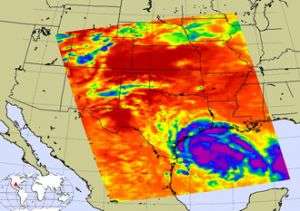
August 16, 2007 Tropical Depression Erin Soaking East Texas

Image credit: NASA/JPL

Tropical Storm Erin quickly weakened to a tropical depression when she made landfall on the Texas coast near Lamar during the early morning hours of Thursday, August 16, 2007.

At 7:00 a.m. CDT the tropical storm warning for the Texas coast was been discontinued. At that time, the center of Tropical Depression Erin was located near latitude 28.0 north and longitude 97.2 west, near Lamar, Texas. That's about 25 miles northeast of Corpus Christi, Texas.

Maximum sustained winds have decreased to 35 mph with higher gusts. The depression should continue to weaken as it moves over land today. Estimated minimum central pressure is 1006 millibars. The depression is moving toward the west-northwest near 12 mph and this motion is expected to continue, bringing the center farther inland today.

Total rain accumulations of 3 to 6 inches are expected across much of central and southern Texas with possible isolated maximum amounts of 10 inches. Isolated tornadoes are possible near the middle Texas gulf coast today.

On Thursday the local forecast for Corpus Christi, Texas includes a flash flood watch, as Erin's showers and thunderstorms could produce heavy rains. A forecast high of 86F is expected with a heat index to 98F. Southeast winds will blow between 20 and 26 mph, and gusts to 32 mph. Showers and thunderstorms will continue through Saturday until the evening hours, when Erin's remnants will be west of the area.

In this infrared image from August 15, created by data from the Atmospheric Infrared Sounder on NASA's Aqua satellite, Tropical Storm Erin lurks off the Texas coast. This AIRS image shows the temperature of the cloud tops or the surface of the Earth in cloud-free regions. The lowest temperatures (in purple) are associated with high, cold cloud tops that make up the top of the hurricane. The infrared signal does not penetrate through clouds. Where there are no clouds the AIRS instrument reads the infrared signal from the surface of the Earth, revealing warmer temperatures (red). This infrared image shows large areas of strong convection surrounding the core of the storm (in purple).

Source: NASA


print this article email this article download pdf blog this article bookmark this article     Stumble it Digg this share on Facebook retweet share on Reddit add to delicious
Rate this story - 3.5 /5 (2 votes)


August 16, 2007 all stories

Comments: 0

3.5 /5 (2 votes)
  • Stumble this up

  • Digg this

  • share this

  • hide
  • Related Stories

  • The GOES-12 satellite sees Large Hurricane Ida nearing landfall
    created Nov 09, 2009 | popularity not rated yet | comments 0
  • GOES-14 Satellite Takes First Full Disk Image
    created Jul 28, 2009 | popularity not rated yet | comments 0
  • Hurricane Ike Larger, Eyeing Landfall Early Saturday in Texas
    created Sep 11, 2008 | popularity not rated yet | comments 0
  • 2007 Hurricane Season Starts Early, Ends Late
    created Feb 11, 2008 | popularity not rated yet | comments 0
  • ORNL, Los Alamos pioneer new approach to assist scientists, farmers
    created Nov 19, 2009 | popularity not rated yet | comments 0


  • hide
  • Relevant PhysicsForums posts

  • The IPCC and the term "most"
    created 8 hours ago
  • Is global warming a fact?
    created 9 hours ago
  • Random variability of wind patterns
    created Nov 23, 2009
  • Record precipitation in the UK
    created Nov 22, 2009
  • More from Physics Forums - Earth

Other News

New computer-developed map shows more extensive valley network on Mars

New computer-developed map shows more extensive valley network on Mars

Space & Earth / Space Exploration

created 8 hours ago | popularity 4.5 / 5 (4) | comments 0

New research adds to the growing body of evidence suggesting the Red Planet once had an ocean.


Supervolcano eruption -- in Sumatra -- deforested India 73,000 years ago

Supervolcano eruption -- in Sumatra -- deforested India 73,000 years ago

Space & Earth / Earth Sciences

created 10 hours ago | popularity 4.1 / 5 (7) | comments 1

A new study provides "incontrovertible evidence" that the volcanic super-eruption of Toba on the island of Sumatra about 73,000 years ago deforested much of central India, some 3,000 miles from the epicenter, ...


Spitzer Telescope Observes Baby Brown Dwarf

Spitzer Telescope Observes Baby Brown Dwarf

Space & Earth / Astronomy

created 7 hours ago | popularity 4.8 / 5 (6) | comments 0

(PhysOrg.com) -- NASA's Spitzer Space Telescope has contributed to the discovery of the youngest brown dwarf ever observed -- a finding that, if confirmed, may solve an astronomical mystery about how these ...


Is global warming unstoppable?

Space & Earth / Environment

created 19 hours ago | popularity 3.8 / 5 (24) | comments 22

In a provocative new study, a University of Utah scientist argues that rising carbon dioxide emissions - the major cause of global warming - cannot be stabilized unless the world's economy collapses or society builds the ...


Cassini Sends Back Images of Enceladus as Winter Nears

Cassini Sends Back Images of Enceladus as Winter Nears

Space & Earth / Space Exploration

created 6 hours ago | popularity 4.5 / 5 (2) | comments 0

(PhysOrg.com) -- NASA's Cassini spacecraft has sailed seamlessly through the Nov. 21 flyby of Saturn's moon Enceladus and started transmitting uncalibrated temperature data and images of the rippling terrain. ...