Photons on the Half Shell
August 16, 2007 Photons on the Half Shell

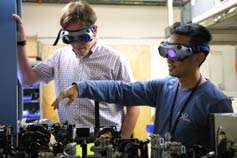
Aaron Lindenberg (left) with Haidan Wen, who designed the optical layout used to create terahertz pulses.

In the realm of ultra-fast science, there's a region where photons of light can be made to dance only half steps. Here, advances in laser science are letting researchers tinker with the behavior light in an entirely new way.

"It's a really new regime for studying materials properties," said Aaron Lindenberg of SLAC's PULSE Center and the Stanford Materials Science and Engineering Department. "We’re just learning how to create such intense fields in this relatively simple way."

Lindenberg's team is pioneering a technique that creates highly intense beams of low-energy infrared photons, separated into extremely short pulses lasting less than a trillionth of a second (one picosecond). These "terahertz fields" show promise as a powerful tool for manipulating matter at the atomic level.

Terahertz fields are nothing new. Very weak terahertz pulses are emitted when electrons shift around naturally inside molecules, and they emanate from electrons inside accelerators. Lindenberg's team is combining this phenomenon with a high-power laser that can be switched on and off very rapidly, creating terahertz fields of unprecedented intensity.

Just like ordinary visible light, infrared photons exist as both particles and waves. As waves, they take the form of electromagnetic oscillations, a rapid push–pull in the electromagnetic environment that rises and falls extremely rapidly. For visible light, these oscillations occur hundreds of trillions of times a second. Now, using a combination of commercially available lasers and optics, Lindenberg's team has devised a way of generating photon pulses that can be switched on and off in roughly half the time of one oscillation. The result is only half an oscillation—all of the push, with none of the pull.

"It's like a hammer," says Lindenberg. "You can use these pulses to give a kick to something, to push it one direction. They could be used to push an electron from one position to another."

Once the phenomenon is more fully understood, it could be used to probe alternative-energy-related materials used in solar cells. Within semiconductors, the motion and speed of electrons changes very rapidly. Manipulating and measuring how these electrons move around could lead to more efficient solar cells, and could improve the efficiency of the production of hydrogen from water. Terahertz pulses might also be used to drive ultrafast switches for computer memory, which could dramatically increase computing speed.

Interest in terahertz pulses has risen in the last decade with the advent of free-electron lasers (FELs), such as the Linac Coherent Light Source now under construction at SLAC. FELs generate extremely intense terahertz fields as a by product of how they accelerate electrons.

"We're at a very early stage," says Lindenberg. "There's a lot of controversy out there about exactly how this process works. Part of what we're doing is trying to understand that… and maybe by understanding that we can generate stronger fields and manipulate and control materials in new ways."

Source: by Brad Plummer, SLAC Today


print this article email this article download pdf blog this article bookmark this article     Stumble it Digg this share on Facebook retweet share on Reddit add to delicious
Rate this story - 4.2 /5 (12 votes)


August 16, 2007 all stories

Comments: 0

4.2 /5 (12 votes)
  • Stumble this up

  • Digg this

  • share this

  • hide
  • Related Stories

  • Silicon could open the way for new terahertz technology
    created May 09, 2007 | popularity not rated yet | comments 0
  • Laser Wakefield Acceleration: Channeling the Best Beams Ever
    created Sep 29, 2004 | popularity not rated yet | comments 0
  • Tapering a Free-Electron Laser to Extract More Juice
    created Nov 20, 2009 | popularity not rated yet | comments 0
  • Confined electrons live longer
    created Aug 18, 2009 | popularity not rated yet | comments 0
  • Closing the terahertz gap could lead to better nanodevices
    created Jul 30, 2009 | popularity not rated yet | comments 0


  • hide
  • Relevant PhysicsForums posts

  • moment of inertia and friction
    created 6 hours ago
  • two-dimensional collision
    created 9 hours ago
  • The acceleration of mass using light
    created 11 hours ago
  • Badminton
    created 12 hours ago
  • More from Physics Forums - General Physics

Other News

In the Brain, Seven Is A Magic Number

In the Brain, Seven Is A Magic Number

Physics / General Physics

created 15 hours ago | popularity 4.3 / 5 (20) | comments 6

Having a tough time recalling a phone number someone spoke a few minutes ago or forgetting items from a mental grocery list is not a sign of mental decline; in fact, it's natural.


Scientists react as they stand in front of a screen at CERN

First atoms reported smashed in Large Hadron Collider (Update)

Physics / General Physics

created 17 hours ago | popularity 4.7 / 5 (24) | comments 11

Two circulating beams on Monday produced the first particle collisions in the world's biggest atom smasher, the Large Hadron Collider (LHC), three days after its restart, scientists announced.


New tool for helping pediatric heart surgery

Physics / General Physics

created 3 hours ago | popularity not rated yet | comments 0

A team of researchers at the University of California, San Diego and Stanford University has developed a way to simulate blood flow on the computer to optimize surgical designs. It is the basis of a new tool that may help ...


Straightening messy correlations with a quantum comb

Straightening messy correlations with a quantum comb

Physics / Quantum Physics

created 18 hours ago | popularity 4.8 / 5 (8) | comments 0

Quantum computing promises ultra-fast communication, computation and more powerful ways to encrypt sensitive information. But trying to use quantum states as carriers of information is an extremely delicate ...


Visual assistance for cosmic blind spots

Visual assistance for cosmic blind spots

Physics / General Physics

created 18 hours ago | popularity 4.3 / 5 (3) | comments 0

A bit of imagination on the part of a measuring instrument wouldn't be a bad thing. It could help to add data from areas where the instrument is unable to measure. However, it must do so constructively. In ...