Tumors use enzyme to recruit regulatory T-cells and suppress immune response
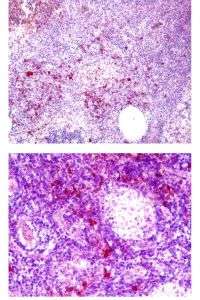
One way tumors fly under the radar of the immune system is by using IDO, an enzyme used by fetuses to help avoid rejection, to recruit powerful regulatory T cells that turn down the immune response, researchers say.
It was known tumors assemble a protective barrier of regulatory T cells, or Tregs, but how they are such able recruiters was an unknown, says Dr. David Munn, pediatric hematologist/oncologist at the Medical College of Georgia Cancer Center.
“People have been very interested in how the tumor gets so many of these cells and how they get activated so they tend to be very aggressive, more suppressive in the tumor than they appear to be elsewhere in the body,” Dr. Munn says of Tregs, major players in preventing autoimmune diseases such as arthritis and type 1 diabetes, where the immune system attacks body tissue.
Research published online Aug. 16 in The Journal of Clinical Investigation shows IDO, which seems to play a powerful role in tumor survival despite the relatively few number of cells in the tumor’s draining lymph nodes, directly activates existing Tregs which become strongly suppressive within a day. “The number doesn’t change a lot, but their activation state changes hugely,” says Dr. Munn, corresponding author.
Studies in a tumor animal model show this rapid conversion occurs only in lymph nodes connected to tumors.
The findings further define a tumor’s survival strategy of first recruiting IDO, which helps recruit Tregs. Tregs then up-regulate the PD-L1/PD-L2 pathway, which has been shown to play an important role in the immune suppression caused by AIDS.
“For the first time it creates a link between IDO, regulatory T cells and this novel pathway we don’t know much about,” says Dr. Munn. Interestingly it’s a link that appears to come full circle because, as researchers at the University of Perugia in Italy showed in 2003, in the test tube at least, Tregs also help recruit more IDO.
“IDO appears to be a sort of linchpin; it’s a crossroads where a number of mechanisms, some of which are more powerful than IDO itself, come together,” says Dr. Munn. “Tregs, for example, are much more powerful than IDO. If you take a mouse and remove IDO, it compensates just fine. If you remove Tregs, the mouse dies. But if the tumor uses IDO to recruit and activate Tregs, that is a leverage point.”
Therapies aimed at these new leverage points will be most effective when packaged with other emerging and existing treatments, he says.
The FDA has approved early clinical trials of the IDO inhibitor, 1MT, in coming months. A team, led by longtime collaborator Dr. Scott Antonia, hematologist/oncologist and co-leader of the Immunology Program at the H. Lee Moffitt Cancer Center and Research Institute, will begin phase 1 trials of 1MT in patients with lung and other tumors shortly. MCG is pursuing FDA approval to begin trials of the combination of 1MT and chemotherapy in breast cancer patients. Dr. Munn notes that while the IDO inhibitor seems to be a safe drug that doesn’t cause autoimmune disorders in mice, it won’t be used in patients with autoimmune disorders because it could worsen the disorders.
By combining IDO with chemotherapy, researchers hope to ‘wipe the slate clean” of the tumor’s manipulation of the immune response, says Dr. Munn. “We have found that once the tumor gets a hold of the immune system, just giving an IDO inhibitor does not restore everything to normal. The tumor has too much influence on the immune system at that point.”
Standard doses of chemotherapy reduce immune system function, creating a window where IDO likely can be more effective. That window may work for cancer vaccines too, which are still under study and getting mixed reviews. Recent reports indicate vaccines can actually increase the number of Tregs in mice with tumors, a problem when fighting cancer but a possible opportunity in which an IDO inhibitor might improve efficacy, Dr. Munn says. An antibody to the PD-L1/PD-L2 already under study in cancer may be another component of a total anti-tumor package.
“We have data from a mouse model that while 1MT works modestly by itself, it works significantly better when combined with chemotherapy,” says Dr. Munn. “I think immunotherapy needs to learn from the finding with multi-agent chemotherapy, which is you need to orchestrate more than one approach. If you give one drug over and over again, the tumor invariably figures out a way to escape, so you always have to combine different strategies.” Multiple approaches also reduce the chance of needing toxic levels of any of them.
Early clinical trials of the IDO inhibitor ideally will benefit patients for whom more standard therapies have failed and enable scientists to verify laboratory findings in people, Dr. Munn says. Scientists will carefully monitor Tregs to see if they show evidence of being activated by IDO – now that they know what that looks like – and de-activated by the IDO inhibitor. They’ll also have to see if Tregs circulating in the bloodstream are good indicators of what’s happening or whether tumor biopsies will be needed.
IDO inhibitors’ potential against tumors as well persistent viruses such as HIV arose out of work MCG scientists, led by Dr. Munn and his long-time collaborator Dr. Andrew L. Mellor, director of the MCG Immunotherapy Center and Georgia Research Alliance Eminent Scholar in Immunogenetics. Their work published in Science in 1998 showed fetuses use IDO – indoleamine 2,3-dioxygenase – to locally disable a pregnant woman’s immune system and avoid rejection. They showed then that one way IDO suppresses the immune response is by degrading tryptophan, a natural amino acid important to T cells.
Later, they found that tumors and certain viruses such as HIV also appear to use IDO for protection from the immune response. However, the fact that IDO-expressing cells make up less than 1 percent of the cells in a tumor or its draining lymph node led MCG researchers to look for a population of “powerful allies” within the immune system that could explain the suppressive impact. Tregs seemed like a good choice. The 2003 paper by Italian scientists, followed by a 2006 paper that showed naïve T-cells exposed to IDO differentiated into Tregs, helped cement that some sort of relationship existed, prompting MCG researchers to further explore the relationship in a tumor animal model.
“It’s only been in the last year or two that people have begun to realize Tregs spend most of their time in a sort of resting state where they have the potential to be suppressive but are not at that moment,” says Dr. Munn. “That would make sense, because you don’t want your immune system always shut off.”
Source: Medical College of Georgia


