Nanoscale blasting adjusts resistance in magnetic sensors
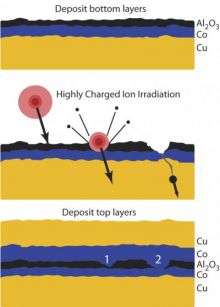
A new process for adjusting the resistance of semiconductor devices by carpeting a small area of the device with tiny pits, like a yard dug up by demented terriers, may be the key to a new class of magnetic sensors, enabling new, ultra-dense data storage devices.
The technique demonstrated by researchers at the National Institute of Standards and Technology allows engineers to tailor the electrical resistance of individual layers in a device without changing any other part of the processing or design.
The tiny magnetic sensors in modern disk drives are a sandwich of two magnetic layers separated by a thin buffer layer. The layer closest to the disk surface is designed to switch its magnetic polarity quickly in response to the direction of the magnetic “bit” recorded on the disk under it. The sensor works by measuring the electrical resistance across the magnetic layers, which changes depending on whether the two layers have matching polarities.
As manufacturers strive to make disk storage devices smaller and more densely packed with data, the sensors need to shrink as well, but current designs are starting to hit the wall. To meet the size constraints, prototype sensors measure sensor resistance perpendicular to the thin layers, but depending on the buffer material in the sensor, two different types of sensors can be made. Giant magneto-resistance (GMR) sensors use a low-resistance metal buffer layer and are fast, but plagued by very low, difficult to detect, signals. On the other hand, magnetic tunnel junction (MTJ) sensors use a relatively high-resistance insulating buffer that delivers a strong signal, but has a slower response time, too slow to keep up with a very high-speed, high-capacity drive.
What’s needed, says NIST physicist Josh Pomeroy, is a compromise. “Our approach is to combine these at the nanometer scale. We start out with a magnetic tunnel junction—an insulating buffer—and then, by using highly charged ions, sort of blow out little craters in the buffer layer so that when we grow the rest of the sensor on top, these craters will act like little GMR sensors, while the rest will act like an MTJ sensor.” The combined signal of the two effects, the researchers argue, should be superior to either alone.
The NIST team has demonstrated the first step—the controlled pockmarking of an insulating layer in a multi-layer structure to adjust its total resistance. The team uses small numbers of highly charged xenon ions that each have enormous potential energies—and can blast out surface pits without damaging the substrate. With each ion carrying more than 50 thousand electron volts of potential energy, only one impact is needed to create a pit—multiple hits in the same location are not necessary. Controlling the number of ions provides fine control over the number of pits etched, and hence the resistance of the layer—currently demonstrated over a range of three orders of magnitude. NIST researchers now are working to incorporate these modified layers into working magnetic sensors.
The new technique alters only a single step in the fabrication process—an important consideration for future scale-up—and can be applied to any device where it’s desirable to fine-tune the resistance of individual layers. NIST has a provisional patent on the work, number 60,905,125.
Citation: J.M. Pomeroy, H. Grube, A.C. Perrella and J.D. Gillaspy. Selectable resistance-area product by dilute highly charged ion irradiation. Appl. Phys. Lett. 91, 073506 (2007).
Source: National Institute of Standards and Technology


