Layered approach may yield stronger, more successful bone implants
August 17, 2007
Layered approach may yield stronger, more successful bone implants

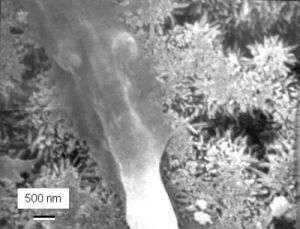
High-magnification scanning electron microscopy shows (center of micrograph) the leg of an osteoblast (bone precursor), called a cytoplasmic extension, attaching to nano-sized hydroxyapatite crystals, similar to those in natural bone, that make up a CPC implant. Credit: NIST

Researchers from the American Dental Association Foundation (ADAF) and the National Institute of Standards and Technology have developed a new method for layering two kinds of biomaterials into one strong, yet porous unit that may lead to improved reconstruction or repair of bones.

Currently, calcium phosphate cements (CPCs)—water-based pastes of powdered calcium and a phosphate compound that form hydroxyapatite, a material found in natural bone—are used for reconstructing or repairing skeletal defects, but only in bones that are not load-bearing (such as those in the face and skull). Macropores built into the CPCs make it easier for new bone cells to infuse and, eventually, solidify the implant. Until this happens, however, the macropores leave the implant brittle and susceptible to failure.

In the September 2007 issue of Biomaterials, Hockin Xu and colleagues describe a unique approach for providing the strength needed to help an implant better survive its early stages. First, a macroporous CPC paste is placed into the area needing reconstruction or repair. Then, a strong, fiber-reinforced CPC paste is layered onto the first CPC to support the new implant. Once new bone has grown into the macroporous layer and increased its strength, the absorbable fibers in the strong layer dissolve and create additional macroporous channels that promote even more bone tissue ingrowth. This method mimics the natural bone structure in which a strong layer, called cortical bone, covers and strengthens a weaker, macroporous layer (spongy bone).

The two pastes used in the layered CPC method harden in the bone cavity to form an implant that for the first time has both the porosity needed for bone growth and the integrity required for reconstruction or repair of load-bearing bones (such as jaws).

NIST and the ADAF have conducted cooperative research on dental and medical materials since 1928. ADAF researchers focus on development of new dental and biomedical materials, while NIST specializes in the development of improved technologies and methods for measuring materials properties.

Source: National Institute of Standards and Technology

4.8 /5 (5 votes)  

Rank 4.8 /5 (5 votes)
Tags

Relevant PhysicsForums posts
  • Factors affecting beet root cell membrane
    createdFeb 12, 2012
  • Stem cell question.
    createdFeb 10, 2012
  • Protease cleavage
    createdFeb 10, 2012
  • Pertubance in a model
    createdFeb 10, 2012
  • Cancer drugs and Alzheimer's, Oh my!
    createdFeb 09, 2012
  • Squishing cells
    createdFeb 09, 2012
  • More from Physics Forums - Biology

More news stories

ORNL microscopy explores nanowires' weakest link

Individual atoms can make or break electronic properties in one of the world's smallest known conductors—quantum nanowires. Microscopic analysis at the Department of Energy's Oak Ridge National Laboratory ...

Nanotechnology / Nanophysics

created 5 hours ago | popularity 5 / 5 (2) | comments 0 | with audio podcast

Nanostructured electrodes for rechargeable sodium-Ion batteries

Highly efficient 3V cathodes for rechargeable sodium-ion batteries have been developed by users from Argonne National Laboratory's Materials Science, Chemical Sciences & Engineering, and X-ray Sciences Divisions, ...

Nanotechnology / Nanomaterials

created 10 hours ago | popularity 5 / 5 (2) | comments 0 | with audio podcast

'Smart' microcapsules in a single step

(PhysOrg.com) -- A new, single-step method of fabricating microcapsules, which have potential commercial applications in industries including medicine, agriculture and diagnostics, has been developed by researchers ...

Nanotechnology / Nanomaterials

created 10 hours ago | popularity 5 / 5 (2) | comments 1 | with audio podcast

NDSU nano research could impact flexible electronic devices

A discovery by a research team at NDSU and the National Institute of Standards and Technology shows the flexibility and durability of carbon nanotube films and coatings are intimately linked to their electronic properties. ...

Nanotechnology / Nanomaterials

created 11 hours ago | popularity 5 / 5 (1) | comments 0

New kind of solar cell could capture significantly more energy than current cells

New solar cells could increase the maximum efficiency of solar panels by over 25%, according to scientists from the University of Cambridge.

Nanotechnology / Nanophysics

created Feb 08, 2012 | popularity 4.3 / 5 (14) | comments 14 | with audio podcast


First-of-its-kind stem cell study re-grows healthy heart muscle in heart attack patients

Results from a Cedars-Sinai Heart Institute clinical trial show that treating heart attack patients with an infusion of their own heart-derived cells helps damaged hearts re-grow healthy muscle.

Sensing self and non-self: New research into immune tolerance

At the most basic level, the immune system must distinguish self from non-self, that is, it must discriminate between the molecular signatures of invading pathogens (non-self antigens) and cellular constituents that usually ...

Missing dark matter located: Intergalactic space is filled with dark matter

Researchers at the University of Tokyo’s Institute for the Physics and Mathematics of the Universe (IPMU) and Nagoya University used large-scale computer simulations and recent observational data of gravitational ...

Scientists discover reason for Mt. Hood's non-explosive nature

(PhysOrg.com) -- For a half-million years, Mount Hood has towered over the landscape, but unlike some of its cousins in Oregon’s Cascade Mountains and many other volcanoes around the Pacific “Rim ...

Discovery paves way for salmonella vaccine

(Medical Xpress) -- An international research team led by a University of California, Davis, immunologist has taken an important step toward an effective vaccine against salmonella, a group of increasingly antibiotic-resistant ...

Time of year important in projections of climate change effects on ecosystems

(PhysOrg.com) -- Does it matter whether long periods of hot weather, such as last year's heat wave that gripped the U.S. Midwest, happen in June or July, August or September?