Polluted Dead Star Indicates Planets Like Earth May Have Formed Around Other Stars, Astronomers Report
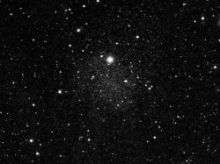
The chemical fingerprint of a burned-out star indicates that Earth-like planets may not be rare in the universe and could give clues to what our solar system will look like when our sun dies and becomes a white dwarf star some five billion years from now.
Astronomers from UCLA report that a white dwarf star known as GD 362, which is surrounded by dusty rings similar to those of Saturn, has been contaminated by a large asteroid that left more than a dozen observable chemical elements in the white dwarf’s atmosphere. Such an observation is unprecedented in astronomy. Was there some kind of violent interaction between the star and the asteroid"
The UCLA astronomers think that after about a billion years orbiting the white dwarf as part of an ancient planetary system, an asteroid got close enough to the star to be torn apart by its very strong gravitational force field. An Earth-sized but exceedingly dense white dwarf is the standard end state for most stars. This particular white dwarf, which is under investigation by the W.M. Keck Observatory in Hawaii, is located in the constellation Hercules, approximately 150 light-years, or 1,000 trillion miles, from Earth.
The asteroid broke apart into dust particles that orbited the white dwarf and over time “polluted the white dwarf’s atmosphere,” said Benjamin Zuckerman, UCLA professor of physics and astronomy and lead author of the research, which has been accepted for publication in an upcoming issue of the Astrophysical Journal, the premier journal of astronomy.
The astronomers note that the spectroscopic observations they are reporting constitute the first detailed assessment of the elemental composition of an object in an extrasolar planetary system.
“The relative abundance of the elements in the white dwarf’s atmosphere, polluted by the asteroid, appears similar to those in our Earth-Moon system,” Zuckerman said.
“What we have here is a composition of the white dwarf that is fairly similar to that of the inner planets of our solar system,” said Michael Jura, UCLA professor of physics and astronomy and co-author of the research. “Are there other terrestrial planets like Earth in other solar
systems" This white dwarf’s fingerprint is a significant advance in demonstrating that something like terrestrial planet formation occurred around this other star and probably occurred around other stars as well, because it suggests the Earth’s composition is not unique.
“The asteroid that is being shredded is very iron-rich and abundant in calcium and other elements, and low in carbon, like a sturdy rock,” Jura added.
The research implies that the forces that made the Earth and our inner solar system seem to have occurred in this system as well, and probably around other white dwarfs too, Jura said.
Zuckerman said the research result does not rule out the possibility that two planets in this ancient planetary system collided and the orbiting dust and detected elements are from a piece of one of the colliding planets rather than from a more conventional asteroid.
“Something dramatic and violent probably happened,” he said.
What knocked the asteroid out of its original orbit" It probably was deflected by the gravitational field of a large planet, Zuckerman said.
Our own planetary system looks very stable, Zuckerman said, but billions of years from now, when the sun starts to expand in size and lose mass rapidly, the planets and asteroids will spiral away, and the planets closest to the sun, like Mercury and Venus, will be engulfed by the sun and destroyed.
“But other planets, probably including the Earth and the asteroid belt between Mars and Jupiter will spiral out, and their orbits then will make our stable system much less stable,” he said.
A third UCLA author on the paper, physics and astronomy associate professor Brad Hansen, said, “In our solar system, objects rich in iron formed closer to the sun than the objects rich in carbon and ice, which formed farther away, where it is colder. This research tells us about the origin of the asteroid, its temperature when it formed and its chemistry — conditions similar to the Earth’s.”
The group of astronomers, which also includes of UCLA graduate student Carl Melis and Detlev Koester at Germany’s University of Kiel, detected 17 elements in the atmosphere of the white dwarf that probably came from a large asteroid; the asteroid may have once been part of a larger body, perhaps like one of the inner planets of our solar system. Many of the elements have never before been detected in the atmosphere of a white dwarf, including the rare elements strontium and scandium.
The gravitational field of the white dwarf is so strong that all elements heavier than the lightest elements — hydrogen and helium — quickly sink into the white dwarf’s interior, Hansen said.
The asteroid likely broke up more than 100,000 years ago, and perhaps as long as a million years ago, the astronomers said. The star became a very hot white dwarf approximately 1 billion years ago and since then has been steadily cooling off.
Unlike GD 362, most white dwarfs are pristine in their composition.
“You wouldn’t notice another skyscraper in New York, but the same skyscraper in Nebraska would stick out like a sore thumb,” Hansen said. “That’s the case here. A little change in the atmosphere of a white dwarf is very obvious.”
The astronomers used the HIRES spectrometer on the Keck I Telescope to take optical spectra of the white dwarf, spanning the ultraviolet to the full visible range of light. Each element can be identified by its own characteristic spectrum.
The researchers said they find it quite remarkable that even at a distance of 1,000 trillion miles, the Keck HIRES measurements enable them to determine minute details of the bulk composition of a relatively tiny object — as astronomical sizes go — like an asteroid. Currently, no other known observational technique exists that allows for such compositional information to be obtained.
The remains of a white dwarf cool slowly over many billions of years as the dying ember makes its slow journey into oblivion.
Source: University of California - Los Angeles


