Nanowire Coating for Bone Implants, Stents
August 17th, 2007 Nanowire Coating for Bone Implants, Stents

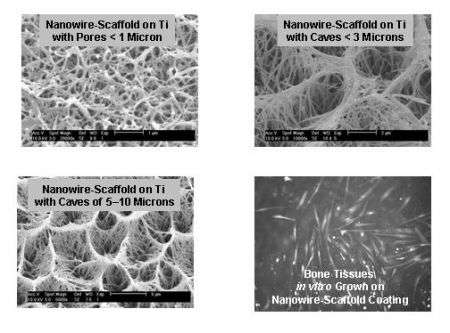
These images show the titanium scaffolding with different pore sizes, plus bone tissue growth on the titanium scaffolding. Images courtesy of Z. Ryan Tian.

University of Arkansas researchers have found a simple, inexpensive way to create a nanowire coating on the surface of biocompatible titanium that can be used to create more effective surfaces for hip replacement, dental reconstruction and vascular stenting. Further, the material can easily be sterilized using ultraviolet light and water or using ethanol, making it useful in hospital settings and meat-processing plants.

Wenjun Dong, Tierui Zhang, Lisa Cooney, Hong Wang, Yanbin Li, Andrew Cogbill, Vijay Varadan and Z. Ryan Tian of the University of Arkansas, Ying-Bing Jiang of the University of New Mexico, and Joshua Epstein of the University of Arkansas for Medical Sciences report their findings in an upcoming issue of the journal Chemistry of Materials.

The researchers used an alkali and heat to create titanium oxide-based ceramic nanowires that coat the surface of a titanium medical device.

"We can control the length, the height, the pore openings and the pore volumes within the nanowire scaffolds" by varying the time, temperature and alkali concentration in the reaction, said Z. Ryan Tian, assistant professor of chemistry and biochemistry in the J. William Fulbright College of Arts and Sciences. "This process is also extremely sustainable," requiring only that the device be rinsed in reusable water after the heating process.

Reconstructive bone surgeries, such as hip replacements, use titanium implants. However, muscle tissue may not adhere well to titanium's smooth surface, causing the implant to fail after a decade or so and requiring the patient to undergo a second surgery.

Tian and his colleagues created a nanowire-coated joint and placed it in mice. After four weeks, the researchers found that tissue had adhered to the joint.

"We saw beautiful tissue growth - lots of muscle fibers," Tian said. "We've added one more function to the currently-in-use titanium implant."

Because the researchers can control the size and shape of the pores in the nanowire scaffold, the material also could be coated onto stents used in patients with coronary artery disease and in potential stroke victims. Conventional stents sometimes become reclogged with fat after implantation. The most recent stent used to address this problem, called the drug-eluting stent, consists of a polymer coating mixed with the drugs, but the coating may be vulnerable to biodegradation, and may not function for long. The nanowire coating without the degradation problem could be used to carry drugs that would help keep the arteries clear over a long period of time.

"This drug release could be applied to the angioplasty catheter's surface," Tian said.

In addition to these biomedical applications, the nanofiber scaffold has a property that may make it useful in both hospitals and food processing plants: The material, when rinsed in water and exposed to ultraviolet light, kills more than 99 percent of bacteria on its surface. This effect occurs because photons from the light cause a charge separation on the material, splitting water molecules into free radicals that destroy the bacteria. Alternatively, immersion in 70 percent ethanol completely sterilizes the material, allowing growth of cells/tissues in the laboratory prior to implantation.

This property could prove extremely useful in bacteria-prone environments, performing such functions as sterilizing on-site surgery hospitals used during military actions or cleaning surfaces in meat-processing plants.

"You could just use water to rinse and UV light to sterilize surfaces," Tian said.

The researchers have applied for a provisional patent for the multifunctional nanowire bioscaffolds on titanium or titanium-containing alloys such as Nitinol.

Source: University of Arkansas


print this article email this article download pdf blog this article bookmark this article     Digg this Stumble it share on Facebook share on Reddit add to delicious save to Yahoo! bookmarks
4.7/5 after 20 votes


August 17th, 2007 all stories
Nanotechnology / Nanomaterials

Comments: 0
Rank: 4.7/5 after 20 votes

  • Stumble this up

  • Digg this

  • Share it:
  • share on Facebook
  • share on MySpace
  • share on Slashdot
  • rss-newsfeed
  • share on Google
  • share on Reddit
  • add to delicious
  • save to Yahoo! bookmarks
  • share on Windows Live
  • Add to Mixx!
Rating: 4.7/5 after 20 votes

  • Related Stories

  • Nanowire coating for bone implants, stents
    created Aug 27, 2007 | popularity not rated yet | comments 0
  • Placing single nanowires: NIST makes the connection
    created Apr 27, 2007 | popularity not rated yet | comments 0
  • Nanoscale Tubing Assembles Itself Instantly
    created Feb 27, 2006 | popularity not rated yet | comments 0
  • Natural gas in the Arctic is mostly Russian
    created May 29, 2009 | popularity not rated yet | comments 0
  • Novel approach estimates nanoparticles in environment
    created May 20, 2009 | popularity not rated yet | comments 0

Tags


  • Physicists Demonstrate Quantum Memory with Matter Qubits
    Physicists Demonstrate Quantum Memory with Matter Qubits
    Physics / General Physics
    created Jul 03, 2009 | popularity 4.4 / 5 (17) | comments 1
  • 'Holey' Nanosheets for Wastewater Dye Removal
    Nanotechnology / Nanomaterials
    created Jul 01, 2009 | popularity 5 / 5 (5) | comments 1
  • Jellyfish Robot Swims Like its Biological Counterpart
    Jellyfish Robot Swims Like its Biological Counterpart
    Electronics / Robotics
    created Jun 26, 2009 | popularity 4.4 / 5 (8) | comments 1
  • Could Maxwell's Demon Exist in Nanoscale Systems?
    Could Maxwell's Demon Exist in Nanoscale Systems?
    Physics / General Physics
    created Jun 24, 2009 | popularity 4.4 / 5 (18) | comments 29
  • Living Safely with Robots, Beyond Asimov's Laws
    Living Safely with Robots, Beyond Asimov's Laws
    Electronics / Robotics
    created Jun 22, 2009 | popularity 4.6 / 5 (52) | comments 40
  • Other News

    A 'quantum of sol' -- how nanotechnology could hold the key to a solar-powered future

    A 'quantum of sol' -- how nanotechnology could hold the key to a solar-powered future

    Nanotechnology / Nanomaterials

    created Jun 30, 2009 | popularity 3.9 / 5 (15) | comments 17

    (PhysOrg.com) -- A new generation of 'nano-structured' millimetre-sized solar cells that could convert the sun's energy to electricity more than twice as efficiently as current technology, is the subject of ...


    Australian researchers are set to begin human trials of a tiny nano-cell that acts as a "Trojan horse" against cancer

    Hi-tech 'Trojan horse' can kill cancer cells: researchers

    Nanotechnology / Bio & Medicine

    created Jun 29, 2009 | popularity 4.7 / 5 (12) | comments 7

    Australian researchers are set to begin human trials of a tiny nano-cell that acts as a "Trojan horse" against cancer cells, a breakthrough they say may curb the need for debilitating chemotherapy.


    'Holey' Nanosheets for Wastewater Dye Removal

    Nanotechnology / Nanomaterials

    created Jul 01, 2009 | popularity 5 / 5 (5) | comments 1

    (PhysOrg.com) -- Researchers have discovered that extremely thin sheets of nickel oxide with hexagonally shaped holes can absorb hazardous dyes from wastewater nearly as well as the best traditional methods, but are recyclable. ...


    Harnessing Nanoparticles To Track Cancer Cell Changes

    Nanotechnology / Bio & Medicine

    created Jul 03, 2009 | popularity not rated yet | comments 1

    The more dots there are, the more accurate a picture you get when you connect them. Cancer researchers adopting that philosophy have developed a new imaging technology that could give scientists the ability to simultaneously ...


    Computer-Guided Nanoparticle Therapy Destroys Tumors

    Nanotechnology / Bio & Medicine

    created Jun 29, 2009 | popularity 4.9 / 5 (12) | comments 0

    Gold nanoshells are among the most promising new nanoscale therapeutics being developed to kill tumors, acting as antennas that turn light energy into heat that cooks cancer to death. Now, a multi-institutional research team ...