NASA eyes warm sea surface temperatures for hurricanes
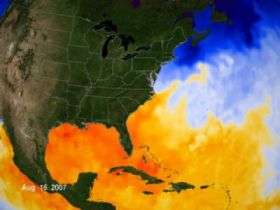
August 17, 2007 Warm Sea Surface Temps Help Fuel Storms

This image combines data from various NASA satellites and shows sea surface temperatures (80F or higher) warm (orange areas) enough to power tropical cyclones. The darker the orange color, the warmer the water. Credit: NASA/SVS

Sea surface temperatures are one of the key ingredients for tropical cyclone formation and they were warming up in the Gulf of Mexico, Caribbean and eastern Atlantic Ocean by the middle of August. As a result, they helped spawn Hurricane Dean in the central Atlantic, and Tropical Storm Erin in the Gulf of Mexico, both during the week of August 13.

By late June, sea surface temperatures in the Gulf of Mexico were all over 80 degrees Fahrenheit. That's one thing that hurricane forecasters watch for because sea surface temperatures of 80 degrees Fahrenheit or warmer are needed to power tropical depressions into tropical storms and grow them into hurricanes.

These areas or warm sea surface waters (80 degrees F or higher) are depicted in yellow, orange, and red. This data was taken by the Advanced Microwave Scanning Radiometer - EOS (AMSR-E) instrument aboard the Aqua satellite. This animation updates every 24 hours.

This animation shows the progression of warm waters slowly filling the Gulf of Mexico (shown in yellow, orange, and red). This natural annual warming contributes to the possible formation of hurricanes in the Gulf. Sea surface temperature data shown here ranges from January 1, 2007 to the present.

NASA's Bill Patzert, oceanographer at the Jet Propulsion Laboratory, Pasadena, Calif. said, "The many Atlantic and Gulf citizens still reeling from the shock of the 2004 and 2005 Atlantic hurricane seasons, received some good news … the Atlantic sea surface temperatures that fuel hurricanes are somewhat cooler than the past few years. Based on this, some forecasters have reduced their forecasts. But the news is mixed."

When asked what factors forecasters are watching, Patzert said "The jet stream has remained stubbornly north, the possibility of a late-developing La Nina is lurking and Gulf of Mexico and Caribbean sea surface temperatures are ripe for late-season hurricane development."

While the experts debate, Gulf and Atlantic coast residents should definitely be prepared. A forecast for an above or below average hurricane season is just an academic exercise if a community is hit.

Hurricane season ends on November 30.

Source: NASA/Goddard Space Flight Center


print this article email this article download pdf blog this article bookmark this article     Stumble it Digg this share on Facebook retweet share on Reddit add to delicious
Rate this story - 3.8 /5 (5 votes)


August 17, 2007 all stories

Comments: 0

3.8 /5 (5 votes)
  • Stumble this up

  • Digg this

  • share this

  • hide
  • Related Stories


  • hide
  • Relevant PhysicsForums posts

  • Climate Science Update
    created 4 hours ago
  • The IPCC and the term "most"
    created Nov 23, 2009
  • Is global warming a fact?
    created Nov 23, 2009
  • Random variability of wind patterns
    created Nov 23, 2009
  • More from Physics Forums - Earth

Other News

Fermi Telescope Peers Deep into Microquasar

Fermi Telescope Peers Deep into Microquasar (w/ Video)

Space & Earth / Astronomy

created 38 minutes ago | popularity 5 / 5 (1) | comments 0

(PhysOrg.com) -- NASA's Fermi Gamma-ray Space Telescope has made the first unambiguous detection of high-energy gamma-rays from an enigmatic binary system known as Cygnus X-3. The system pairs a hot, massive ...


New radar helps monitor site of century-old tragedy

New radar helps monitor site of century-old tragedy

Space & Earth / Earth Sciences

created 47 minutes ago | popularity not rated yet | comments 0

(PhysOrg.com) -- A University of Alberta researcher has turned the site of a southern Alberta rockslide tragedy into the proving ground for new equipment meant to avert such a disaster in the future.


The Energy Sources of Ultraluminous Galaxies

The Energy Sources of Ultraluminous Galaxies

Space & Earth / Astronomy

created 1hour ago | popularity 5 / 5 (1) | comments 0

(PhysOrg.com) -- Ultraluminous infrared galaxies ((ULIRGs) are galaxies whose luminosity exceeds that of a trillion suns; for comparison, the Milky Way galaxy has a typical (and much more modest) luminosity ...


Space shuttle Atlantis, 7 astronauts back on Earth

Space & Earth / Space Exploration

created 2 hours ago | popularity not rated yet | comments 0

(AP) -- Space shuttle Atlantis and its seven astronauts returned to Earth with a smooth touchdown Friday to end an 11-day flight that resupplied the International Space Station.


China is set to launch its second moon orbiter next October, state media have reported

China to launch second lunar probe: state media

Space & Earth / Space Exploration

created 6 hours ago | popularity 5 / 5 (3) | comments 0

China will launch its second moon orbiter next October, state media reported Friday, as it powers ahead with a space programme that has sparked concerns abroad.