Model explains how electron beams make nanotubes visible
Scanning electron microscopes are the workhorses of imaging structures on the scale of billionths of a meter. Typically, they work by shooting a beam of electrons at the specimen and then detecting newly generated electrons as they bounce off and scatter. But carbon nanotubes, essentially rolled up sheets of chicken wire a billionth of a meter in diameter, are so narrow and their sides so thin, that scientists haven't properly understood why they are visible using a scanning electron microscope, or SEM.
Now, Stanford engineers have solved the mystery, and its explanation not only could help researchers understand what they see in nanotube images but also suggests new nanotube applications such as ultra-sensitive detection of electrons and ultra-precise electron beams for microelectronics manufacturing.
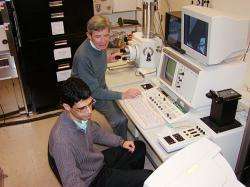
"Based on our traditional view of scanning electron microscopy, it doesn't make any sense that we do see nanotubes," says electrical engineering doctoral student Alireza Nojeh. Engineers care about sighting the small structures because nanotubes have potential applications in computer chips, novel materials and even medical treatments. In the Feb. 9 online edition of the journal Physical Review Letters, Nojeh and co-authors electrical engineering Professor Fabian Pease, mechanical engineering Assistant Professor Kyeongjae Cho and applied physics doctoral student Bin Shan offer a theoretical model explaining how the electrons in an SEM beam cause nanotubes to emit their own electrons, making them detectable with the scope.
Assuming that all specimens in the path of the microscope's electron beam look like bulky solids, traditional theoretical models statistically predict how electrons will scatter off samples. But the thin, hollow nanotubes don't look solid to an incoming electron beam. Using the traditional model, one might expect electrons in the microscope beam to pass right through the nanotube as if it weren't there.
But electron beams don't just pass through and they don't just scatter. According to the researchers' new model, when beam electrons pass into the nanotube, they give nearby electrons inside the nanotube's carbon atoms enough energy to escape. These liberated electrons are emitted out of the tube and are easily visible to the electron microscope's detectors.
Scientists have observed nanotubes emitting electrons in this manner before but now that there is model to explain it, they might learn how to exploit this behavior for new technologies. For example, in their research in collaboration with chemistry Associate Professor Hongjie Dai at Stanford and electrical and computer engineering Assistant Professor Wai-Kin Wong at the National University of Singapore, Nojeh and Pease have discovered how to use an electric field to predispose a nanotube to emit as many as 100 electrons for each electron that strikes it. This amplification could lead to a technology for an ultra-sensitive electron detector.
Similarly, the understanding provided by the new model could help scientists control the timing of electron emission from a nanotube. That would enable more precise and consistent electron beams than are currently available. This new capability could lead to improved machines for "e-beam lithography," which is a technique for patterning finer integrated circuits than can be produced using light.
"Carbon nanotubes have great promise because of their unique properties arising out of their molecular structure," Pease says. "But to realize that promise we still need to improve the understanding of their interaction with external stimuli, such as beams of electrons."
Source: Stanford University (by David Orenstein)


