What, oh, what are those actinides doing?
August 20, 2007
What, oh, what are those actinides doing?

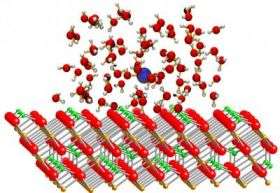
Researchers are discovering how actinides such as uranium in solution interact with magnetite and other mineral surfaces. Credit: Pacific Northwest National Laboratory

Researchers at Pacific Northwest National Laboratory are uniting theory, computation and experiment to discover exactly how heavy elements, such as uranium and technetium, interact in their environment.

As part of that effort, scientists have combined sensitive experimental measurements with fi rst principle electronic structure calculations to measure, and to really understand, the structural and bonding parameters of uranyl, the most common oxidation state of uranium in systems containing water.

The insights were achieved by PNNL scientist Bert de Jong and associates Gary Groenewold of Idaho National Laboratory and Michael Van Stipdonk of Wichita State University, employing the supercomputing resources of the William R. Wiley Environmental Molecular Sciences Laboratory, a Department of Energy national scientifi c user facility located at PNNL.

The large number and behavior of electrons in heavy elements makes most of them extremely diffi cult to study. De Jong said that advancements in computing power and theory are enabling computational actinide chemistry to contribute significantly to the understanding and interpretation of experimental chemistry data, as well as to predicting the chemical and physical properties of heavy transition metal, lanthanide and actinide complexes.

“Now we can make sure we get the right answer for the right reason,” de Jong said, adding that results obtained from the calculations are an invaluable supplement to current, very expensive and often hazardous experimental studies.

Researchers are discovering how actinides such as uranium in solution interact with magnetite and other mineral surfaces.

Discoveries made using the new capabilities available to the growing field of computational actinide chemistry could have wide impact, from radioactive waste and cleanup challenges to the design and operation of future nuclear facilities.

Bert De Jong will make his presentation at the 234th American Chemical Society National Meeting in Boston.

Source: DOE/Pacific Northwest National Laboratory

3.5 /5 (6 votes)  

Rank 3.5 /5 (6 votes)
Tags

Relevant PhysicsForums posts

More news stories

Hydrogen from acidic water: Researchers develop potential low cost alternative to platinum for splitting water

A technique for creating a new molecule that structurally and chemically replicates the active part of the widely used industrial catalyst molybdenite has been developed by researchers with the Lawrence Berkeley ...

Chemistry / Materials Science

created Feb 09, 2012 | popularity 4.8 / 5 (15) | comments 21 | with audio podcast

Fool's gold may prove an unlikely alternative to overexploited catalytic materials

Catalytic materials, which lower the energy barriers for chemical reactions, are used in everything from the commercial production of chemicals to catalytic converters in car engines. However, with current catalytic materials ...

Chemistry / Materials Science

created Feb 10, 2012 | popularity 4.4 / 5 (8) | comments 8 | with audio podcast

Research provides octagonal window of opportunity for carbon capture

(PhysOrg.com) -- Filtering carbon dioxide, a greenhouse gas, from factory smokestacks is a necessary, but expensive part of many manufacturing processes. However, a collaborative research team from the National ...

Chemistry / Materials Science

created Feb 08, 2012 | popularity 5 / 5 (1) | comments 5 | with audio podcast

Flexible paper robots

(PhysOrg.com) -- These inexpensive robots can stretch, bend and twist under control, and lift objects up to 120 times their own weight. Being soft, they can apply gentle and even pressure, and adapt to varied ...

Chemistry / Materials Science

created Feb 09, 2012 | popularity 5 / 5 (5) | comments 4 | with audio podcast

New form of hafnium oxide developed

(PhysOrg.com) -- A novel material developed by researchers at the University of Cambridge is opening up new possibilities for next generation electronic and optoelectronic devices, and paving the way for further ...

Chemistry / Materials Science

created Feb 07, 2012 | popularity 4.6 / 5 (5) | comments 4 | with audio podcast


Injured boomers beware: Know when to see doctor

(AP) -- It happened to nurse Jane Byron years after an in-line skating fall, business owner Haralee Weintraub while doing "men's" push-ups, and avid cyclist Gene Wilberg while lifting a heavy box.

Google might launch Drive for cloud storage soon

(PhysOrg.com) -- Google's next big move, according to the Wall Street Journal, is a cloud storage service called Drive. Hardly first to the plate, Google is simply catching up to introducing its cloud reposi ...

Latin America mining boom clashes with conservation

Latin America is experiencing a mining boom as prices rise fuelled by a hike in global demand, but the region is also being hit by a wave of violent protests, strikes and rallies by environmentalists.

Love a click away in Indonesia's Twitter Republic

He was a geeky kid from Yogyakarta, she a glamorous city girl in Jakarta. In a country with one of the world's most vibrant social networking scenes they fell in love on Twitter.

Europeans protest controversial Internet pact

Tens of thousands of people marched in protests in more than a dozen European cities Saturday against a controversial anti-online piracy pact that critics say could curtail Internet freedom.

Walney offshore wind farm is world's biggest (for now)

(PhysOrg.com) -- The Walney wind farm on the Irish Sea--characterized by high tides, waves and windy weather--officially opened this week. The farm is treated in the press as a very big deal as the Walney ...