Nanoparticle Could Help Detect Many Diseases Early
August 20, 2007
Nanoparticle Could Help Detect Many Diseases Early

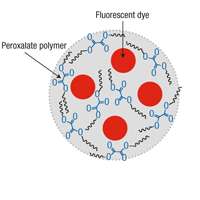
The nanoparticle polymer is made of peroxalate esters. A fluorescent dye (pentacene) is then encapsulated into the polymer. When the nano particles bump into hydrogen peroxide, they excite the dye, which then emits photons (or light) that can be detected. Credit: Georgia Tech

Most people think of hydrogen peroxide as a topical germ killer, but the medicine cabinet staple is gaining steam in the medical community as an early indicator of disease in the body.

Georgia Institute of Technology and Emory University researchers are the first to create a nanoparticle capable of detecting and imaging trace amounts of hydrogen peroxide in animals. The nanoparticles, thought to be completely nontoxic, could some day be used as a simple, all-purpose diagnostic tool to detect the earliest stages of any disease that involves chronic inflammation — everything from cancer and Alzheimer’s to heart disease and arthritis.

The research, lead by the laboratories of Niren Murthy at the Wallace H. Coulter Department of Biomedical Engineering at Georgia Tech and Emory University and Dr. Robert Taylor in the Division of Cardiology at the Emory University School of Medicine, will appear in the October issue of Nature Materials and was funded by the National Science Foundation and the National Institutes of Health.

Hydrogen peroxide is thought to be over-produced by cells at the early stages of most diseases. Because there were previously no imaging techniques available to capture this process in the body, the details of how the hydrogen peroxide is produced and its role in a developing disease must still be determined.

The Georgia Tech and Emory nanoparticles may be the key to better understanding the role of hydrogen peroxide in the progression of many diseases and later play an important diagnostic role, Murthy said.

“These nanoparticles are incredibly sensitive so you can detect nanomolar concentrations of hydrogen peroxide. That’s important because researchers aren’t yet certain what amounts of hydrogen peroxide are present in various diseases,” Murthy said.

The ultimate goal, however, is that the nanoparticles could some day be used as a simple, all-purpose diagnostic tool for most diseases. In the future, the nanoparticle would be injected by needle into a certain area of the body (for instance, the heart). If the nanoparticles encountered hydrogen peroxide, they would emit light. Should a doctor see a significant amount of light activity in the area, the doctor would know that the patient may be presenting early signs of a disease in that area of the body.

The Georgia Tech and Emory nanoparticles penetrate deep tissue and operate at a high wave length, making them sensitive indicators of the presence of hydrogen peroxide produced by any sort of inflammation.

The nanoparticle polymer is made of peroxalate esters. A fluorescent dye (pentacene) is then encapsulated into the polymer. When the nano particles bump into hydrogen peroxide, they excite the dye, which then emits photons (or light) that can be detected in a simple, photon-counting scan.

“It’s using this nanoparticle made of peroxalate esters that allows you to do this three component reaction in vivo. If you were to inject a peroxalate ester and a dye, they would go their own ways once in the body. With the nanoparticles we can sequester both of these reagents within nanometers of each other, in vivo,” Murthy said.

The goal was to maximize the wavelength of the particles. Wavelength determines the sensitivity in vivo. And if the particle’s wavelength is high enough, it can penetrate the skin and display clearly on a scan.

The research team started with a nanoparticle that was made of dye and filled with peroxide esthers. They later realized that the reverse (a particle made of peroxalate esters and filled with dye) was more effective at imaging hydrogen peroxide, Murthy said.

The group will conduct further tests with the nanoparticles to confirm their safety and effectiveness.

Source: Georgia Institute of Technology

4.9 /5 (19 votes)  

Rank 4.9 /5 (19 votes)
Tags

Relevant PhysicsForums posts
  • Factors affecting beet root cell membrane
    created13 hours ago
  • Stem cell question.
    createdFeb 10, 2012
  • Protease cleavage
    createdFeb 10, 2012
  • Pertubance in a model
    createdFeb 10, 2012
  • Cancer drugs and Alzheimer's, Oh my!
    createdFeb 09, 2012
  • Squishing cells
    createdFeb 09, 2012
  • More from Physics Forums - Biology

More news stories

Lab study raises questions over nano-particle impact

Tests involving chickens have raised questions about the impact on health from engineered nano-particles, the ultra-fine grains commonly used in drugs and processed foods, scientists said on Sunday.

Nanotechnology / Bio & Medicine

created 8 hours ago | popularity 5 / 5 (5) | comments 0

New kind of solar cell could capture significantly more energy than current cells

New solar cells could increase the maximum efficiency of solar panels by over 25%, according to scientists from the University of Cambridge.

Nanotechnology / Nanophysics

created Feb 08, 2012 | popularity 4.5 / 5 (13) | comments 14 | with audio podcast

Nanoshell whispering galleries improve thin solar panels

Visitors to Statuary Hall in the U.S. Capitol Building may have experienced a curious acoustic feature that allows a person to whisper softly at one side of the cavernous, half-domed room and for another on ...

Nanotechnology / Nanomaterials

created Feb 07, 2012 | popularity 4.4 / 5 (7) | comments 6 | with audio podcast

'Dark plasmons' transmit energy

Microscopic channels of gold nanoparticles have the ability to transmit electromagnetic energy that starts as light and propagates via "dark plasmons," according to researchers at Rice University.

Nanotechnology / Nanophysics

created Feb 09, 2012 | popularity 4.8 / 5 (10) | comments 1 | with audio podcast

Revealing how a battery material works

Since its discovery 15 years ago, lithium iron phosphate (LiFePO4) has become one of the most promising materials for rechargeable batteries because of its stability, durability, safety and ability to deliver ...

Nanotechnology / Nanomaterials

created Feb 08, 2012 | popularity 5 / 5 (6) | comments 0 | with audio podcast


Scientists discover molecular secrets of 2,000-year-old Chinese herbal remedy

For roughly two thousand years, Chinese herbalists have treated Malaria using a root extract, commonly known as Chang Shan, from a type of hydrangea that grows in Tibet and Nepal. More recent studies suggest that halofuginone, ...

New method to examine batteries -- MRI from the inside

There is an ever-increasing need for advanced batteries for portable electronics, such as phones, cameras, and music players, but also to power electric vehicles and to facilitate the distribution and storage of energy derived ...

Google might launch Drive for cloud storage soon

(PhysOrg.com) -- Google's next big move, according to the Wall Street Journal, is a cloud storage service called Drive. Hardly first to the plate, Google is simply catching up to introducing its cloud reposi ...

A mitosis mystery solved: How chromosomes align perfectly in a dividing cell

Although the process of mitotic cell division has been studied intensely for more than 50 years, Whitehead Institute researchers have only now solved the mystery of how cells correctly align their chromosomes during symmetric ...

Starve a virus, feed a cure? Findings show how some cells protect themselves against HIV

A protein that protects some of our immune cells from the most common and virulent form of HIV works by starving the virus of the molecular building blocks that it needs to replicate, according to research published online ...

Researchers find extensive RNA editing in human transcriptome

In a new study published online in Nature Biotechnology, researchers from BGI, the world's largest genomics organization, reported the evidence of extensive RNA editing in a human cell line by analysis of RNA-seq data, demons ...