Possible closest neutron star to Earth found
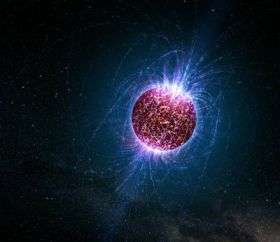
August 20th, 2007 Artist's Illustration of an 'Isolated Neutron Star'

Artist's illustration of an "isolated neutron star." Credit: Casey Reed, courtesy of Penn State University

Using NASA's Swift satellite, McGill University and Penn State University astronomers have identified an object that is likely one of the closest neutron stars to Earth -- and possibly the closest.

The object, located in the constellation Ursa Minor, is nicknamed Calvera, after the villain in the movie "The Magnificent Seven." If confirmed, it would be only the eighth known "isolated neutron star" -- meaning a neutron star that does not have an associated supernova remnant, binary companion, or radio pulsations. "The seven previously known isolated neutron stars are known collectively as 'The Magnificent Seven' within the community and so the name Calvera is a bit of an inside joke on our part," says co-discoverer Derek Fox of Penn State. A paper describing the research will be published in the Astrophysical Journal.

First author Robert Rutledge of McGill University in Montreal, Quebec, originally called attention to the source. He compared a catalog of 18,000 X-ray sources from the German-American ROSAT satellite, which operated from 1990 to 1999, with catalogs of objects that appear in visible light, infrared light, and radio waves. He realized that the ROSAT source known as 1RXS J141256.0+792204 did not appear to have a counterpart at any other wavelength.

The group aimed Swift at the object in August 2006. Swift's X-ray Telescope showed that the source was still there, and emitting about the same amount of X-ray energy as it had during the ROSAT era. The Swift observations enabled the group to pinpoint the object's position more accurately, and showed that it was not associated with any known object.

"The Swift observation of this source is what got the show going," says paper coauthor and Penn State undergraduate Andrew Shevchuk. "As soon as I saw the data, I knew Calvera was a great neutron-star candidate."

The team next targeted Calvera with the 8.1-meter Gemini North Telescope in Hawaii. These observations, along with a short observation by NASA's Chandra X-ray Observatory, showed that the object is not associated with any optical counterpart down to a very faint magnitude. Chandra's sharper X-ray vision sees the object as point-like, consistent with the neutron-star interpretation.

According to Rutledge, there are no widely accepted alternate theories for objects like Calvera that are bright in X-rays and faint in visible light. Exactly which type of neutron star it is, however, remains a mystery. As Rutledge says, "Either Calvera is an unusual example of a known type of neutron star, or it is some new type of neutron star, the first of its kind."

Calvera's location high above the plane of our Milky Way Galaxy is part of its mystery. In all likelihood, the neutron star is the remnant of a star that lived in our galaxy's starry disk before exploding as a supernova. In order to reach its current position, it had to wander some distance out of the disk. But exactly how far" "The best guess is that it is still close to its birthplace, and therefore close to Earth," says Rutledge. If this interpretation is correct, the object is 250 to 1,000 light-years away. This would make Calvera one of the closest known neutron stars -- possibly the closest.

"Because it is so bright, and probably close to Earth, it is a promising target for many types of observations," says Fox. Indeed, to clear up the mysteries surrounding Calvera the team will be taking a longer observation with Chandra to see if the source pulsates in X-rays, and to measure its spectrum. They also joined a group using a radio telescope to search for radio pulsations, which were not seen.

Calvera could represent the tip of the iceberg for isolated neutron stars. "There could easily be dozens," says Fox. "The key point is that until our Swift survey, no one was able to refine the X-ray positions of large numbers of ROSAT sources to the point where it became clear which ROSAT sources were 'missing' their optical counterparts."

Source: Penn State


print this article email this article download pdf blog this article bookmark this article     Digg this Stumble it share on Facebook share on Reddit add to delicious save to Yahoo! bookmarks
4.4/5 after 29 votes


August 20th, 2007 all stories
Space & Earth / Astronomy

Comments: 0
Rank: 4.4/5 after 29 votes

  • Stumble this up

  • Digg this

  • Share it:
  • share on Facebook
  • share on MySpace
  • share on Slashdot
  • rss-newsfeed
  • share on Google
  • share on Reddit
  • add to delicious
  • save to Yahoo! bookmarks
  • share on Windows Live
  • Add to Mixx!
Rating: 4.4/5 after 29 votes

  • Related Stories

  • Fermi Telescope reveals a population of radio-quiet gamma-ray pulsars
    created Jul 02, 2009 | popularity not rated yet | comments 0
  • New technique improves estimates of pulsar ages
    created Jun 09, 2009 | popularity not rated yet | comments 0
  • Keck Study Sheds New Light on "Dark" Gamma-ray Bursts
    created Jun 08, 2009 | popularity not rated yet | comments 0
  • Network creates virtual super-telescope
    created Jun 08, 2009 | popularity not rated yet | comments 0
  • A new class of dim supernovae
    created Jun 05, 2009 | popularity not rated yet | comments 0

Tags


  • Physicists Demonstrate Quantum Memory with Matter Qubits
    Physicists Demonstrate Quantum Memory with Matter Qubits
    Physics / General Physics
    created Jul 03, 2009 | popularity 4.4 / 5 (17) | comments 1
  • 'Holey' Nanosheets for Wastewater Dye Removal
    Nanotechnology / Nanomaterials
    created Jul 01, 2009 | popularity 5 / 5 (5) | comments 1
  • Jellyfish Robot Swims Like its Biological Counterpart
    Jellyfish Robot Swims Like its Biological Counterpart
    Electronics / Robotics
    created Jun 26, 2009 | popularity 4.4 / 5 (8) | comments 1
  • Could Maxwell's Demon Exist in Nanoscale Systems?
    Could Maxwell's Demon Exist in Nanoscale Systems?
    Physics / General Physics
    created Jun 24, 2009 | popularity 4.4 / 5 (18) | comments 29
  • Living Safely with Robots, Beyond Asimov's Laws
    Living Safely with Robots, Beyond Asimov's Laws
    Electronics / Robotics
    created Jun 22, 2009 | popularity 4.6 / 5 (54) | comments 40
  • Other News

    Researchers test new 'space Internet' system on International Space Station

    Researchers test new 'space Internet' system on International Space Station

    Space & Earth / Space Exploration

    created 59 minutes ago | popularity not rated yet | comments 0

    The University of Colorado at Boulder is working with NASA to develop a new communications technology now being tested on the International Space Station, which will extend Earth's Internet into outer space ...


    Space Station Marathon

    Space Station Marathon

    Space & Earth / Space Exploration

    created 29 minutes ago | popularity not rated yet | comments 0

    The International Space Station (ISS) is about to make a remarkable series of flybys over the United States. Beginning this 4th of July weekend, the station will appear once, twice, and sometimes three times ...


    Proba-2's journey to Russia marks its first step towards space

    Proba-2's journey to Russia marks its first step towards space

    Space & Earth / Space Exploration

    created 39 minutes ago | popularity not rated yet | comments 0

    (PhysOrg.com) -- Proba-2, one of the smallest satellites ESA has ever built for space, is about to leave its Belgian homeland. Its development and testing complete, the satellite is being packed up for the ...


    China environmental phenomena monitored from space

    Space & Earth / Earth Sciences

    created 4 hours ago | popularity not rated yet | comments 0

    China is in a very seismically active area and has had many catastrophic earthquakes during its history. A joint European-Chinese team is using satellite radar data to monitor ground deformation across major continental faults ...


    California to require sun-blocking car windows

    Space & Earth / Environment

    created 6 hours ago | popularity 2 / 5 (4) | comments 8

    New cars sold in California must include windshields that block or absorb the sun's rays beginning in 2012, the state's Air Resources Board recently ruled.