Researchers identify brain network that may help prevent or slow Alzheimer's
August 20, 2007
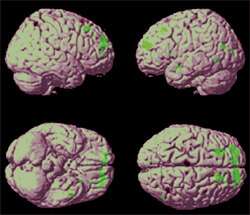
These highlighted spots of activity represent a brain network. Credit: Columbia University
Columbia University Medical Center researchers have identified a brain network within the frontal lobe that is associated with cognitive reserve, the process that allows individuals to maintain function despite brain function decline due to aging or Alzheimer’s disease. This finding may provide a hint about how higher levels of cognitive reserve – which is believed to build by regularly engaging in mentally-stimulating activities such as taking classes, gardening and volunteering, provides protection against Alzheimer’s disease or dementia by “exercising” the brain.
The study was led by principal investigator Yaakov Stern, Ph.D., a professor at the Taub Institute for the Research on Alzheimer’s Disease and the Aging Brain and director of the Cognitive Neuroscience Division of the Gertrude H. Sergievsky Center at Columbia University Medical Center. It is published in the current issue of Cerebral Cortex.
To obtain the data evaluated in the study, participants, categorized as young (between 18-30 years of age) and elderly (between 65-80 years of age), were given one of two different memory tasks – one involving a series of letters and a second involving a series of nonsensical shapes, to complete while undergoing functional magnetic resonance imaging (fMRI). The tasks were designed with increasing difficulty to allow the research team to observe the participants’ brain activation as tasks got progressively harder. This activation is known to correlate with IQ level and educational background, which Dr. Stern and his team have determined to be measures of cognitive reserve, with higher levels corresponding with higher levels of cognitive reserve.
Findings demonstrated that participants with higher levels of cognitive reserve were able to activate this network in the brain while working on more difficult tasks, while participants with lower levels of reserve were not able to tap into this particular network.
“With the identification of this brain network – located within the frontal lobe – that is active during the performance both of these verbal and spatial tasks and probably other types of tasks as well, we believe we have accomplished an important first step towards improving our understanding of how cognitive reserve is expressed within the brain,” said Dr. Stern, who is a professor of clinical neuropsychology in the Departments of Neurology, Psychiatry, and Psychology at the Columbia University College of Physicians and Surgeons.
Dr. Stern’s hope is that with this new understanding, he and other experts can continue working towards developing interventions to increase cognitive reserve and prevent or delay the onset of Alzheimer’s disease or other age-related memory conditions.
“Interestingly, the network was found more often in younger participants, signifying that the network may degrade during the natural aging process,” said Dr. Stern. “If this degradation process can be slowed or halted, it may benefit the millions of people living with devastating memory decline.”
Source: Columbia University
-
Mice stem cells guided into myelinating cells by the trillions
Sep 25, 2011 |
5 / 5 (5) |
1
-
Retired NFL players at higher risk for mild cognitive impairment
Jul 18, 2011 |
not rated yet |
0
-
PET-CT exams help identify cognitive reserve in early-onset Alzheimer's disease
May 02, 2011 |
not rated yet |
0
-
Anti-depressants boost brain cells after injury in early studies
Apr 18, 2011 |
5 / 5 (4) |
0
-
Speaking 2 languages may delay getting Alzheimer's
Feb 18, 2011 |
4.8 / 5 (8) |
0
-
Engineers build first sub-10-nm carbon nanotube transistor
Feb 01, 2012 |
4.9 / 5 (31) |
30
-
Something old, something new: Evolution and the structural divergence of duplicate genes
Jan 31, 2012 |
4.6 / 5 (7) |
1
-
The hidden nanoworld of ice crystals: Revealing the dynamic behavior of quasi-liquid layers
Jan 30, 2012 |
5 / 5 (3) |
1
-
Stock market network reveals investor clustering
Jan 27, 2012 |
3.9 / 5 (23) |
8
-
Of microchemistry and molecules: Electronic microfluidic device synthesizes biocompatible probes
Jan 26, 2012 |
5 / 5 (1) |
0
-
Classical and Quantum Mechanics via Lie algebras
Apr 15, 2011
- More from Physics Forums - Independent Research
More news stories
Injured boomers beware: Know when to see doctor
(AP) -- It happened to nurse Jane Byron years after an in-line skating fall, business owner Haralee Weintraub while doing "men's" push-ups, and avid cyclist Gene Wilberg while lifting a heavy box.
1 hour ago |
not rated yet |
0
FDA-approved drug rapidly clears amyloid from the brain, reverses Alzheimer's symptoms in mice
Neuroscientists at Case Western Reserve University School of Medicine have made a dramatic breakthrough in their efforts to find a cure for Alzheimer's disease. The researchers' findings, published in the journal Science, show t ...
Medicine & Health / Neuroscience
Feb 09, 2012 |
4.9 / 5 (53) |
21
|
Green tea found to reduce disability in the elderly
(Medical Xpress) -- A lot of research has been done over the past several years looking into the health benefits of green tea. As a result, scientists have found that regular consumption of the beverage leads ...
Teen school drop-outs three times as likely to be on benefits in later life
Teen school drop-outs are almost three times as likely to be on benefits in later life as their peers who complete their schooling, indicates research published online in the Journal of Epidemiology and Community Health.
Feb 06, 2012 |
not rated yet |
13
To perform with less effort, practice beyond perfection
Whether you are an athlete, a musician or a stroke patient learning to walk again, practice can make perfect, but more practice may make you more efficient, according to a surprising new University of Colorado Boulder study.
Medicine & Health / Neuroscience
Feb 09, 2012 |
4.4 / 5 (15) |
6
|
Google might launch Drive for cloud storage soon
(PhysOrg.com) -- Google's next big move, according to the Wall Street Journal, is a cloud storage service called Drive. Hardly first to the plate, Google is simply catching up to introducing its cloud reposi ...
Latin America mining boom clashes with conservation
Latin America is experiencing a mining boom as prices rise fuelled by a hike in global demand, but the region is also being hit by a wave of violent protests, strikes and rallies by environmentalists.
Love a click away in Indonesia's Twitter Republic
He was a geeky kid from Yogyakarta, she a glamorous city girl in Jakarta. In a country with one of the world's most vibrant social networking scenes they fell in love on Twitter.
Europeans protest controversial Internet pact
Tens of thousands of people marched in protests in more than a dozen European cities Saturday against a controversial anti-online piracy pact that critics say could curtail Internet freedom.
Walney offshore wind farm is world's biggest (for now)
(PhysOrg.com) -- The Walney wind farm on the Irish Sea--characterized by high tides, waves and windy weather--officially opened this week. The farm is treated in the press as a very big deal as the Walney ...
Navy to begin tests on electromagnetic railgun prototype launcher
The Office of Naval Research (ONR)'s Electromagnetic (EM) Railgun program will take an important step forward in the coming weeks when the first industry railgun prototype launcher is tested at a facility ...