The building blocks of memory
Learning new things, remembering past experiences and adapting to a changing environment - these abilities carried out by the brain are essential for day-to-day survival. This unique flexibility is in part accomplished through the continuous remodeling of the brain’s nerve cells.
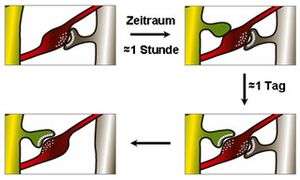
Scientists at the Max Planck Institute of Neurobiology were able to demonstrate that neuronal activity causes the formation of new cell connections, and to determine how quickly these new synapses become functional: while nerve cells create new contacts with neighboring cells within a few minutes after stimulation, it takes several hours before these connections are mature enough to transmit information.
"I really have to strain my brain to understand this!" - Who hasn’t experienced this, or something like it, when it comes to trying to understand something complicated? Scientists have only recently been able to show that this is not very far-fetched. For whenever we learn something new, regardless of how complicated it is, our "little grey cells", or neurons, grow new contacts to their neighboring cells. If the new information is retained, then such contacts become stable.
However, what is the time frame for the development of these connections? Is the exchange of information possible immediately after two nerve cells make contact? And what happens in the brain when new information dispels old information, for example, when learning a new language, which can result in the fading of knowledge of a previously learned language? Scientists at the Max Planck Institute of Neurobiology are now able to provide some answers to these questions.
The Martinsried-based neurobiologists, in cooperation with colleagues in Zurich, have been investigating the relation between the development of new cell contacts, called "spines", and the creation of functional synapses. Synapses enable the transfer of information between cells. The scientists have been focusing their experiments on nerve cells from the hippocampus, the brain region that is essential for learning and memory processes.
In order to intentionally cause the nerve cells to react, the scientists stimulated a group of neurons via a short electrical impulse of high frequency. It is a known fact that this type of electrical stimulation causes the formation of new spines - similar to what happens during learning processes. The key question, however, whether and when these new spines actually form functional synapses and thus play a role in memory functions has, thus far, remained unanswered.
Using time-lapse two-photon microscopy, the scientists were able to follow the outgrowth of spines in the immediate area of the stimulated area. Further analysis with an electron microscope enabled the detection of functional synapses in the newly developed spines. The observed changes in neuronal connections and their dynamics surprised the scientists: new spines began to sprout from the stimulated nerve cells within minutes of the stimulation. The growth of these thin spines was initially not random, but directed toward a potential contact site.
However, despite the quick connection of these spines to new contact sites, their further differentiation seemed to follow the motto "haste makes waste": the transfer of information through the newly established contact was not possible within the first eight hours. It took another few hours before it could be established whether the connections would degenerate or thrive, thereby forming synapses. All of the contacts that still persisted after 24 hours had fully-functional synapses and a good chance for continued existence.
The unraveling of the time-scale and functional relationships were not the only exciting observations that the scientists were treated to. When a new spine made contact with a site already hosting a contact, the new spine was highly likely to displace the old connection. "We are not yet completely sure what this means," said Valentin Nägerl from the Max Planck Institute of Neurobiology. "But it could indicate, for example, that newly learned information might lead to a fading of older information."
That it is easier to retrieve information which has been learned previously could also be related to spine modifications: the displaced connections might not disintegrate completely, but can perhaps be reactivated again at a later time. If this is true, and whether repeated learning impulses have an effect on the development and longevity of synapses, are some of the questions now being pursued by the scientists. All of these findings are contributing to a better understanding of the mechanisms involved in learning and memory. And it is also relatively safe to assume that a few of your nerve cells have just made some new connections.
Citation: Nägerl UV, Köstinger G, Anderson, JC, Martin AC and Bonhoeffer T, Protracted synaptogenesis after activity-dependent spinogenesis in Hippocampal neurons, The Journal of Neuroscience, July 2007
Source: Max Planck Institute of Neurobiology


