Australian orchids' sneaky sex tricks
August 20, 2007 Australian orchids' sneaky sex tricks

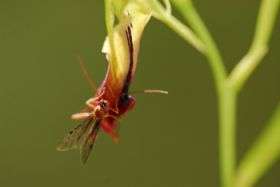
Photo by Esther Beaton.

Australian orchids are engaged in an arms race, using sensory overload to seduce male insects. Macquarie University PhD student Anne Gaskett has discovered just how they do it. Her work is important to the conservation of orchids and the control of economically important agricultural pests.

Gaskett has been analysing the smells, colours and shapes of flowers from an insect's perspective. She has found that orchids mimic female insects so well that male insects cannot resist mating with them, accidentally collecting the pollen.

"I have accumulated the first compelling evidence of an ongoing and escalating arms race between orchids and their unwitting insect pollinators," Gaskett, says, "Over generations the insects learn to avoid having sex with orchids, and this means only the most persuasive orchids reproduce, which drives the acceleration of orchid subterfuge."

The Australian bush is rife with such sexual deception, Gaskett says, as native orchids lure pollinators with false promises of romance.

Gaskett has been studying the hardworking Orchid Dupe wasp (Lissopimpla excelsa), which is fooled into copulating with not just one, but five native Tongue Orchid species (Cryptostylis) in urban and regional Australia. All the Tongue Orchid species mimic the female Orchid Dupe wasp. But, to the human eye, they look quite different.

By using modern technology to study the physics of the colours of the orchids and the female insects, Gaskett has revealed that they are identical when viewed by male insects. The flowers are also shaped to mimic female insect bodies.

Gaskett is now looking at the impact of the chemical components of orchid perfumes directly on wasp antennae, to understand what makes these fragrances irresistible.

Studying these intimate interactions addresses big questions about nature and evolution and highlights the millions of other unknown interactions crucial for a sustainable and healthy environment.

"These insects might be fools for love, but their role as orchid pollinators makes them indispensable."

Anne Gaskett is one of 16 early-career scientists presenting their research to the public for the first time thanks to Fresh Science, a national program sponsored by the Federal and Victorian Governments.

Source: Macquarie University


print this article email this article download pdf blog this article bookmark this article     Stumble it Digg this share on Facebook retweet share on Reddit add to delicious
Rate this story - 4 /5 (8 votes)


August 20, 2007 all stories

Comments: 0

4 /5 (8 votes)
  • Stumble this up

  • Digg this

  • share this

  • hide
  • Related Stories

  • Orchid sexual deceit has male wasps in a loved-up frenzy
    created Apr 29, 2008 | popularity not rated yet | comments 0
  • New orchid deception found: wearing the scent of hornet's prey
    created Aug 06, 2009 | popularity not rated yet | comments 0
  • Saving the wild orchids of Borneo
    created Jul 17, 2008 | popularity not rated yet | comments 0
  • DNA 'barcode' identified for plants
    created Feb 05, 2008 | popularity not rated yet | comments 0
  • New animal and plant species found in Vietnam
    created Sep 26, 2007 | popularity not rated yet | comments 0


Other News

15,000 reasons to worry about invasive species

Biology / Ecology

created 2 hours ago | popularity not rated yet | comments 1

A day at the beach in Wisconsin's North Woods didn't used to go like this. Candy Dailey spent a Fourth of July holiday splashing with grandkids on the sandy shore of Lake Metonga when she felt a nasty sting on her foot.


Scientists visualize how bacteria talk to one another

Scientists visualize how bacteria talk to one another

Biology / Cell & Microbiology

created 20 hours ago | popularity 4.9 / 5 (9) | comments 1

Using imaging mass spectrometry, researchers at the University of California, San Diego have developed tools that will enable scientists to visualize how different cell populations of cells communicate. Their ...


Laser etching safe alternative for labeling grapefruit

Laser etching safe alternative for labeling grapefruit

Biology / Other

created Nov 03, 2009 | popularity 4.4 / 5 (14) | comments 8

Laser labeling of fruit and vegetables is a new, patented technology in which a low-energy carbon dioxide laser beam is used to label, or "etch" information on produce, thereby eliminating the need for common ...


Caught in the act: Butterfly mate preference shows how 1 species can become 2

Caught in the act: Scientists find butterflies splitting into two species

Biology / Plants & Animals

created Nov 05, 2009 | popularity 4.5 / 5 (8) | comments 5

(PhysOrg.com) -- Breaking up may actually not be hard to do, say scientists who've found a population of tropical butterflies that may be on its way to a split into two distinct species.


Wolves, moose and biodiversity: An unexpected connection

Wolves, moose and biodiversity: An unexpected connection

Biology / Ecology

created Nov 02, 2009 | popularity 4.9 / 5 (7) | comments 4

Moose eat plants; wolves kill moose. What difference does this classic predator-prey interaction make to biodiversity?