Hurricane Dean tracked from space
August 21st, 2007 Hurricane Dean tracked from space

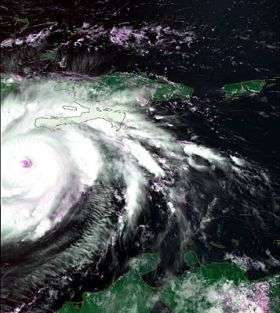
This Envisat MERIS image of Hurricane Dean was acquired on 19 August 2007 (14:52 UTC) and shows the storm passing off the South coast of Haiti. At the time of image acquisition, Dean was a Category-4 hurricane on the Saffir-Simpson Hurricane Scale, with winds at 230 km per hr. The MERIS image is in Reduced Resolution mode with a spatial resolution of 1200 metres. Credits: ESA

ESA satellites are tracking the path of Hurricane Dean as it rips across the Caribbean Sea carrying winds as high as 260 km per hour. The hurricane, which has already claimed eight lives, is forecast to slam into Mexico’s Yucatan Peninsula on Tuesday morning.

Dean was upgraded early Tuesday to a Category 5 – the highest on the Saffir-Simpson scale – before pummelling the peninsula. Knowing the strength and path of hurricanes is critical for issuing timely warnings; satellites are the best means of providing data on the forces that power the storm, such as cloud structure, wind and wave fields, sea surface temperature and sea surface height. Instruments aboard ESA’s Envisat and ERS-2 satellites allow them to peer through hurricanes. Envisat carries both optical and radar instruments, enabling researchers to observe high-atmosphere cloud structure and pressure in the visible and infrared spectrum.

Dean off coast of Haiti The Medium Resolution Imaging Spectrometer (MERIS) optical instrument shows the swirling cloud-tops of a hurricane, while radar instruments such as the Advanced Synthetic Aperture Radar (ASAR) pierce through the clouds to show how the wind fields shape the sea surface and estimate their likely destructive extent.

ERS-2 uses its radar scatterometer to observe the hurricane's underlying wind fields. The scatterometer instrument works by firing a trio of high-frequency radar beams down to the ocean, then analysing the pattern of backscatter reflected up again. Wind-driven ripples on the ocean surface modify the radar backscatter, and as the energy in these ripples increases with wind velocity, backscatter increases as well. Scatterometer results enable measurements of not only wind speed but also direction across the water surface.

What makes ERS-2's scatterometer especially valuable is that its C-band radar frequency is almost unaffected by heavy rain, so it can return useful wind data even from the heart of the fiercest storms.

Winds around eye of Hurricane Dean Dr. Ad Stoffelen of the Royal Netherlands Meteorological Institute (KNMI), which processes ESA’s scatterometer images, said: "Observed winds from hurricane Dean by ESA's ERS-2 scatterometer are provided to meteorologists within the hour. This C-band radar wavelength scatterometer peeks right into the ‘eye’ of a hurricane like Dean, providing timely and precise information on its position and force.

"The wind field derived from the ESA ERS-2 scatterometer measurements are distributed via a EUMETSAT (European Organisation for the Exploitation of Meteorological Satellites) project to a registered database of a few hundred users, originating from all over the world, such as the Americas, Australia, Asia and Europe. Scatterometer winds are used directly by shift meteorologists in forecast rooms and to initialise Numerical Weather Prediction models aiding the forecasting of hurricanes 5 days ahead."

Dean leaving Martinique Another Envisat instrument called the Radar Altimeter-2 (RA-2) uses radar pulses to measure sea surface height (SSH) down to an accuracy of a few centimetres. Near-real time radar altimetry is a powerful tool for monitoring a hurricane's progress and predicting its potential impact because anomalies in SSH can be used to identify warmer ocean features such as warm core rings, eddies and currents.

Water temperatures are the main underlying energy reservoir that power hurricanes; together with the correct atmospheric conditions, temperatures need to exceed 26şC in order to form and maintain a tropical cyclone. Because warm water expands, scientists can locate warm underwater ocean features by detecting bulges in the ocean surface height, as detected by RA-2.

Dean's path and category level The thermal energy of warm water, which partly powers a hurricane, is known as tropical cyclone heat potential (TCHP). Warm waters may extend to at least 100 meters beneath the surface in many of these oceanic features, representing waters of very high heat content. Several hurricanes have intensified when their tracks pass over eddies or other masses of warm water with high TCHP values.

Source: European Space Agency


print this article email this article download pdf blog this article bookmark this article     Digg this Stumble it share on Facebook share on Reddit add to delicious save to Yahoo! bookmarks
2.7/5 after 3 votes


August 21st, 2007 all stories
Space & Earth / Earth Sciences

Comments: 0
Rank: 2.7/5 after 3 votes

  • Stumble this up

  • Digg this

  • Share it:
  • share on Facebook
  • share on MySpace
  • share on Slashdot
  • rss-newsfeed
  • share on Google
  • share on Reddit
  • add to delicious
  • save to Yahoo! bookmarks
  • share on Windows Live
  • Add to Mixx!
Rating: 2.7/5 after 3 votes

  • Related Stories

  • QuikScat Finds Tempests Brewing In 'Ordinary' Storms
    created Jun 26, 2009 | popularity not rated yet | comments 0
  • Envisat and ERS-2 reveal hidden side of Hurricane Rita (update)
    created Sep 26, 2005 | popularity not rated yet | comments 0
  • Beating the radar: Getting a jump on storm prediction
    created Jun 16, 2009 | popularity not rated yet | comments 0
  • UN sketches countries with climate risk profile
    created Jun 11, 2009 | popularity not rated yet | comments 0
  • QuikScat Sees Santa Barbara 'Quick Dry'
    created May 12, 2009 | popularity not rated yet | comments 0

Tags


  • Physicists Demonstrate Quantum Memory with Matter Qubits
    Physicists Demonstrate Quantum Memory with Matter Qubits
    Physics / General Physics
    created Jul 03, 2009 | popularity 4.4 / 5 (17) | comments 1
  • 'Holey' Nanosheets for Wastewater Dye Removal
    Nanotechnology / Nanomaterials
    created Jul 01, 2009 | popularity 5 / 5 (5) | comments 1
  • Jellyfish Robot Swims Like its Biological Counterpart
    Jellyfish Robot Swims Like its Biological Counterpart
    Electronics / Robotics
    created Jun 26, 2009 | popularity 4.4 / 5 (8) | comments 1
  • Could Maxwell's Demon Exist in Nanoscale Systems?
    Could Maxwell's Demon Exist in Nanoscale Systems?
    Physics / General Physics
    created Jun 24, 2009 | popularity 4.4 / 5 (18) | comments 29
  • Living Safely with Robots, Beyond Asimov's Laws
    Living Safely with Robots, Beyond Asimov's Laws
    Electronics / Robotics
    created Jun 22, 2009 | popularity 4.6 / 5 (52) | comments 40
  • Other News

    Scientists: Silent tremors may foretell next Big One

    Space & Earth / Earth Sciences

    created 28 minutes ago | popularity not rated yet | comments 0

    The seismometer is snugged in its hole and tamped over with dirt. Now it's time for the stomp test.


    California to require sun-blocking car windows

    Space & Earth / Environment

    created 27 minutes ago | popularity not rated yet | comments 0

    New cars sold in California must include windshields that block or absorb the sun's rays beginning in 2012, the state's Air Resources Board recently ruled.


    Steam billows from the cooling towers at a nuclear power generating station in Byron

    Tropical zone expanding due to climate change: study

    Space & Earth / Earth Sciences

    created 2 hours ago | popularity 5 / 5 (2) | comments 0

    Climate change is rapidly expanding the size of the world's tropical zone, threatening to bring disease and drought to heavily populated areas, an Australian study has found.


    US ambitions to send astronauts back to the moon as a prelude to missions to Mars have been put in doubt

    Forty years ago man first walked on the moon

    Space & Earth / Space Exploration

    created 23 hours ago | popularity 4.4 / 5 (5) | comments 2

    Forty years ago on July 20, 1969, American astronaut Neil Armstrong realized the oldest dream of human civilizations when he became the first man to walk on the moon.


    The least sea ice in 800 years

    The least sea ice in 800 years

    Space & Earth / Earth Sciences

    created Jul 01, 2009 | popularity 4.1 / 5 (65) | comments 60

    New research, which reconstructs the extent of ice in the sea between Greenland and Svalbard from the 13th century to the present indicates that there has never been so little sea ice as there is now. The ...